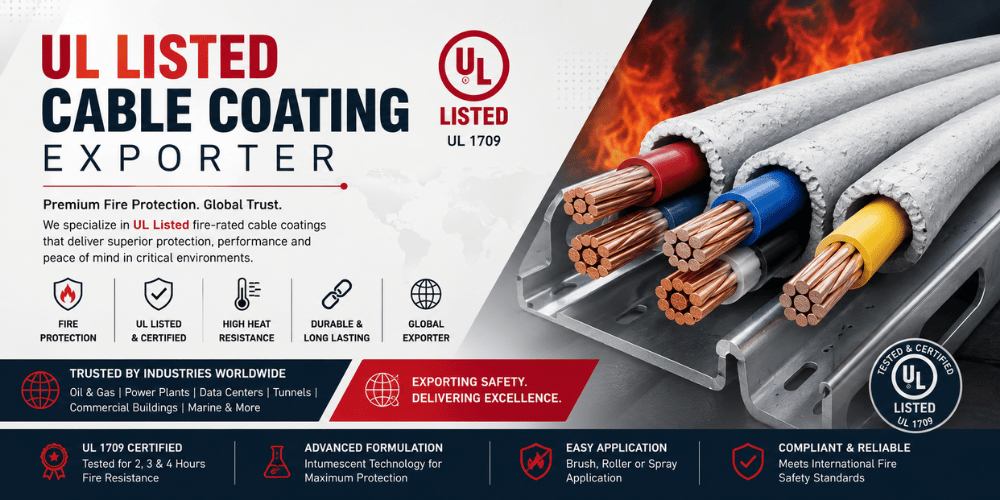
For industrial projects that require reliable electrical fire protection, choosing the right UL Listed cable coating exporter can be an important procurement decision. Gopalfiresafety provides fire safety products and solutions for industrial and commercial applications, and customers can explore its offerings through Gopalfiresafety. The company also shares fire safety information, product updates, and industry content through Instagram. When sourcing cable protection products internationally, buyers should evaluate the actual certification, testing scope, technical documentation, application requirements, and export capabilities of the supplier rather than relying only on marketing terminology.
What Is a UL Listed Cable Coating Exporter?
A UL Listed cable coating exporter is a supplier or manufacturer involved in supplying cable coating products to international markets where the product or system carries a relevant UL Listing or other applicable UL certification.
However, it is important to understand that “UL Listed” is not a generic description that should be applied to every fire protection coating.
UL certification applies to a specific product, system, construction, or intended use according to the applicable certification requirements. Therefore, buyers should verify the exact certification details before purchasing.
A professional exporter should be able to provide information such as:
- Product identification
- Manufacturer details
- Certification information
- Applicable standards
- Test reports
- Technical data sheet
- Safety data sheet
- Application instructions
- Recommended thickness
- Coverage information
- Environmental limitations
- Packaging information
- Export documentation
This documentation helps international buyers evaluate whether a cable coating is suitable for their specific project.
Why UL Certification Matters
UL is widely recognized in many international markets for safety testing and certification.
For electrical and fire protection products, certification can help demonstrate that a product has been evaluated against defined requirements.
However, certification should always be considered in context.
A buyer should ask:
- What product is certified?
- What standard applies?
- What performance characteristic was evaluated?
- What installation configuration was tested?
- What cable type was used?
- What coating thickness was used?
- Is the certification current?
- Does the certification apply to the exact product being offered?
These questions are especially important when purchasing from an international supplier.
UL Listed vs UL Classified
One common source of confusion is the difference between UL Listed and UL Classified.
UL Listing generally indicates that a product has been evaluated to applicable requirements for its intended use.
UL Classification generally relates to evaluation for specific properties, hazards, or special conditions.
Therefore, an exporter should not interchange the terms without supporting certification documentation.
Buyers should verify the exact certification status of the product they intend to purchase.
What Is Cable Coating?
Cable coating is a protective material applied to electrical cables or cable-related systems.
Depending on its formulation and testing, a coating may be designed to:
- Reduce flame propagation
- Protect cable insulation
- Reduce heat transfer
- Form an insulating barrier
- Provide passive fire protection
- Support defined fire-performance requirements
Different coating technologies are available for different applications.
The most appropriate product depends on the cable construction, environment, fire exposure, and required performance.
Intumescent Cable Coating
Intumescent technology is commonly used in passive fire protection.
When exposed to elevated temperatures, an intumescent coating can expand and form a protective char layer.
This expanded layer can help slow the transfer of heat to the protected substrate.
The performance depends on:
- Coating formulation
- Applied thickness
- Cable material
- Fire exposure
- Installation configuration
- Application quality
- Curing conditions
The coating should therefore be used according to its technical documentation.
Fire Protection for Electrical Cables
Electrical cables can contain polymeric materials that may contribute to fire propagation.
Large cable installations can include:
- Power cables
- Control cables
- Instrumentation cables
- Communication cables
- Data cables
- Fire alarm cables
- Emergency circuits
In industrial environments, cable routes can connect different areas of a facility.
Fire protection planning may therefore consider cable routes as part of the overall passive fire protection strategy.
Why Exporters Need Technical Expertise
International buyers often have specific project requirements.
These can involve:
- UL requirements
- IEC standards
- Local building regulations
- Fire engineering specifications
- Oil and gas requirements
- Power plant requirements
- Data center specifications
- Transportation standards
A knowledgeable exporter should understand the importance of matching the product to the customer’s actual application.
Simply providing a generic fire-retardant coating may not be sufficient.
Industrial Applications
A UL Listed cable coating exporter may supply products for a wide range of industrial applications, subject to the actual product certification and suitability.
Power Plants
Power generation facilities contain extensive cable networks supporting:
- Generators
- Turbines
- Transformers
- Switchgear
- Control systems
- Instrumentation
- Emergency systems
Cable protection can form part of a broader fire safety strategy.
Oil and Gas Facilities
Oil refineries, petrochemical plants, LNG facilities, and gas processing plants can have demanding fire protection requirements.
Cable systems may be located near:
- Process equipment
- Pumps
- Compressors
- Instrumentation
- Control systems
- Emergency shutdown systems
Coating selection should account for environmental and chemical exposure.
Data Centers
Data centers rely heavily on electrical and communication infrastructure.
Cable systems may support:
- Servers
- UPS systems
- Power distribution
- Cooling systems
- Security
- Monitoring
Fire protection should consider both equipment and cable infrastructure.
Manufacturing Facilities
Manufacturing plants use cables for:
- Automation
- Robotics
- Motors
- Sensors
- PLC systems
- Instrumentation
- Communication
Cable protection requirements vary according to the facility.
Commercial Buildings
Commercial properties may contain extensive cable networks supporting:
- Lighting
- Fire alarms
- Security
- Data systems
- Emergency systems
- Building management
Cable protection can be considered as part of passive fire safety planning.
Cable Tray Applications
Cable trays allow multiple cables to be routed and supported efficiently.
Depending on the product’s tested application, cable coatings may be used to protect cables installed in trays.
Important factors include:
- Cable quantity
- Cable diameter
- Tray material
- Cable arrangement
- Tray orientation
- Coating thickness
- Fire exposure
A coating tested on a particular cable arrangement should not automatically be assumed to provide identical protection in another arrangement.
Vertical Cable Systems
Vertical cable routes can present specific fire propagation concerns.
Flames and hot gases can move upward through cable installations.
Where vertical-tray fire performance is required, buyers should identify the applicable test requirements.
UL 1685 is associated with vertical-tray fire-propagation and smoke-release testing for electrical and optical-fiber cables.
The test scope should always be reviewed before making certification claims.
Horizontal Cable Systems
Horizontal cable installations have different fire exposure characteristics.
A coating intended for a particular horizontal configuration should have documented suitability for that configuration.
The installation orientation should therefore be considered during product selection.
Cable Compatibility
One of the most important considerations when selecting a cable coating is compatibility.
Cable jackets can be made from different materials, including:
- PVC
- XLPE
- PE
- LSZH compounds
- Rubber
- Other polymeric materials
The coating should be confirmed as compatible with the actual cable construction.
Compatibility can influence:
- Adhesion
- Flexibility
- Long-term durability
- Surface condition
- Fire performance
Environmental Conditions
International projects can involve very different operating environments.
A cable coating may be exposed to:
- High temperatures
- Humidity
- Rain
- UV radiation
- Salt
- Dust
- Chemicals
- Oils
- Mechanical vibration
A supplier should provide clear environmental limitations.
Indoor Applications
Indoor cable installations may have relatively controlled conditions.
However, the facility may still experience:
- Heat
- Humidity
- Dust
- Chemical vapors
- Mechanical activity
The coating should be selected accordingly.
Outdoor Applications
Outdoor installations can experience significantly more demanding conditions.
UV radiation, rain, temperature cycling, and moisture can affect coating performance.
If outdoor use is required, buyers should verify that the product has documented suitability for the environment.
Chemical Exposure
Industrial facilities may expose cable coatings to:
- Hydrocarbons
- Oils
- Solvents
- Acids
- Alkalis
- Cleaning chemicals
Chemical resistance should be verified when required.
Coating Thickness
Correct application thickness is essential.
A coating manufacturer may specify:
- Wet film thickness
- Dry film thickness
- Number of coats
- Recoat interval
- Coverage rate
The required thickness should be based on the manufacturer’s tested system.
Applying less material than specified may compromise the intended performance.
Applying excessive material can create:
- Cracking
- Poor curing
- Adhesion problems
- Extended drying times
Surface Preparation
Surface preparation is another important part of application.
Before applying the coating, installers may need to remove:
- Dust
- Dirt
- Oil
- Grease
- Moisture
- Loose material
The exact preparation method depends on the cable jacket and coating.
Application Methods
Depending on the product, application can be performed using:
- Brush
- Roller
- Spray
- Airless spray
For large industrial projects, spray application can improve productivity.
For smaller or difficult-to-access areas, brush or roller application may be practical.
The manufacturer’s approved application method should always be followed.
Curing Requirements
A coating may require controlled curing conditions.
Important parameters can include:
- Temperature
- Humidity
- Ventilation
- Drying time
- Recoat interval
Incorrect curing can affect the final properties of the coating.
Testing and Certification
When evaluating a UL Listed cable coating exporter, buyers should request supporting certification documentation.
The documentation should clearly identify:
- Product name
- Manufacturer
- Certification status
- Applicable standard
- Testing scope
- Product limitations
- Installation requirements
Certification should be verified for the exact product rather than inferred from another product manufactured by the same company.
IEC and UL Requirements
International projects may reference both IEC and UL requirements.
IEC standards cover many aspects of electrical cable fire performance.
For example, the IEC 60332 series includes fire tests for electric and optical-fibre cables.
UL standards and certification programs cover other defined safety and performance requirements.
The correct requirement depends on the project specification and jurisdiction.
Cable Fire Testing
Fire testing may evaluate different characteristics.
These can include:
- Flame propagation
- Flame spread
- Smoke generation
- Heat release
- Fire resistance
- Circuit integrity
These characteristics should not be treated as interchangeable.
A coating that limits flame spread is not automatically a system that maintains electrical circuit integrity during a fire.
Circuit Integrity
Circuit integrity is particularly important for emergency systems.
Examples include:
- Fire pumps
- Emergency lighting
- Fire alarms
- Emergency communication
- Smoke control
- Safety instrumentation
- Emergency shutdown
If circuit operation must continue during fire exposure, the selected system should have appropriate documented testing.
Firestop Systems
Cable coatings should not be confused with firestop systems.
Where cables penetrate:
- Fire-rated walls
- Floors
- Barriers
- Compartments
a tested firestop system may be required.
The coating itself does not automatically provide penetration protection.
Passive Fire Protection
Cable coating can form one element of a larger passive fire protection strategy.
Other components may include:
- Fire-rated cables
- Cable barriers
- Firestop systems
- Fire-resistant enclosures
- Compartmentation
- Cable tray protection
The overall system should be designed according to the facility’s fire protection requirements.
Why Choose Gopalfiresafety?
Gopalfiresafety provides fire safety products and solutions for industrial and commercial applications.
Customers can visit Gopalfiresafety to explore fire protection solutions.
For international buyers, supplier evaluation should include product documentation, certification, application guidance, technical support, packaging, and export capabilities.
Gopalfiresafety can be considered when sourcing fire safety solutions for industrial and commercial applications, subject to confirming the exact product specifications and certification requirements for the intended project.
Choosing the right UL Listed cable coating exporter involves more than comparing prices. International buyers need to evaluate certification, technical performance, product compatibility, documentation, packaging, application support, logistics, and after-sales service. For industrial and commercial fire safety requirements, Gopalfiresafety offers fire protection products and solutions, and buyers can explore its website at Gopalfiresafety. Gopalfiresafety also shares fire safety information, product updates, and industry content through Instagram.
International Export Requirements
Exporting cable fire protection products requires attention to both technical and commercial requirements.
International buyers may need:
- Commercial invoice
- Packing list
- Product technical data sheet
- Safety data sheet
- Certificate of origin
- Test reports
- Certification documents
- Product specifications
- Shipping documentation
- Batch information
- Product labels
The exact documentation depends on the destination country and project requirements.
Product Documentation
A professional exporter should provide clear documentation for the coating being supplied.
Important documents can include:
Technical Data Sheet
The technical data sheet can provide information about:
- Product composition
- Application method
- Coverage
- Recommended thickness
- Drying time
- Curing conditions
- Operating temperature
- Storage conditions
- Shelf life
Safety Data Sheet
The safety data sheet provides information related to:
- Handling
- Storage
- Personal protective equipment
- Fire response
- Spill response
- Disposal
- Transportation
Test Reports
Test reports can provide evidence of the product’s performance under defined conditions.
Buyers should check whether the test report applies to:
- The exact product
- The required cable
- The required configuration
- The required coating thickness
- The intended fire exposure
Certification Verification
When purchasing from a UL Listed cable coating exporter, certification verification should be treated as a key procurement step.
Do not rely only on:
- Website statements
- Brochures
- Marketing claims
- Logos
- Product descriptions
Ask for official certification information that identifies the exact product and applicable certification scope.
Why Certification Scope Matters
A certification may apply to a particular:
- Product
- Construction
- Installation method
- Cable type
- Performance characteristic
- Environmental condition
Therefore, a certification associated with one product should not automatically be transferred to another product.
This is particularly important when suppliers offer multiple cable coatings.
Export Packaging
Cable coating products must be packaged appropriately for international transportation.
Packaging should protect the material from:
- Leakage
- Moisture
- Contamination
- Physical damage
- Excessive temperatures
Labels should provide relevant product information.
Depending on the product chemistry, transportation regulations may also apply.
Storage Requirements
Storage conditions can influence product quality.
The supplier should specify:
- Recommended temperature
- Humidity limitations
- Shelf life
- Container orientation
- Ventilation
- Protection from direct sunlight
Products should be stored according to the manufacturer’s instructions after arrival.
Batch Traceability
Batch traceability can be particularly useful for large industrial projects.
The supplier should ideally be able to identify:
- Manufacturing batch
- Production date
- Product code
- Expiry or recommended-use period
Traceability helps with quality control and future maintenance.
Quality Control Before Shipment
Before accepting an international shipment, buyers can verify:
- Product labels
- Batch numbers
- Packaging condition
- Quantity
- Product identification
- Documentation
- Certification references
For large projects, pre-shipment inspection may also be considered.
Factory Quality Control
Manufacturers should maintain appropriate quality control throughout production.
Depending on the product, quality control may involve:
- Raw material inspection
- Viscosity checks
- Density testing
- Batch consistency
- Adhesion testing
- Fire-performance testing
- Packaging inspection
Consistent manufacturing is important because coating performance depends on product formulation.
Selecting the Right Supplier
When evaluating a UL Listed cable coating exporter, consider the supplier’s ability to support the complete project rather than focusing only on product price.
Important factors include:
- Product certification
- Technical documentation
- Product quality
- Manufacturing capabilities
- Export experience
- Packaging
- Technical support
- Delivery capability
- Customer service
- Application guidance
Price vs Product Performance
Price is important in procurement, but the lowest-cost product may not provide the best value.
A cheaper coating could result in:
- Higher application consumption
- More coats
- Longer installation time
- Difficult curing
- Higher maintenance costs
- Certification problems
A better approach is to compare the complete installed cost and documented performance.
Coverage Calculation
Coating requirements should be calculated based on:
- Cable surface area
- Number of cables
- Cable diameter
- Required thickness
- Coating density
- Application losses
The manufacturer’s coverage information should be used for project calculations.
Actual consumption can vary depending on:
- Surface condition
- Application method
- Installer experience
- Cable geometry
- Overspray
- Number of coats
Application Quality Control
Application quality can significantly influence the final result.
Quality control should verify:
- Surface preparation
- Product mixing
- Application thickness
- Coating uniformity
- Recoat interval
- Curing
- Final appearance
Large projects may use inspection records for each cable route or designated area.
Measuring Dry Film Thickness
Dry film thickness measurement can help confirm that the required coating has been applied.
The appropriate measurement technique depends on:
- Cable material
- Coating characteristics
- Product requirements
- Available inspection equipment
Measurements should follow the manufacturer’s recommended procedure.
Repair and Recoating
Cable coatings can become damaged during the life of an installation.
Damage can occur due to:
- Maintenance work
- Cable additions
- Mechanical impact
- Equipment movement
- Temperature changes
- Chemical exposure
Repair procedures should be based on the manufacturer’s recommendations.
Maintenance Inspection
A UL Listed cable coating exporter should ideally provide maintenance information for the supplied product.
Inspection can identify:
- Peeling
- Cracking
- Abrasion
- Delamination
- Chemical damage
- Water damage
- Missing coating
- Mechanical damage
The inspection frequency depends on the facility’s environment and risk profile.
Industrial Cable Protection
Industrial facilities can have complex cable infrastructure.
Cable systems may support:
- Process control
- Power distribution
- Instrumentation
- Automation
- Communication
- Emergency systems
Protecting important cable routes can contribute to a broader passive fire protection strategy.
Oil and Gas Applications
Oil and gas facilities often have strict fire safety requirements.
Cable coatings may be considered around:
- Process units
- Control rooms
- Electrical rooms
- Compressor areas
- Pump systems
- Instrumentation
- Emergency shutdown systems
Environmental compatibility is particularly important in these applications.
Power Generation Applications
Power plants use electrical and control cables throughout the facility.
Cable routes can support:
- Turbine controls
- Generator systems
- Switchgear
- Transformers
- Protection systems
- Monitoring systems
Fire protection requirements should be coordinated with the plant’s engineering design.
Data Center Applications
Data centers require reliable electrical and communication infrastructure.
Cable fire protection planning may include:
- Power cables
- Network cables
- UPS infrastructure
- Control cables
- Emergency systems
Cable coating should be evaluated together with compartmentation, fire detection, suppression, and penetration protection.
Transportation Infrastructure
Airports, railways, metro systems, and tunnels can contain extensive electrical cable networks.
Critical circuits may support:
- Signaling
- Emergency lighting
- Communication
- Security
- Ventilation
- Control systems
Where cable continuity is required, the complete tested protection system should be considered.
Fire-Rated Cable Coating vs Fire-Resistant Cable
These terms should not be used interchangeably.
A fire-resistant cable is manufactured specifically to achieve certain fire-performance characteristics.
A coating is applied to an existing cable or cable system.
A project may require:
- Fire-resistant cable only
- Cable coating
- Both cable and coating
- Cable enclosure
- Other passive protection
The decision depends on the project specification.
Fire-Retardant vs Fire-Resistant
Fire-retardant and fire-resistant are also different concepts.
Fire-retardant performance generally relates to reducing or limiting flame propagation.
Fire resistance may involve maintaining a particular function or barrier performance for a specified period.
The required performance should be clearly defined before procurement.
Common Buyer Mistakes
Mistake 1: Trusting the Word “UL”
A product mentioning UL in its marketing material is not automatically UL Listed.
Mistake 2: Ignoring Certification Scope
A certification may apply only to a specific product or application.
Mistake 3: Choosing Based Only on Price
Lowest price does not necessarily mean lowest total project cost.
Mistake 4: Ignoring Cable Compatibility
The coating must be compatible with the cable jacket.
Mistake 5: Ignoring Environmental Conditions
Outdoor, chemical, marine, and industrial environments can require specialized products.
Mistake 6: Applying the Wrong Thickness
Incorrect thickness can affect intended performance.
Mistake 7: Skipping Technical Approval
Critical projects should review technical documents before bulk procurement.
Procurement Checklist
Before placing an order with a UL Listed cable coating exporter, confirm:
- Exact product name
- Manufacturer
- Product code
- UL certification status
- Applicable standard
- Certification scope
- Test report
- Cable compatibility
- Required thickness
- Coverage
- Application method
- Curing requirements
- Environmental suitability
- Shelf life
- Packaging
- Storage requirements
- Export documentation
- Delivery schedule
Questions to Ask the Exporter
Buyers can ask:
- What exact product is UL certified?
- What is the certification number or listing information?
- What standard applies?
- What cable types were tested?
- What coating thickness was tested?
- Was circuit integrity evaluated?
- Was flame propagation evaluated?
- Is the product suitable for cable trays?
- Is outdoor application permitted?
- What environmental limitations apply?
- What is the recommended application method?
- What documents are supplied with the shipment?
Clear answers to these questions can reduce procurement risk.
Project Approval Process
For major projects, cable coating procurement may involve multiple stakeholders.
These can include:
- Fire engineers
- Electrical engineers
- Procurement teams
- Safety managers
- Consultants
- Main contractors
- Inspectors
- Facility operators
The coating should be approved according to the project’s technical specifications.
Why Gopalfiresafety Can Be Considered
Gopalfiresafety provides fire safety products and solutions for industrial and commercial requirements.
Customers can visit Gopalfiresafety for information about its fire protection products and services.
When sourcing a UL Listed cable coating exporter, buyers should evaluate the specific product, certification, technical documentation, and project suitability rather than relying on general company-level claims.
Frequently Asked Questions
What does UL Listed mean for cable coating?
UL Listed means the specific product has been evaluated under an applicable UL certification program for its intended use. Buyers should verify the exact listing and scope.
Is every fireproof cable coating UL Listed?
No. A coating can be marketed as fireproof or fire-resistant without being UL Listed. Certification must be verified for the exact product.
What should an exporter provide with a UL-certified coating?
Documentation can include technical data sheets, safety data sheets, test reports, certification information, application instructions, batch information, and export documentation.
Can UL Listed cable coating be exported worldwide?
A UL certification does not automatically mean that the product satisfies every country’s regulations. The destination country’s requirements must also be checked.
Is UL certification the same as IEC certification?
No. UL and IEC are different standards and certification frameworks. A project may require one or both depending on its specifications and jurisdiction.
Can a UL Listed coating be applied to any cable?
No. Cable compatibility and the tested configuration must be confirmed before application.
Can cable coating protect critical emergency circuits?
It can be part of a protection strategy when the complete system has been appropriately tested for the required performance. Critical circuit requirements should be verified by the project’s fire and electrical engineers.
Does cable coating replace a firestop system?
No. Cable coatings and firestop systems serve different functions. Cable penetrations through fire-rated barriers generally require an appropriate tested firestop assembly.
How long does cable coating last?
Service life depends on the product, environmental conditions, application quality, exposure, and maintenance. The manufacturer’s technical documentation should be consulted.
How should cable coating be maintained?
Regular inspections should check for cracking, peeling, abrasion, chemical damage, moisture damage, and other deterioration. Damaged areas should be repaired according to the manufacturer’s procedure.
Final Conclusion
Selecting a UL Listed cable coating exporter requires careful evaluation of certification, testing, technical documentation, product compatibility, application requirements, environmental conditions, packaging, logistics, and technical support.
For international projects, buyers should verify the exact UL certification status of the product instead of relying on general marketing statements. They should also confirm whether the certification applies to the intended cable type, coating thickness, installation configuration, and required fire-performance characteristic.
A cable coating can be an important component of passive fire protection, but it should be integrated into a broader fire safety strategy. Depending on the facility, additional measures may include fire-resistant cables, firestop systems, cable barriers, compartmentation, detection, suppression, and emergency planning.
Gopalfiresafety provides fire safety products and solutions for industrial and commercial applications. Visit Gopalfiresafety to explore its range of fire safety solutions and follow Gopalfiresafety on Instagram for product updates and fire safety information.