UL-Classified Cable Tray: Complete Guide to Cable Tray Fire Protection, Testing, Applications and Selection
Electrical cable trays are an essential part of modern industrial and commercial infrastructure. They provide organized pathways for power, control, instrumentation, communication, and data cables across facilities where reliability and safety are critical. When fire performance is part of a project specification, selecting the right UL-classified cable tray requires more than simply looking for a UL logo. The exact UL classification, evaluated property, product identification, installation conditions, and applicable requirements should all be verified. At Gopalfiresafety, businesses can explore industrial fire safety and passive fire protection solutions through Gopalfiresafety. Gopalfiresafety provides fire protection products and solutions for industrial and commercial applications and also shares fire safety information, product updates, and industry insights on Instagram.
UL Solutions explains that a UL Classified product is evaluated for specific properties, a limited range of hazards, or suitability for use under limited or special conditions. The UL Classification Mark includes the UL symbol, the word “Classified,” a statement describing the scope of evaluation, the product or category name, and a control number. This distinction is important when using UL-classified cable tray as an SEO or procurement term because “UL Classified” should not automatically be interpreted as a universal fireproof rating.
What Is a UL-Classified Cable Tray?
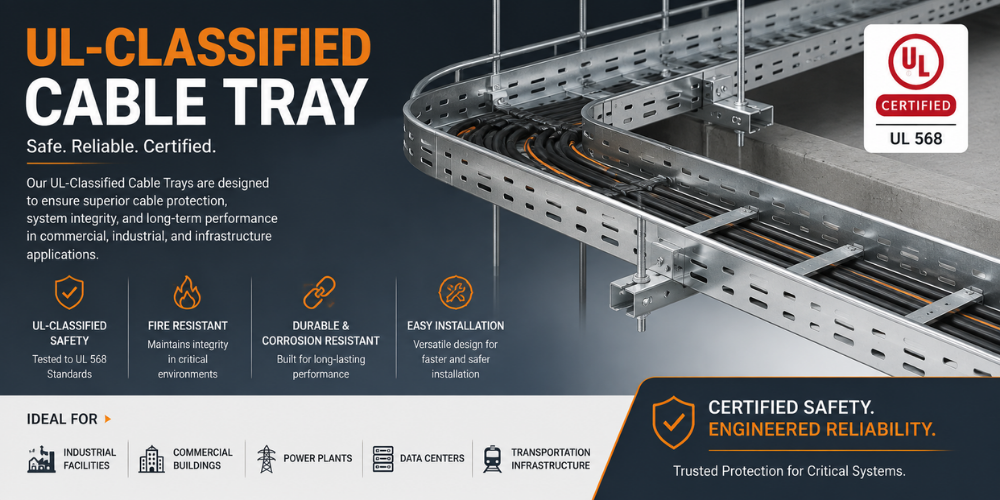
A UL-classified cable tray refers to a cable tray product or related assembly that has been evaluated under a UL Classification program for specific properties, hazards, or conditions.
Cable trays themselves are used to support and route electrical cables throughout a facility. Depending on the project, they may carry:
- Power cables
- Control cables
- Instrumentation cables
- Communication cables
- Data cables
- Fire alarm cables
- Emergency system cables
- Industrial automation cables
The purpose of the tray is primarily to provide organized mechanical support and routing. Fire performance is a separate consideration that depends on the cable construction, tray arrangement, fire protection system, applicable testing, and project requirements.
Therefore, a buyer should not assume that every tray carrying a UL mark has identical fire performance.
Understanding UL Classification
The meaning of the UL mark is central to correctly evaluating a UL-classified cable tray.
UL Solutions states that UL Listed products are evaluated for reasonably foreseeable safety-related hazards for their intended use, while UL Classified products are evaluated for specific properties, limited hazards, or suitability under limited or special conditions.
This means the word “Classified” should always be followed by an understanding of what was actually evaluated.
The classification information may identify:
- Specific product properties
- Particular hazards
- Special conditions of use
- Product category
- Certification identification
- Control number
This information allows engineers and inspectors to determine whether the product is appropriate for the intended application.
Why Cable Tray Fire Protection Matters
Cable trays can contain substantial quantities of electrical and communication cables. In large industrial facilities, hundreds or thousands of cables may be routed through common pathways.
These cables can support critical systems such as:
- Power distribution
- Process control
- Emergency shutdown
- Fire detection
- Emergency lighting
- Security
- Communication
- Automation
- Building management
- Instrumentation
A fire affecting a concentrated cable route can potentially affect multiple systems.
For this reason, cable fire protection should be considered as part of the overall fire safety design.
The correct solution can involve a combination of:
- Appropriate cable selection
- Cable spacing
- Fire barriers
- Fire-rated penetrations
- Fire detection
- Suppression
- Passive fire protection
- Fire-resistant cable products
- Cable coatings or wraps where appropriately tested
UL and Cable Fire Testing
UL Solutions provides testing and certification services for wire and cable products and explains that its certification marks communicate different types and scopes of evaluation. For wire and cable, UL notes that UL Listed indicates evaluation for reasonably foreseeable safety-related hazards for the intended use, while UL Classified addresses specific risks or conditions.
This distinction is particularly important for projects using a UL-classified cable tray because the tray’s classification and the cable’s certification are not necessarily the same thing.
A UL classification for one product does not automatically certify every component installed alongside it.
Cable Tray vs Cable Certification
A cable tray and the cable installed in it are separate products.
The tray provides:
- Mechanical support
- Cable routing
- Organization
- Accessibility
- Load support
The cable provides:
- Electrical conduction
- Insulation
- Signal transmission
- Fire performance characteristics
A project may therefore require separate certification or testing requirements for both the tray and the cable.
For example, a cable may have specific fire-propagation test results, while the tray may have separate mechanical, material, or fire-related evaluation.
The project specification should identify what certification is required for each component.
UL Classified vs UL Listed
One of the most important aspects of selecting a UL-classified cable tray is understanding the difference between UL Classified and UL Listed.
UL Listed
UL Solutions describes the UL Listed Mark as indicating that representative samples met UL safety requirements primarily based on applicable UL Standards or recognized third-party standards.
UL Classified
The UL Classification Mark indicates evaluation for specific properties, limited hazards, or suitability under limited or special conditions. The mark includes a statement describing the scope of evaluation.
UL Certified
UL Solutions also uses an enhanced UL Certification Mark that can communicate multiple certifications and attributes.
These terms should not be used interchangeably in product marketing or procurement documentation.
Why Certification Scope Matters
Suppose a product is UL Classified for a particular fire-performance characteristic. That does not necessarily mean the product has been evaluated for every other characteristic.
The classification may be limited by:
- Specific test conditions
- Specific product configuration
- Specific materials
- Specific installation method
- Specific environmental conditions
- Specific application
Therefore, when evaluating a UL-classified cable tray, the project team should obtain the certification information and read the scope rather than relying on a general statement such as “UL approved.”
How to Verify a UL Product
UL Solutions provides certification information and Product iQ resources for verifying certified products. For wire and cable products, UL states that the certification tag on the reel, flange, or smallest unit container is primary evidence, while surface printing is supplemental.
A professional verification process should include:
- Manufacturer name
- Product identification
- UL mark
- Classification statement
- Control number
- Applicable certification information
- Evaluation scope
- Installation requirements
This is especially important for international projects where multiple distributors may offer similar-looking products.
Industrial Applications
Cable trays are used in virtually every sector where organized cable routing is required.
A UL-classified cable tray may be relevant to projects where the specification calls for a defined UL evaluation.
Power Generation
Power plants contain extensive electrical and control cable networks.
Cable trays may carry cables for:
- Generators
- Turbines
- Transformers
- Switchgear
- Control rooms
- Instrumentation
- Monitoring systems
- Emergency equipment
Cable protection planning is particularly important because multiple critical circuits may share common routes.
Oil and Gas
Oil refineries, petrochemical facilities, LNG terminals, offshore platforms, gas processing plants, and storage facilities have demanding fire safety requirements.
Cable trays can support:
- Process control
- Instrumentation
- Power distribution
- Emergency shutdown systems
- Communication
- Fire detection
A UL-classified cable tray should be selected only after confirming that its specific evaluation matches the project requirement.
Manufacturing
Manufacturing facilities depend on cable trays for:
- Industrial automation
- Motors
- Robotics
- Production systems
- PLC controls
- Sensors
- Communication
- Safety equipment
Cable routing can change as machinery and production lines are upgraded, making inspection and maintenance important.
Data Centers
Data centers use extensive cable infrastructure for:
- Server power
- Network systems
- UPS systems
- Cooling
- Security
- Monitoring
- Building automation
Cable tray selection should be coordinated with electrical design, fire protection, redundancy, and maintenance planning.
Hospitals
Hospitals rely on critical electrical infrastructure for:
- Medical equipment
- Emergency lighting
- Fire alarms
- Communication
- Security
- Building services
- Critical power
Fire protection planning should identify circuits that need enhanced protection or continued operation during emergency conditions.
Transportation
Airports, metro systems, railways, tunnels, and ports depend on cable networks for:
- Signaling
- Lighting
- Communications
- Security
- Passenger systems
- Emergency equipment
- Control systems
Cable tray design is therefore an important component of infrastructure planning.
Materials Used for Cable Trays
Cable trays may be manufactured from materials such as:
- Steel
- Aluminum
- Stainless steel
- Other engineered materials
The correct material depends on the project environment.
Important factors include:
- Corrosion
- Weight
- Mechanical strength
- Temperature
- Chemical exposure
- Outdoor conditions
- Moisture
- Installation requirements
For corrosive industrial environments, material selection can significantly affect service life.
Cable Tray Design Considerations
A cable tray should be selected based on the complete installation.
Important design considerations include:
- Tray width
- Tray depth
- Cable quantity
- Cable weight
- Support spacing
- Cable diameter
- Heat dissipation
- Future expansion
- Power and control cable arrangement
- Environmental exposure
A tray should have sufficient capacity for the intended cable load while maintaining suitable access for inspection and maintenance.
Cable Loading
Overloading a tray can create mechanical and operational problems.
Engineers should consider:
- Total cable weight
- Cable fill
- Support spacing
- Temperature
- Cable grouping
- Future capacity
Proper loading also helps maintenance teams identify cable additions and modifications.
Cable Arrangement
Cable arrangement can affect maintenance, heat dissipation, and overall system organization.
Depending on the project, designers may separate:
- High-voltage power cables
- Low-voltage power cables
- Control cables
- Instrumentation
- Communication cables
- Safety circuits
The required arrangement should follow applicable codes and project engineering specifications.
Cable Tray Fire Protection Systems
Cable tray fire protection can include several technologies depending on the project.
Potential solutions include:
- Fire-resistant cables
- Fire-rated barriers
- Cable wraps
- Intumescent coatings
- Firestop systems
- Compartmentation
- Fire detection
- Suppression systems
The selected solution should be supported by appropriate testing or certification for the intended application.
A UL-classified cable tray should not automatically be presented as equivalent to a fire-rated cable protection system unless the relevant documentation specifically supports that claim.
Intumescent Coatings
Intumescent coatings are passive fire protection materials that expand when exposed to high temperatures and form an insulating char layer.
They can be used for certain fire protection applications involving:
- Cables
- Cable trays
- Structural elements
- Penetration systems
- Other substrates
However, the certification of an intumescent coating is separate from the classification of a cable tray.
Before applying a coating, engineers should verify:
- Tested substrate
- Coating thickness
- Application method
- Curing requirements
- Environmental suitability
- Product certification
- Tested configuration
- Compatibility
Firestop Systems Around Cable Trays
Where cable trays pass through fire-rated walls or floors, the penetration must be appropriately protected.
Firestop systems are designed to maintain the fire-resistance characteristics of the penetrated assembly when installed according to their tested configuration.
The system selection may depend on:
- Wall construction
- Floor construction
- Cable type
- Tray size
- Penetration dimensions
- Required fire rating
- Tested system
This is separate from the classification of the cable tray itself.
Installation Best Practices
Proper installation is critical for cable tray performance.
Installers should follow the manufacturer’s instructions and project specifications regarding:
- Support spacing
- Fasteners
- Joints
- Cable loading
- Bend radius
- Grounding
- Bonding
- Accessories
- Fire protection components
Any change to a tested or evaluated configuration should be reviewed before implementation.
Environmental Conditions
A cable tray can operate in demanding environments.
Before selecting a UL-classified cable tray, evaluate:
- Temperature
- Humidity
- Water exposure
- Chemical exposure
- UV radiation
- Salt
- Industrial gases
- Mechanical vibration
- Outdoor weather
- Corrosion
Certification does not automatically mean that a product is suitable for every environment.
Corrosion Protection
Corrosion can reduce the structural integrity of a cable tray system.
Potential protective measures include:
- Galvanized finishes
- Protective coatings
- Stainless steel construction
- Appropriate material selection
- Regular inspection
The appropriate approach depends on the environment and project specifications.
Inspection and Maintenance
Cable tray systems should be included in the facility’s maintenance program.
Routine inspection can identify:
- Corrosion
- Loose connections
- Damaged sections
- Excessive cable loading
- Unsupported cables
- Damaged insulation
- Contamination
- Unauthorized modifications
Maintenance records should be updated after significant electrical modifications.
Housekeeping Around Cable Trays
Good housekeeping is an important part of industrial fire safety.
Cable tray areas should be kept free of unnecessary combustible materials, waste, packaging, oil contamination, and other materials that could contribute to fire risk.
Maintenance teams should also ensure that access to cable trays remains available for inspection.
Why Choose Gopalfiresafety?
Gopalfiresafety provides industrial and commercial fire safety products and solutions.
Businesses can visit Gopalfiresafety to explore fire protection solutions and obtain product information.
Gopalfiresafety focuses on areas including:
- Industrial fire safety
- Passive fire protection
- Cable fire protection
- Electrical fire protection
- Fire protection equipment
- Industrial safety solutions
For products marketed as UL Classified, UL Listed, or UL Certified, buyers should verify the exact product certification and scope before final procurement.
Cable tray systems are an important part of electrical infrastructure in industrial, commercial, and critical facilities. They provide organized routes for power, control, instrumentation, communication, and data cables. When a project includes specific fire protection requirements, selecting a UL-classified cable tray requires careful consideration of the product’s UL evaluation, cable characteristics, installation arrangement, environmental conditions, and applicable project specifications.
UL Classification should always be understood according to its stated scope. UL Solutions explains that Classified products are evaluated for specific properties, limited hazards, or suitability under limited or special conditions. Therefore, a UL Classification should not automatically be interpreted as a universal fireproof rating.
Businesses looking for industrial fire protection solutions can explore Gopalfiresafety, which provides fire safety products and solutions for industrial and commercial applications. Gopalfiresafety also shares fire safety information, product updates, and industry insights on Instagram.
How to Verify a UL-Classified Cable Tray
Before purchasing a UL-classified cable tray, procurement teams should verify the actual UL information associated with the product.
Important information includes:
- Manufacturer name
- Product identification
- UL marking
- Classification statement
- Control number
- Applicable product category
- Evaluation scope
- Installation requirements
- Environmental limitations
UL Solutions provides certification information through its certification resources and Product iQ. For wire and cable products, UL also explains that certification information on the product or packaging is important for verification.
The buyer should verify the exact product rather than assuming that every product manufactured by a certified company carries the same certification.
Why Certification Scope Matters
A UL Classification can address a particular characteristic rather than every characteristic of a product.
For example, an evaluation may relate to:
- A specific fire characteristic
- A specific material property
- A limited hazard
- A defined installation condition
- A specific product configuration
Therefore, a UL-classified cable tray should be evaluated according to the exact statement associated with its UL Classification Mark.
This is especially important when products are being purchased for:
- Power plants
- Refineries
- Data centers
- Manufacturing facilities
- Hospitals
- Transportation projects
- Commercial infrastructure
Cable Tray and Cable Certification Are Different
The cable tray and the cable installed inside it are separate components.
The tray primarily provides:
- Mechanical support
- Cable organization
- Routing
- Accessibility
- Structural support
The cable provides:
- Electrical conduction
- Insulation
- Signal transmission
- Fire-performance characteristics
Consequently, certification of one component does not automatically certify the other.
A project requiring fire-tested cables may need separate documentation for the cable itself, even if the supporting tray has a UL evaluation.
UL-Classified Cable Tray and Fire Protection
Fire protection for cable systems should be considered as part of a complete facility strategy.
Depending on the application, protection can involve:
- Fire-resistant cables
- Fire-resistant cable coatings
- Intumescent coatings
- Cable wraps
- Firestop systems
- Fire barriers
- Compartmentation
- Fire detection
- Automatic suppression
The appropriate solution depends on the project requirements.
A UL-classified cable tray should not be marketed as a complete fire protection system unless the applicable documentation specifically supports that claim.
Cable Tray Fire Testing
Fire testing can evaluate different characteristics depending on the product and application.
For cables installed in trays, testing may address:
- Flame propagation
- Flame spread
- Smoke release
- Circuit integrity
- Performance under specified fire exposure
UL Solutions identifies UL 1685 as the Standard for Vertical-Tray Fire-Propagation and Smoke-Release Test for electrical and optical-fiber cables.
This type of testing focuses on cable behavior under defined conditions.
The result should not be interpreted as a universal rating for every cable, tray, or installation configuration.
UL 1685 and Cable Applications
UL 1685 is particularly relevant to vertical-tray fire-propagation and smoke-release testing for electrical and optical-fiber cables.
Cable fire testing can provide useful information about:
- Flame propagation
- Flame travel
- Smoke generation
- Cable fire behavior
However, project teams should identify the precise test requirement specified for the project.
The test standard, cable construction, installation arrangement, and intended application all matter.
Industrial Power Plant Applications
Power plants contain complex cable systems connecting generators, turbines, transformers, switchgear, control rooms, instrumentation, and emergency equipment.
Cable trays may carry hundreds of cables through electrical and process areas.
Fire protection planning may involve:
- Cable separation
- Fire barriers
- Fire-resistant cables
- Firestop systems
- Detection
- Suppression
- Passive fire protection
A UL-classified cable tray can be considered when its particular evaluation matches the project’s requirements.
Oil and Gas Applications
Oil and gas facilities have demanding fire protection requirements.
Cable trays are commonly used in:
- Refineries
- Petrochemical plants
- LNG facilities
- Gas processing plants
- Offshore platforms
- Fuel storage facilities
Cable systems may support process control, instrumentation, communication, power distribution, emergency shutdown, and fire detection.
In these facilities, cable protection should be integrated with the overall fire safety engineering strategy.
Manufacturing Applications
Manufacturing facilities depend on cable trays for automation, robotics, motors, production equipment, instrumentation, and communication systems.
Cable routes may change when:
- New machinery is installed
- Production lines are expanded
- Automation is upgraded
- Old equipment is removed
- New communication systems are added
These changes should be documented and reviewed to ensure that cable tray loading and fire protection arrangements remain suitable.
Data Center Applications
Data centers contain extensive power and communication cable systems.
Cable trays may support:
- Server power
- Network cables
- UPS systems
- Power distribution
- Cooling controls
- Security systems
- Monitoring equipment
Because data centers depend on continuous operation, electrical infrastructure protection is an important part of facility planning.
A UL-classified cable tray may be relevant where the project specification requires a defined UL evaluation.
Hospital Applications
Hospitals use cable systems for:
- Medical equipment
- Emergency lighting
- Fire alarms
- Communication
- Security
- Critical power
- Building management
Fire safety planning should identify which cable circuits are critical and determine what level of protection is required.
Transportation Applications
Transportation facilities such as airports, railway stations, metro systems, tunnels, and ports rely on electrical cables for:
- Signaling
- Lighting
- Communications
- Security
- Passenger information
- Control systems
- Emergency services
Cable tray design and fire protection should therefore be coordinated with the facility’s overall safety strategy.
Cable Tray Material Selection
The material selected for a cable tray depends on the environment and project requirements.
Common materials include:
- Galvanized steel
- Stainless steel
- Aluminum
- Other engineered materials
Selection factors include:
- Corrosion
- Weight
- Mechanical loading
- Temperature
- Chemical exposure
- Moisture
- Outdoor conditions
A UL classification does not automatically mean that a product is suitable for every environmental condition.
Corrosion Protection
Industrial cable trays may be exposed to:
- Moisture
- Salt
- Chemicals
- Industrial gases
- Outdoor weather
- High humidity
Corrosion can weaken structural components and affect long-term reliability.
Depending on the application, protection may involve:
- Galvanized finishes
- Protective coatings
- Stainless steel
- Suitable aluminum alloys
- Regular inspection
The appropriate solution should be selected based on the actual operating environment.
Cable Loading and Tray Capacity
Cable tray capacity should be calculated during the engineering stage.
Consider:
- Cable weight
- Cable diameter
- Number of cables
- Tray width
- Tray depth
- Support spacing
- Future cable additions
- Heat dissipation
Overloaded cable trays can create mechanical problems and make inspection and maintenance more difficult.
Cable Separation
Different cable types may need to be separated depending on project requirements.
Possible categories include:
- Power cables
- Control cables
- Instrumentation
- Communication cables
- Emergency circuits
- Safety-related systems
The correct separation requirements should be established by the project’s electrical and fire protection engineers.
Installation Best Practices
Proper installation is essential for reliable cable tray performance.
Installers should follow approved project drawings and manufacturer instructions regarding:
- Tray support
- Fasteners
- Joints
- Cable loading
- Grounding
- Bonding
- Accessories
- Clearances
- Fire protection components
Unapproved modifications can affect the intended performance of a tested or evaluated configuration.
Firestop Protection at Cable Penetrations
Cable trays frequently pass through walls and floors.
When these assemblies are fire-rated, appropriate firestop systems may be required around penetrations.
The firestop system should be selected according to:
- Wall construction
- Floor construction
- Tray dimensions
- Cable types
- Penetration size
- Required fire rating
- Tested configuration
The firestop system is separate from the UL Classification of the cable tray.
Intumescent Cable Protection
Intumescent coatings can provide passive fire protection for certain cable and tray applications.
When heated, an intumescent material can expand and create an insulating char layer.
However, product selection should be based on documented testing and certification.
Before using an intumescent coating, confirm:
- Tested substrate
- Product certification
- Application thickness
- Application method
- Curing requirements
- Environmental suitability
- Cable compatibility
- Maintenance requirements
A coating’s certification should not automatically be transferred to a different substrate or configuration.
Inspection and Maintenance
Routine maintenance helps preserve the reliability of cable tray systems.
Inspection teams should check for:
- Corrosion
- Damaged tray sections
- Loose fasteners
- Unsupported cables
- Excessive cable loading
- Damaged cable insulation
- Contamination
- Unauthorized modifications
Maintenance should also be documented after significant changes.
Cable Tray Housekeeping
Cable tray areas should remain clean and accessible.
Good housekeeping can help prevent unnecessary fire hazards and support easier inspection.
Maintenance teams should remove:
- Packaging
- Waste
- Combustible debris
- Oil contamination
- Unnecessary materials
Access to cable trays should remain clear for inspection and maintenance activities.
Common Procurement Mistakes
Mistake 1: Treating UL Classified as Universal Fireproof Certification
UL Classification applies to specific evaluated characteristics or conditions.
Mistake 2: Not Verifying the Product
Always verify the exact manufacturer and product identification.
Mistake 3: Ignoring Certification Scope
The classification statement should be reviewed before procurement.
Mistake 4: Assuming Tray Certification Covers the Cable
The cable may require separate certification or fire testing.
Mistake 5: Ignoring Installation Conditions
A product should be installed according to applicable instructions and evaluated conditions.
Mistake 6: Choosing Only Based on Price
Technical compliance should be evaluated alongside cost, availability, and support.
Mistake 7: Ignoring Maintenance
A well-designed installation still requires inspection and maintenance throughout its service life.
How Gopalfiresafety Can Help
Gopalfiresafety provides fire safety products and industrial fire protection solutions for commercial and industrial applications.
Visit Gopalfiresafety to explore fire protection products and solutions.
The company focuses on areas such as:
- Cable fire protection
- Passive fire protection
- Industrial fire safety
- Electrical fire protection
- Fire protection equipment
- Industrial safety solutions
When a project requires UL Listed, UL Classified, or UL Certified products, buyers should verify the exact certification and evaluation scope before final procurement.
Frequently Asked Questions
What is a UL-classified cable tray?
A UL-classified cable tray is a cable tray or related product that has been evaluated by UL for specific properties, hazards, or special conditions. The exact classification scope should always be verified from the applicable documentation.
Is a UL-classified cable tray fireproof?
Not necessarily. UL Classification applies only to the specific properties and conditions covered by the evaluation.
What is UL 1685?
UL 1685 is associated with vertical-tray fire-propagation and smoke-release testing for electrical and optical-fiber cables.
Is UL Classified the same as UL Listed?
No. UL Solutions distinguishes UL Classified from UL Listed. Classification addresses specific properties, limited hazards, or special conditions, while Listing addresses reasonably foreseeable safety-related hazards for the intended use.
Does a UL-classified cable tray certify the cables installed inside it?
No. The tray and the cables are separate products and may have separate certification or testing requirements.
Can intumescent coatings be used on cable trays?
Intumescent coatings can be used for certain passive fire protection applications, but the specific product, substrate, thickness, installation method, and test documentation must be verified.
How can UL certification be verified?
Check the manufacturer’s certification documentation and use UL’s certification resources and Product iQ where applicable.
A UL-classified cable tray can be a valuable component of industrial and commercial electrical infrastructure when its specific UL evaluation matches the intended application. However, UL Classification should not be interpreted as a universal fireproof certification.
The correct selection process should consider the exact UL classification, manufacturer, product identification, evaluation scope, cable type, tray configuration, environmental conditions, applicable fire testing, installation requirements, and project specifications.
For critical installations, cable tray fire protection should be treated as part of a broader strategy that can include fire-resistant cables, tested coatings, cable wraps, firestop systems, barriers, detection, suppression, and regular inspection.
Businesses looking for industrial fire safety and passive fire protection solutions can visit Gopalfiresafety and follow Gopalfiresafety on Instagram for fire safety information, product updates, and industry insights.