
Understanding FM Approval and Flame-Retardant Textiles
Introduction
Fire safety is an important consideration when selecting textiles for commercial buildings, industrial facilities, public spaces and specialised applications. Curtains, protective fabrics, upholstery, partitions and temporary fabric structures can contribute to fire risks if they are not selected and maintained correctly. Businesses researching FM Approved Flame Retardant Textile solutions should understand the difference between flame-retardant performance, fire-test compliance and formal third-party product approval. At Gopalfiresafety, we believe that informed product selection and reliable technical documentation are essential parts of fire-risk management. Readers can also follow Gopalfiresafety on Instagram for updates about fire safety products, protection practices and industry information.
The term FM Approved is associated with the certification programme operated by FM Approvals, part of FM Global. It is not simply a general description for a material that has some level of flame resistance. FM Approval is granted to products that complete the applicable evaluation and certification process. Therefore, buyers should verify the exact product, manufacturer, model and approved application before using an approval claim in a specification or purchase decision.
This guide explains how flame-retardant textiles work, why textile fire performance matters, how approval terminology should be understood, and what buyers should check before selecting a fabric for a project.
1. What Is an FM Approved Flame-Retardant Textile?
An FM Approved Flame Retardant Textile is a phrase buyers may use when searching for a textile product that combines flame-retardant performance with FM Approval. However, the phrase must be used carefully. A textile cannot be called FM Approved simply because it has been treated with a flame-retardant chemical or has passed a general fabric flammability test.
FM Approvals evaluates products against specific requirements. Products that successfully complete the relevant certification process may carry the FM APPROVED mark within the scope of their approval. The approval relates to the product and its documented conditions of use, not to every item made from a similar material.
When a project specification requests an FM Approved Flame Retardant Textile, the buyer should first confirm whether the project requires a formally FM Approved product, a fabric that meets a particular fire-test standard, or a textile suitable for a defined application. These requirements are not interchangeable.
A fabric may demonstrate flame-retardant performance under one test method without having FM Approval. Similarly, a product approved for one application should not automatically be assumed suitable for another application. The exact scope and limitations must be checked.
The most reliable approach is to request the product’s technical data sheet, fire-test reports, certification documents and any relevant listing details. These records help buyers understand what has actually been tested and what claims can legitimately be made.
2. Understanding FM Approvals
FM Approvals is an independent testing and certification organisation associated with FM Global. Its certification programme evaluates products and services against defined performance requirements. The FM APPROVED mark indicates that the relevant product has completed the applicable certification process.
The programme covers different categories, including fire protection equipment, electrical equipment and building materials. Its purpose is to provide evidence that products have been tested for specified performance characteristics and are suitable for their approved uses.
For buyers, the important point is that FM Approval is product-specific. A manufacturer’s general statement that it supplies fire-safe materials is not sufficient evidence that a particular textile is FM Approved.
Before accepting an FM Approved Flame Retardant Textile claim, ask the supplier for:
- The exact product name and model number.
- The manufacturer’s legal name.
- The FM Approval certificate or listing details, where applicable.
- The approved application and any restrictions.
- The relevant technical data sheet.
- The fire-test reports supporting the product’s performance.
- Installation, application and maintenance instructions.
- Confirmation that the supplied product matches the approved product description.
A certificate or marketing brochure should not be treated as proof unless its details can be matched to the product being purchased. If the document refers to another model, formulation or application, it may not support the claim being made.
Buyers can learn more about the certification programme through the official FM Approvals information page.
3. What Does Flame-Retardant Mean?
A flame-retardant textile is a fabric that has been designed, manufactured or treated to reduce its tendency to ignite or support flame spread under specified test conditions.
Flame retardancy can be achieved in different ways. Some fabrics use fibres with inherent flame-resistant properties. Other fabrics receive a chemical treatment during manufacturing or after production. Certain technical textiles use specialised fibre blends, coatings or layered constructions to achieve a required level of fire performance.
The actual result depends on several factors:
- Fibre composition.
- Yarn construction.
- Fabric weight and thickness.
- Weave or knit structure.
- Surface treatments.
- Coating formulation.
- Application method.
- Environmental exposure.
- Cleaning and maintenance.
- The test method used to assess performance.
A flame-retardant treatment does not make a textile completely fireproof. It also does not mean that a fabric cannot ignite, melt, produce smoke or lose strength when exposed to extreme heat. Performance must always be understood in relation to the specific test method and conditions.
When comparing an FM Approved Flame Retardant Textile with other fire-performance fabrics, buyers should avoid relying only on product names or general descriptions. They should compare documented test results and confirm that the material is suitable for the intended environment.
4. Why Textile Fire Safety Matters
Textiles are used throughout commercial and industrial environments. They can be found in office interiors, hotels, hospitals, auditoriums, exhibition venues, factories, warehouses and temporary structures.
In many applications, fabrics are installed close to electrical equipment, lighting, heating systems, machinery or other potential ignition sources. If a textile ignites, flames may spread across its surface or involve nearby combustible materials. The resulting smoke and heat can create additional hazards.
Textile fire safety is therefore one part of a wider fire-protection strategy. Choosing a suitable fabric can help reduce certain risks, but it does not replace fire detection, alarms, sprinklers, extinguishers, emergency exits, evacuation planning or building-level fire protection.
For example, a hotel may use decorative curtains, upholstered furniture and fabric partitions. A theatre may use stage curtains, backdrops and acoustic fabrics. A factory may use technical textiles as protective covers or process-related materials. Each application has different performance requirements.
The correct textile should be selected according to the actual hazard, location, use and applicable regulations. A material suitable for a decorative curtain may not be appropriate for industrial protective equipment.
5. Common Types of Flame-Retardant Textiles
Different textile materials have different physical and fire-performance characteristics. Buyers should understand the basic fabric categories before evaluating a supplier’s claims.
Cotton fabrics
Cotton is a natural fibre commonly used in curtains, upholstery, clothing and industrial textiles. Untreated cotton can ignite and burn, so some applications require a suitable flame-retardant treatment.
Treated cotton fabrics should be evaluated for the specific treatment process, expected durability and cleaning requirements. Buyers should ask whether the treatment is durable or intended for limited use, and whether washing or repeated cleaning affects its performance.
Polyester fabrics
Polyester is widely used in commercial interiors, event materials, curtains and upholstery. Its behaviour under heat differs from that of natural fibres. Depending on the fabric construction, polyester may soften, shrink or melt when exposed to high temperatures.
A flame-retardant polyester textile should be evaluated using test evidence relevant to its intended use. Buyers should not assume that every polyester fabric has the same fire performance.
Wool fabrics
Wool has natural characteristics that can make it useful in certain textile applications. However, natural fibre characteristics alone do not establish compliance with a project’s fire-safety requirements.
Where a wool textile is specified for a regulated or higher-risk environment, the completed fabric should still be assessed against the applicable test criteria.
Modacrylic and specialised fibre blends
Some technical textiles use specialised fibres or fibre blends designed for protective applications. These materials may be selected for industrial clothing, protective covers or other uses where heat and flame exposure are relevant.
The performance of a blend depends on its exact composition and construction. A supplier should provide product-specific documentation rather than relying on a broad statement about the fibre category.
Fibreglass and coated technical fabrics
Fibreglass-based textiles and coated technical fabrics are used in some industrial and construction-related applications. Their suitability depends on the complete material construction, including coatings, laminates, seams and installation details.
For example, FM Global guidance for fabric and membrane structures discusses specific criteria for fabrics that are noncombustible or will not self-propagate fire in the context of those structures. It also distinguishes these materials from fire-resistance-rated construction. This illustrates why the application and test criteria matter when choosing technical fabric.
6. How Flame-Retardant Treatments Work
Flame-retardant treatments are designed to influence how a textile behaves when exposed to heat or flame. The exact mechanism depends on the chemistry of the treatment and the fabric being treated.
Some formulations encourage the formation of a protective char layer. This layer can help limit heat transfer and reduce the release of combustible gases from the underlying material. Other formulations may influence reactions in the gas phase or alter the way the textile decomposes when heated.
A treatment must be compatible with the textile. If it does not adhere properly, penetrates unevenly or changes the fabric’s physical characteristics, the final result may not meet the intended performance requirements.
The application process can also influence the outcome. Important variables may include:
- Chemical concentration.
- Application quantity.
- Fabric absorbency.
- Drying temperature.
- Curing conditions.
- Treatment uniformity.
- Environmental humidity.
- Storage conditions.
- Post-treatment handling.
A product that performs well on one fabric may not produce the same result on another. Cotton, polyester, blended textiles and coated fabrics can respond differently to the same treatment.
For this reason, buyers evaluating an FM Approved Flame Retardant Textile should ask whether the supplied fabric is tested in its final form. If the product is treated after manufacture, they should also confirm whether the test evidence covers the treatment process and the finished textile.
7. Difference Between Flame Retardant, Fire Resistant and Fireproof
These terms are often used together in marketing materials, but they do not mean the same thing.
Flame retardant generally describes a material designed or treated to reduce ignition or flame spread under specified conditions.
Fire resistant is a broader description that may refer to a material’s ability to withstand a particular fire exposure for a defined period or under a defined test. The meaning depends on the applicable standard and product category.
Fireproof suggests that a material cannot be damaged or affected by fire. This is an absolute claim and is generally unsuitable for describing ordinary treated textiles.
A flame-retardant fabric may still burn under severe conditions. It may also shrink, melt, char, release smoke or lose mechanical strength. Buyers should therefore ask for measurable test results rather than accepting broad claims such as fireproof, completely safe or non-burning.
The phrase FM Approved Flame Retardant Textile should also not be used as a substitute for a clear technical description. A formal approval claim must be supported by evidence for the exact product and approved scope.
8. Where Flame-Retardant Textiles Are Used
Flame-retardant textiles are used in a wide range of environments. The required performance depends on the building, activity, occupancy and applicable fire-safety rules.
Hotels and hospitality facilities
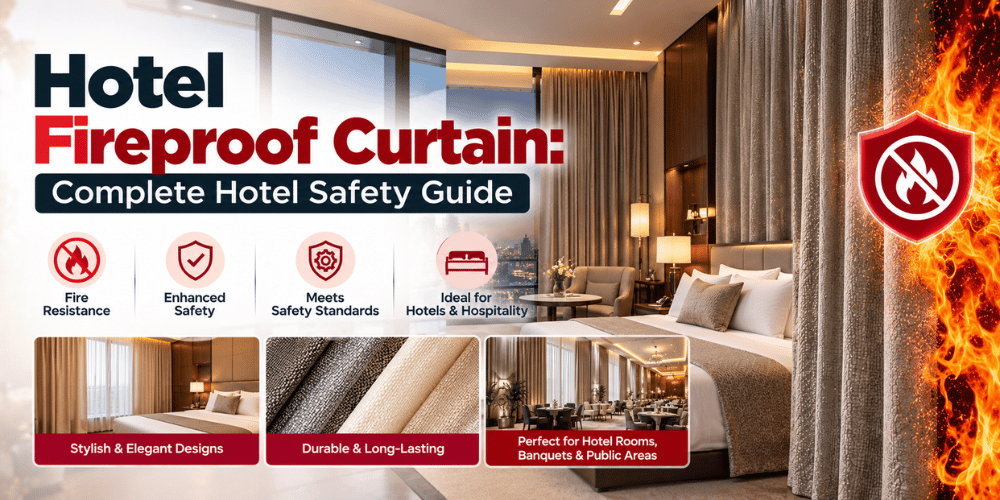
Hotels use textiles in guest rooms, restaurants, conference halls, corridors and event spaces. Curtains, upholstery, decorative fabrics and partitions can all be relevant to interior fire safety.
Hotel operators should check local requirements and project specifications before selecting fabrics. They should also consider cleaning frequency, expected service life, colour stability and replacement schedules.
Theatres and auditoriums
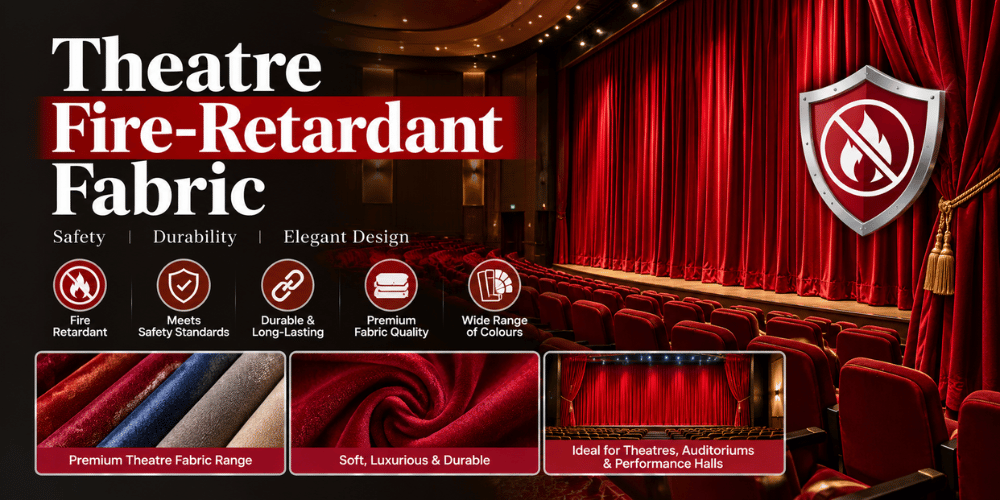
Theatres and auditoriums may contain stage curtains, backdrops, acoustic fabrics, seating upholstery and decorative materials. These items can cover large areas and may be close to stage lighting and electrical equipment.
The fabric’s fire performance should be assessed for its exact use. A curtain test does not automatically establish suitability for every other textile application in the venue.
Industrial facilities
Industrial environments may use textiles for equipment covers, protective screens, temporary partitions and specialised technical applications. The selection process should consider heat exposure, sparks, chemicals, abrasion and mechanical stress.
A textile intended for general interior decoration should not be substituted for a material designed for an industrial hazard.
Exhibition and event venues
Temporary structures, exhibition booths, stage decorations and display fabrics may require specific fire-performance documentation. Since these installations are often assembled and removed repeatedly, inspection and recordkeeping are important.
The project team should confirm whether the fabric’s test evidence applies to the complete installed construction, including any backing, coating, seams or attachments.
Healthcare and public buildings
Hospitals, clinics, educational facilities and other public buildings may use textiles in curtains, screens, upholstery and interior furnishings. The selected materials should meet the relevant local requirements and the facility’s technical specifications.
A buyer should not assume that a fabric suitable for one type of public building is automatically acceptable in another.
9. Choosing the Correct Fire-Test Evidence
A fire-test report provides information about how a sample performed under a defined test procedure. It should identify the tested material, sample preparation, method, conditions and results.
Different standards evaluate different aspects of fire behaviour. A test for flame spread is not necessarily equivalent to a test for ignition resistance, heat release, smoke production or fire resistance.
For textiles, the relevant method depends on the product and its intended application. In India, the Bureau of Indian Standards publishes textile-related standards, including IS 18931:2024 for fire-resistant fabrics made from cotton, man-made fibres or their blends, and IS 13501:2025 for determination of flammability by oxygen index. The applicable standard should be checked against the project’s actual requirements.
Buyers should ask the testing laboratory or supplier to explain:
- Which test method was used?
- Was the sample identical to the supplied product?
- Was the textile tested before or after coating or treatment?
- Were seams, backing materials or laminates included?
- What was the test result?
- Does the report apply to the intended end use?
- Are there restrictions on cleaning, installation or maintenance?
A test report is not automatically an FM Approval certificate. Likewise, passing one textile test does not establish approval under every certification programme.
10. How to Verify an FM Approval Claim
Verification is essential when a tender, consultant, insurer or facility owner requests an FM Approved product.
Start by asking the supplier for the full product identity and its FM Approval details. Check that the manufacturer, product name, model and description match the material being offered. Review the scope to determine whether the approval covers the proposed use.
If a supplier provides only a logo, brochure or general statement, request the supporting documentation. Do not assume that a related product from the same manufacturer has the same approval.
A useful verification process includes:
- Confirming the manufacturer’s identity.
- Checking the exact product description.
- Reviewing the approval scope.
- Checking any conditions or limitations.
- Matching the supplied product to the documentation.
- Keeping a copy of the evidence with procurement records.
The official FM Approvals website explains the certification programme and identifies the Approval Guide as a resource for FM Approved products and services. Buyers should use official records rather than relying only on supplier advertising.
11. Questions Buyers Should Ask Suppliers
Before purchasing a textile for a fire-safety-sensitive project, ask direct questions. These help identify unsupported claims and reduce the risk of selecting an unsuitable material.
Is the exact textile FM Approved?
Ask for documentation that identifies the exact product and its approval scope. Do not accept a general claim about the manufacturer’s product range.
Which fire-test standards does it meet?
Request the complete test report and check whether the method is appropriate for the intended application.
Is the fabric inherently flame resistant or chemically treated?
This helps explain how the product achieves its stated performance and what maintenance may be required.
Does cleaning affect the treatment?
Ask for written cleaning instructions and information about any limitations on washing, dry cleaning or repeated use.
Can the supplier provide a technical data sheet?
The document should describe the textile, composition, construction, performance claims and relevant handling requirements.
Does the documentation match the supplied batch?
Product identity and traceability matter. Keep purchase records, batch information and certificates together.
12. Key Takeaways
Textile fire safety requires more than choosing a fabric described as flame retardant. Buyers need to understand the material, the intended application, the relevant test methods and the evidence supporting performance claims.
The term FM Approved should be used only when the exact product has a verifiable FM Approval within the relevant scope. A flame-retardant treatment or a general fire-test report does not automatically establish FM Approval.
When evaluating an FM Approved Flame Retardant Textile, focus on product identity, test evidence, approval scope, fabric construction, treatment compatibility and maintenance requirements. These checks help procurement teams make better-informed decisions and avoid unsupported certification claims.
In Part 2, we will cover fabric selection, technical documentation, treatment and application considerations, inspection, maintenance, supplier evaluation and common purchasing mistakes.
Part 2: Selection, Application, Testing, Maintenance and Supplier Evaluation
13. How to Select the Right Flame-Retardant Textile
Selecting the right textile requires more than comparing prices, colours or fabric thickness. Buyers should evaluate the material according to its intended application, fire-performance requirements, expected service life and available certification documents.
When a project specifies an FM Approved Flame Retardant Textile, the first step is to confirm the exact approval requirement. Ask the project consultant, architect, safety officer or insurance representative which product category and approval scope are required.
A practical selection process should consider the following factors:
Application requirements: Identify whether the textile will be used for curtains, upholstery, protective covers, industrial screens, stage backdrops or another purpose. Each application can have different fire and performance requirements.
Fabric composition: Check whether the material is made from cotton, polyester, wool, fibreglass or a specialised fibre blend. Fibre composition influences how the material responds to heat and how it interacts with chemical treatments.
Fire-test performance: Review test reports that relate directly to the finished textile. Confirm the test method, sample construction and acceptance criteria.
Durability: Consider whether the fabric will experience regular washing, dry cleaning, abrasion, sunlight, moisture or chemical exposure.
Certification: Verify the exact certification or approval claim through the relevant official source. A supplier’s general product brochure is not sufficient evidence of formal approval.
Installation conditions: Check whether the textile will be installed near lighting, electrical equipment, heating systems or machinery.
Maintenance requirements: Confirm that the facility can follow the cleaning and inspection instructions provided by the manufacturer.
These checks help prevent a common procurement mistake: buying a fabric that performs well in a laboratory test but is unsuitable for the actual operating environment.
14. Understanding Technical Data Sheets
A technical data sheet, commonly called a TDS, is one of the most useful documents when evaluating fire-retardant textiles. It provides product information that helps buyers, consultants and installers understand the material.
A complete TDS may include:
- Product name and identification.
- Manufacturer information.
- Fibre composition.
- Fabric weight and thickness.
- Colour and available finishes.
- Flame-retardant properties.
- Applicable test standards.
- Test results or performance classifications.
- Application restrictions.
- Cleaning and maintenance instructions.
- Storage and handling recommendations.
For an FM Approved Flame Retardant Textile, the technical data sheet should be checked alongside the official approval documentation. The TDS describes product characteristics, while the approval record establishes the scope of the relevant certification.
Do not treat a technical data sheet as an approval certificate. A document may contain impressive fire-performance figures without confirming that the product has received FM Approval.
Buyers should also check the document revision date. Manufacturers may change formulations, suppliers, fabric constructions or production processes. An old technical document may not describe the material currently being supplied.
If a product is manufactured in different grades, colours, weights or constructions, ask whether the documentation applies to the exact selected variant.
15. Fire-Test Reports and Their Importance
Fire-test reports provide evidence of how a material performed under a defined laboratory procedure. They are essential when evaluating textile safety claims.
A report should identify the testing laboratory, sample description, test method, test date, test conditions and results. It should also make clear whether the sample was untreated, chemically treated, coated, laminated or otherwise modified.
For example, a report for untreated cotton cannot automatically be used to demonstrate the performance of a coated cotton fabric. Similarly, a report for one polyester construction should not automatically be applied to every polyester textile from the same manufacturer.
When reviewing a fire-test report, pay attention to:
Sample identification: The fabric description should match the purchased material.
Test method: The report should state the standard and edition used.
Sample preparation: Confirm whether the sample was conditioned, washed, coated or otherwise prepared before testing.
Results: Review the actual measurements and classification rather than relying on a general pass statement.
Limitations: Check whether the laboratory has stated any restrictions on interpreting or applying the results.
Laboratory details: Confirm that the testing organisation is appropriately competent for the required test.
A report is evidence of a particular test. It does not automatically establish a separate certification, product listing or approval.
16. Relevant Indian Textile Fire-Safety Standards
Businesses sourcing fire-resistant textiles in India should understand the applicable Indian Standards as well as any international requirements specified by their project.
One important reference is IS 18931:2024, titled Textiles – Fire Resistant Fabric Made of Cotton, Man-made Fibres/Filaments and Their Blends – General and Performance Requirements.
According to the Bureau of Indian Standards, this standard covers requirements for fire-resistant fabrics made from cotton, man-made fibres and their blends. The Press Information Bureau has explained that its performance requirements include heat resistance, limited flame spread, heat transmission performance, tensile strength, tear strength, burst strength, dimensional change and pH value.
Another relevant reference is IS 13501:2025, which covers the determination of textile flammability by oxygen index. BIS also lists IS 11871:1986 for methods of determining flammability and flame resistance of textile fabrics.
These standards should be selected according to the textile category and intended use. They should not be presented as equivalent to FM Approval.
For an FM Approved Flame Retardant Textile specification, the buyer may need both relevant textile test evidence and separate approval documentation, depending on the project’s requirements.
Official references:
- BIS: IS 18931:2024 standard details
- BIS: IS 13501:2025 standard details
- Press Information Bureau: Discussion on IS 18931:2024
17. Application of Flame-Retardant Treatments
Some textiles are manufactured with flame-resistant properties, while others receive a treatment during or after production. The application method depends on the chemical formulation, textile construction and manufacturer’s instructions.
Before treatment, the fabric should be checked for compatibility. The supplier should confirm whether the treatment is suitable for the fibre type, fabric weight, weave and intended environment.
The application process may involve several stages.
Fabric inspection
Inspect the textile for dust, oil, dirt, stains, moisture and surface contamination. Contamination can interfere with treatment penetration or adhesion.
Damaged fabrics should be identified before processing. Applying a chemical treatment does not restore damaged fibres or repair weak seams.
Compatibility assessment
A small sample may be used to assess whether the treatment changes the fabric’s appearance, feel, strength or other important characteristics.
Compatibility testing should be carried out according to the product manufacturer’s recommendations. A treatment that works on cotton may not be suitable for polyester or a coated textile.
Treatment preparation
Prepare the treatment product according to its technical instructions. Do not change concentration, dilution ratio or application quantity without manufacturer guidance.
The correct quantity may depend on the fabric’s absorbency and construction. Excessive application can cause problems such as stiffness, uneven drying or unwanted changes in appearance.
Application
Depending on the formulation, the treatment may be applied by spraying, dipping, padding or another controlled process.
The application should provide uniform coverage and follow the manufacturer’s specified conditions. Operators should use appropriate protective equipment and follow the safety data sheet.
Drying and curing
The textile must be dried or cured under the conditions specified by the manufacturer. Temperature, humidity, airflow and processing time can influence the final result.
Do not assume that a fabric is ready for use immediately after treatment. It may require a defined drying or curing period.
Final inspection
After processing, inspect the fabric for uneven coverage, stains, colour changes, damage and other defects.
Where required, representative samples of the finished material should be tested by a competent laboratory. The finished product should not be assumed to meet its intended fire-performance requirements solely because the treatment was applied.
18. Can Existing Fabrics Be Treated?
In some situations, an existing textile may be suitable for a flame-retardant treatment. However, this depends on the fabric composition, previous treatments, contamination, condition and the chemical product’s approved or recommended use.
Before treating existing curtains, upholstery or industrial fabric, obtain confirmation from the treatment manufacturer that the product is suitable for the material.
Consider these questions:
- Is the fabric clean and in good condition?
- Is the fibre composition known?
- Has the textile previously received another treatment?
- Is the fabric coated or laminated?
- Can the treatment penetrate or adhere properly?
- Will the treatment affect colour or texture?
- Is the fabric likely to be washed or dry-cleaned?
- Can the treated material be tested after application?
A successful treatment on a small sample does not automatically establish the performance of every installed fabric. Large installations may contain different batches, seams, linings and accessories.
If formal approval is required, verify whether the approval covers the finished treated construction and its application process. Do not assume that an approved chemical treatment automatically makes every treated textile FM Approved.
19. Maintenance and Cleaning of Treated Textiles
Maintenance is an important part of long-term textile fire safety. Even a properly tested material can experience changes during service.
Dust, dirt, abrasion, moisture, cleaning chemicals and repeated handling can affect a textile’s condition. Some treatments may also be affected by washing or dry cleaning.
Facility managers should follow the cleaning instructions supplied by the manufacturer. Avoid using unapproved detergents, solvents or chemical treatments.
A maintenance programme should include:
Routine visual inspection: Look for tears, holes, damaged seams, surface deterioration and contamination.
Cleaning records: Record the cleaning method, date and service provider where appropriate.
Treatment records: Maintain information about the original fabric, treatment product, application date and supporting test documents.
Damage assessment: Remove or assess damaged materials instead of continuing to use them without review.
Retesting: Where required by the project specification or applicable guidance, arrange testing after cleaning, treatment or other significant changes.
Replacement planning: Replace fabrics that are damaged, deteriorated or no longer suitable for their intended use.
For an FM Approved Flame Retardant Textile installation, the facility should also maintain records showing that the installed product matches the documentation supporting the approval claim.
20. Common Mistakes When Buying Flame-Retardant Textiles
Businesses can make costly mistakes when selecting fire-performance textiles. Many of these problems occur because purchasing decisions are based on marketing language rather than technical evidence.
Mistake 1: Assuming flame retardant means FM Approved
A fabric may have flame-retardant properties without having formal FM Approval. Buyers should request exact approval documentation and verify the product identity.
Mistake 2: Accepting a generic certificate
A certificate for a different fabric, treatment or product model may not support the material being purchased.
Always match the certificate to the actual product.
Mistake 3: Ignoring the intended application
A textile tested for one purpose may not be appropriate for another. Curtains, upholstery, protective clothing and technical industrial fabrics have different performance requirements.
Mistake 4: Ignoring cleaning conditions
Some treatments may lose effectiveness or change after washing or dry cleaning. Buyers should understand the maintenance limitations before installation.
Mistake 5: Focusing only on price
A low purchase price may not include testing, documentation, installation support or maintenance requirements.
Compare the complete project cost and technical suitability rather than selecting only the cheapest option.
Mistake 6: Assuming all colours and weights are identical
Changes in dyes, fabric weight, coatings or construction can affect material performance. Ask whether the test evidence applies to the exact variant.
Mistake 7: Treating fire-retardant as fireproof
No general flame-retardant claim should be interpreted as a guarantee that a textile cannot burn or be damaged by heat.
Mistake 8: Not maintaining documentation
Certificates, test reports and product records should be retained throughout the material’s service life. Without traceable documents, it can be difficult to establish what was installed and whether it meets project requirements.
21. How to Evaluate a Flame-Retardant Textile Supplier
A reliable supplier should be able to explain the product’s construction, intended use and documented performance.
When evaluating suppliers, consider the following:
Product knowledge: The supplier should understand fibre types, textile construction and the limitations of different treatments.
Documentation: Technical data sheets, test reports and certification details should be available where applicable.
Traceability: Product names, batch numbers and manufacturer details should be clear.
Technical support: The supplier should be able to answer questions about compatibility, installation and maintenance.
Honest certification claims: A supplier should distinguish between a tested product, a flame-retardant product and a formally approved product.
After-sales support: Buyers should have access to product instructions and assistance when questions arise during service.
Gopalfiresafety can be included in the buyer’s research when evaluating fire-safety products and related information. Visit Gopalfiresafety to explore the company’s website and available fire-safety information. Always confirm the exact product range, technical specifications and certification documents directly before placing an order.
22. Cost Factors and Project Planning
The price of flame-retardant textiles depends on several factors. There is no single price that applies to all materials.
Important cost factors include:
- Fibre type and fabric construction.
- Fabric weight and thickness.
- Specialised manufacturing processes.
- Flame-retardant treatment.
- Coating or lamination.
- Required fire testing.
- Certification and documentation.
- Order quantity.
- Custom colours and dimensions.
- Installation and finishing.
- Maintenance and replacement requirements.
A specialised technical textile may cost more than a general-purpose decorative fabric. However, the correct comparison should consider the project’s complete performance requirements.
For example, a facility may need a textile that offers specific heat resistance, limited flame spread, mechanical strength and durability. Selecting a cheaper fabric that does not meet these requirements can create additional costs through replacement, retesting or project delays.
Procurement teams should define the required standard, application, documentation and quantity before requesting quotations. This makes supplier comparisons more accurate.
23. Documentation Checklist Before Purchase
Before approving a textile purchase, use the following checklist:
- Confirm the intended application.
- Identify the exact fabric composition.
- Obtain the technical data sheet.
- Request the relevant fire-test reports.
- Confirm the test method and edition.
- Verify the manufacturer’s identity.
- Check the product model and batch details.
- Request formal FM Approval evidence if required.
- Verify the approval scope through official records.
- Review cleaning and maintenance instructions.
- Confirm any installation restrictions.
- Retain all documents for future inspection.
This process helps distinguish a genuinely documented product from one supported only by broad marketing claims.
24. The Role of Textile Fire Safety in a Complete Protection Strategy
Flame-retardant textiles are only one part of a building’s fire-safety arrangements. A safe facility also needs suitable fire detection, alarms, emergency lighting, escape routes, firefighting equipment and evacuation procedures.
The choice of textile should be coordinated with the building’s fire-safety design. Architects, consultants, facility managers and procurement teams should work together to identify the required material properties.
For example, selecting a suitable stage curtain does not remove the need for fire alarms, emergency exits or other venue safety measures. Likewise, using a treated industrial fabric does not eliminate risks from hot work, electrical faults or combustible materials nearby.
A complete fire-safety strategy combines suitable materials, good installation practices, inspection and emergency preparedness.
25. Future Developments in Flame-Retardant Textile Technology
Textile manufacturers continue to explore materials and treatments that balance fire performance with durability, comfort, appearance and environmental considerations.
Research and product development may focus on:
- Improved flame-retardant fibre blends.
- More durable textile treatments.
- Better compatibility with different fabric constructions.
- Reduced changes to fabric appearance and feel.
- Improved resistance to repeated cleaning.
- Lower-impact chemical formulations.
- More consistent manufacturing and quality control.
- Better traceability and testing documentation.
However, new technology should be evaluated using measurable performance evidence. Environmental claims, durability claims and fire-performance claims should each be supported by suitable documentation.
Buyers should avoid assuming that a new or advanced treatment automatically meets a particular fire-safety standard or certification programme.
26. Frequently Asked Questions
What is an FM Approved Flame Retardant Textile?
It is a search term describing a textile expected to offer flame-retardant performance and have FM Approval for a defined product and application. The exact approval must be verified through official documentation.
Is every flame-retardant fabric FM Approved?
No. Flame-retardant performance and FM Approval are different things. A fabric may pass a fire test without receiving FM Approval.
How can I verify FM Approval?
Ask the manufacturer for the exact product details and approval documentation. Check the product identity and scope using official FM Approvals resources.
Does flame-retardant fabric mean fireproof fabric?
No. Flame-retardant fabrics are designed to reduce certain fire behaviours under specified conditions. They can still be damaged by high temperatures and may ignite under severe exposure.
Can cotton fabric be made flame retardant?
Yes. Suitable cotton fabrics can receive flame-retardant treatments or be manufactured using specialised processes. The finished fabric should be tested for the intended application.
Can polyester fabric be flame retardant?
Yes. Some polyester textiles are manufactured or treated for specific fire-performance requirements. Their suitability must be established using product-specific evidence.
Does washing affect flame-retardant performance?
It can. The effect depends on the fibre, treatment chemistry and cleaning process. Always follow the manufacturer’s cleaning instructions and verify any required durability testing.
Is a fire-test report the same as FM Approval?
No. A fire-test report records performance under a particular test method. FM Approval is a separate certification process with its own requirements and scope.
Which Indian Standard is relevant to fire-resistant fabrics?
IS 18931:2024 covers general and performance requirements for fire-resistant fabrics made from cotton, man-made fibres or their blends. The applicable standard depends on the specific textile and use.
Can an existing curtain receive flame-retardant treatment?
Some existing curtains may be suitable, but compatibility must be confirmed. The fabric condition, fibre composition, previous treatment and cleaning history should be assessed.
What documents should a buyer request?
Common documents include the technical data sheet, safety data sheet where applicable, fire-test reports, manufacturer details, product identification and formal certification records where required.
Does FM Approval cover every product from a manufacturer?
No. Approval applies to the specific products and scope identified in the official documentation. Buyers should not assume that all products from one manufacturer are covered.
Why is textile fire safety important in commercial buildings?
Textiles can contribute to fire spread depending on their material and installation. Suitable selection, testing, maintenance and compliance with applicable requirements help manage this risk.
Should buyers check the fabric after treatment?
Yes. The finished fabric should be inspected, and testing should be arranged where required. Treatment application alone does not prove that the textile meets a specified performance requirement.
27. Conclusion
Choosing a suitable flame-retardant textile requires careful consideration of the material, application, fire-test evidence, maintenance requirements and certification claims. Businesses should never rely only on a product description or a supplier’s general statement when a project requires a formally approved product.
An FM Approved Flame Retardant Textile should be accepted as such only when the exact product and its approved application can be verified through official documentation. A fire-test report, a treatment certificate or a general flame-retardant claim should not be confused with FM Approval.
For buyers, the most effective approach is to define project requirements before purchasing, compare technical documents, verify certification details and maintain records after installation. These steps support more reliable procurement and better long-term fire-safety management.
Gopalfiresafety encourages businesses, contractors and facility managers to make informed decisions when evaluating fire-safety products and textile protection requirements. Visit https://gopalfiresafety.com/ for company information and fire-safety resources, and follow Gopalfiresafety on Instagram for further updates and educational content.
Final reminder: Always verify the exact product’s certification, test evidence and intended application before describing it as FM Approved.