Hotel Fireproof Curtain: A Complete Guide to Hotel Curtain Fire Safety
Introduction
A Hotel Fireproof Curtain is an important consideration for hotels that want to improve textile fire safety while maintaining attractive, comfortable interiors. From guest rooms and reception areas to conference halls, restaurants, banquet spaces, and corridors, curtains are widely used in hospitality environments. Gopalfiresafety, available at https://gopalfiresafety.com/, provides a starting point for exploring fire-safety products and learning more about fire protection. Hotel owners, facility managers, interior designers, and procurement teams can also follow Gopalfiresafety on Instagram for fire-safety awareness and product-related updates.
In a hotel, curtains contribute to privacy, light control, acoustic comfort, and interior design. However, ordinary curtains can contribute to fire growth if they ignite and burn readily. Choosing suitable fire-retardant curtains, supported by relevant testing and documentation, can help hotels manage this risk as part of a broader fire-safety strategy. The correct selection depends on the curtain material, its intended location, applicable local requirements, installation details, and maintenance practices.
This guide explains what hotel fire-resistant curtains are, how they differ from ordinary curtains, which materials may be suitable, how fire performance is evaluated, and what hotel managers should check before purchasing or treating curtain fabrics.
1. What Is a Hotel Fireproof Curtain?
A Hotel Fireproof Curtain is a curtain made from, or treated with, material designed to meet specified fire-performance requirements. In commercial use, the term “fireproof” is commonly used informally. A more precise description is usually fire-retardant curtain or fire-resistant curtain, depending on the product and its tested performance.
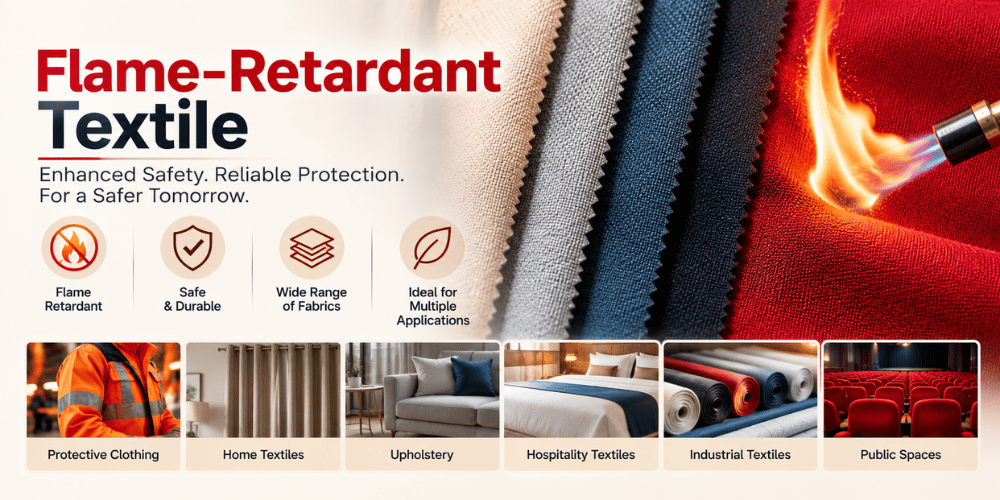
Fire-retardant fabrics are designed to resist ignition, reduce flame spread, or demonstrate other defined performance characteristics under particular test conditions. Their performance varies according to the fibre composition, fabric construction, applied treatment, installation, and testing method.
A curtain should not be considered suitable for a hotel simply because its seller describes it as fireproof. Hotel buyers should request relevant test reports, technical information, and documentation identifying the material that was actually tested.
Key characteristics to consider
- Fire-performance evidence: Documentation showing the results of a relevant fire test.
- Material compatibility: Confirmation that the fabric and any treatment are suitable for the intended application.
- Durability: Information about whether the fire-retardant properties remain effective after cleaning or repeated use.
- Appearance: Colour, texture, opacity, drape, and compatibility with the hotel’s interior design.
- Maintenance: Clear cleaning, inspection, and replacement instructions.
- Compliance: Evidence that the proposed product meets the requirements applicable to the building and location.
A well-selected Hotel Fireproof Curtain should satisfy the project’s verified fire-safety requirements while also meeting practical expectations for guest comfort, durability, and appearance.
2. Why Hotel Curtains Need Fire-Safety Consideration
Hotels operate around the clock and contain different types of spaces, including guest bedrooms, restaurants, kitchens, lounges, meeting rooms, ballrooms, and service areas. Curtains may be installed near windows, lighting, electrical equipment, heating sources, and other potential ignition sources.
Although curtains are only one part of a building’s interior, their behaviour during a fire can affect how fire develops within a space. The risk depends on factors such as the fabric, room layout, ignition source, ventilation, and nearby combustible materials.
Supporting a wider fire-safety plan
Fire-retardant curtains can be one component of a coordinated fire-safety approach. They do not replace smoke detection, alarm systems, emergency lighting, evacuation procedures, fire doors, sprinklers where required, or appropriate fire extinguishers.
Hotels should assess their complete fire-safety arrangements rather than relying on a single material or product to protect occupants.
Protecting guests and staff
Guests may be unfamiliar with a hotel’s layout, exits, and emergency procedures. Some guests may also need additional assistance during evacuation. Staff therefore need clear procedures, effective warning systems, and suitable building protection measures.
Selecting curtains with appropriate fire-performance evidence can support responsible interior-material selection. However, no curtain alone can guarantee occupant safety during a fire.
Protecting property and business continuity
A fire can damage rooms, furniture, decorations, electrical systems, and other building components. Even an incident confined to one area may disrupt hotel operations and require inspections, cleaning, repairs, or temporary closure.
The selection of suitable interior materials is therefore relevant to both fire-risk management and operational planning.
3. How Fire-Retardant Hotel Curtains Work
Fire-retardant curtains do not all work in the same way. Their performance depends on the fibres used and, where applicable, the chemical treatment or coating applied to the fabric.
Some fibres have inherent flame-resistant characteristics. Other fabrics receive a treatment intended to change how they respond to heat and flame. The resulting performance must be assessed using the relevant test method rather than assumed from the treatment description alone.
Inherent flame-resistant fibres
Some textiles are manufactured using fibres designed to provide flame-resistant performance. Because the property is associated with the fibre itself, it may be more durable than a surface treatment, depending on the material and construction.
However, buyers must still verify the complete curtain’s performance. Fibre names or general product descriptions do not establish compliance with every hotel fire-safety requirement.
Chemically treated fabrics
Other curtains are manufactured from conventional textile materials and treated with a fire-retardant formulation. The formulation is intended to improve specified fire-related properties.
The performance of treated curtains may depend on the quantity of treatment applied, the application process, drying conditions, fabric composition, and subsequent cleaning or environmental exposure.
A treatment intended for one textile should not automatically be used on another. Compatibility and performance need to be confirmed for the actual material.
Why testing matters
Two curtains that look identical may behave differently under fire-test conditions. Differences in fibre composition, weave, backing, lining, dyes, coatings, and finishing treatments can affect performance.
For this reason, hotels should request documentation that identifies the tested material and the test standard used. Where a complete curtain assembly includes multiple layers, the buyer should check whether the evidence applies to the full construction or only to an individual fabric.
4. Common Types of Hotel Fire-Resistant Curtains
Different hotel spaces have different practical requirements. A curtain suitable for a guest bedroom may not be appropriate for a ballroom, public corridor, or specialised commercial environment.
Guest-room curtains
Guest rooms commonly use curtains for privacy, daylight control, and interior decoration. Blackout curtains may include multiple fabric layers or a backing designed to reduce incoming light.
When selecting a Hotel Fireproof Curtain for a guest room, hotel managers should check the fire-performance documentation for the complete material construction, including any lining or backing where relevant.
The curtains should also be easy to operate, appropriately sized, securely installed, and compatible with the hotel’s cleaning procedures.
Blackout curtains
Blackout curtains are designed to limit light entering a room. Their construction may include dense fabrics, laminated layers, or specialised backings.
These additional components matter when evaluating fire performance. A fire-test report for a face fabric alone may not establish the performance of the finished blackout curtain.
Buyers should ask suppliers whether the tested configuration includes the backing, lining, and other components used in the proposed installation.
Sheer curtains
Sheer curtains allow more daylight to pass through and are often combined with heavier drapes. Their lightweight construction and open weave can differ substantially from those of dense blackout curtains.
The selected fabric should be assessed for the intended use. Hotels should not assume that a sheer curtain has suitable fire performance because it is lightweight or made from a particular synthetic fibre.
Decorative drapes
Decorative drapes are frequently used in reception areas, restaurants, event spaces, and premium guest rooms. They may incorporate pleats, multiple fabric layers, trims, or decorative finishes.
All these details should be considered when checking material compatibility and testing evidence. Decorative components should not be overlooked during procurement or inspection.
Stage and event curtains
Ballrooms, conference venues, and entertainment spaces may use large curtains or stage drapes. These installations can involve extensive fabric surfaces and specific venue requirements.
The appropriate specification should be established with the building’s fire-safety professionals and relevant authorities. Hotels should verify that the exact curtain material and configuration meet the requirements for the intended venue.
5. Suitable Fabric Options for Hotel Curtains
The best fabric depends on the desired appearance, expected use, cleaning requirements, budget, and verified fire-performance criteria. No single fibre is automatically the best option for every hotel.
Polyester curtains
Polyester is widely used in commercial interiors because it can offer useful durability, colour retention, and maintenance characteristics. It is available in a broad range of textures and constructions.
However, standard polyester should not automatically be regarded as fire-resistant. Its performance depends on the particular fibre, fabric structure, finishing treatments, and any applicable testing.
For a polyester Hotel Fireproof Curtain, the hotel should verify the product-specific fire-test evidence and confirm that the tested construction matches the fabric being purchased.
Cotton curtains
Cotton provides a natural appearance and is used in many interior styles. Depending on the fabric construction and finish, it may require a suitable fire-retardant treatment to meet a particular performance requirement.
If treated cotton is selected, the hotel should establish whether the treatment remains effective after the specified cleaning process. Washing, dry cleaning, abrasion, and environmental exposure can affect certain treatments.
Procurement teams should request written maintenance instructions and confirm whether re-treatment or periodic testing is recommended.
Blended fabrics
Blended fabrics combine two or more fibre types to achieve particular qualities, such as texture, durability, drape, or cost efficiency.
The fire behaviour of a blend cannot reliably be predicted from the properties of just one fibre. Its performance depends on the complete fabric construction and any finishing process.
Hotels should therefore obtain evidence for the actual blend rather than assuming that a component fibre guarantees the performance of the finished textile.
Specialised flame-resistant textiles
Some textile suppliers offer fabrics specifically developed for commercial environments that require defined fire-performance characteristics.
These products may be useful for hotels when their documented performance matches the relevant specification. Buyers should verify the applicable standard, test results, material identity, and limitations before approving the product.
A specialised label alone is not sufficient evidence of compliance.
6. Hotel Areas Where Fire-Retardant Curtains May Be Used
A hotel-wide curtain specification should account for the different uses of each space. Requirements can vary according to building type, occupancy, local regulations, and the particular room or installation.
Reception and lobby areas
Lobby curtains may be selected for visual impact, privacy, or glare control. Because these spaces often accommodate many people, the building’s interior-material requirements should be checked before installation.
The curtain’s position relative to lighting, electrical equipment, decorative installations, and escape routes should also be reviewed.
Restaurants and lounges
Restaurants and lounges often use curtains to create separate dining zones, improve ambience, or reduce glare. Fabric selection should account for cleaning needs and the nature of the environment.
Where curtains are installed near cooking or heating equipment, the hotel should obtain a professional assessment of the location and ensure that the installation follows applicable safety requirements. Curtains should not obstruct required exits or interfere with fire-safety equipment.
Conference rooms
Conference rooms may use blackout curtains for presentations and daylight control. Their curtains may be opened and closed frequently, making hardware durability and maintenance important.
The fire-performance documentation should apply to the actual fabric and construction, and staff should know how to inspect and operate the curtains safely.
Ballrooms and banquet halls
Large event spaces may contain extensive decorative fabrics, stage curtains, backdrops, and temporary event decorations. The requirements for these materials may differ from those for ordinary guest-room curtains.
Hotels should establish which requirements apply to permanent curtains and which apply to temporary event materials. Supplier documentation should be reviewed before an event installation is approved.
Guest bedrooms and suites
Guest bedrooms need a balance of comfort, privacy, appearance, and safety. Curtain selection should account for the intended window arrangement, blackout requirements, fabric care, and fire-performance evidence.
Hotels should also make sure that curtain rails, tiebacks, and other fittings are securely installed and do not create additional hazards.
7. Fire-Retardant Treatment for Existing Hotel Curtains
Some hotels may consider treating existing curtains rather than replacing them. This can be practical in certain situations, but it is not suitable for every textile or every fire-safety requirement.
Before treating existing curtains, the hotel should identify the fabric composition, lining, backing, finish, and cleaning history. The treatment supplier should confirm in writing that the product is compatible with the complete material.
Compatibility checks
A treatment may perform differently on cotton, polyester, blended fabrics, coated textiles, or curtains with specialised backings. It may also change the fabric’s appearance, feel, colour, or drape.
A small-area assessment can help identify visible changes, but it does not establish fire performance. Fire-performance claims require the appropriate testing and documentation.
Application and drying
The product instructions should specify the application method, required quantity, drying conditions, ventilation, and any protective equipment. Staff should follow these instructions and avoid using a treatment in a way that has not been approved by its manufacturer.
Curtains should not be returned to service until the required drying or curing conditions have been met.
Cleaning and future maintenance
After treatment, the hotel should retain the product information, application date, fabric details, and maintenance instructions. Cleaning methods that remove or alter the treatment may affect performance.
The hotel should confirm how the curtains must be cleaned and whether treatment must be repeated after particular maintenance procedures. It should not assume that the treatment remains effective indefinitely.
8. How to Evaluate Fire-Test Reports for Hotel Curtains
Fire-test documentation is one of the most important elements in choosing a suitable curtain. A product description may use phrases such as “fireproof,” “flame-retardant,” or “fire-resistant,” but the hotel needs evidence showing what was tested and what the results mean.
Check the test standard
The report should identify the test method and, where relevant, the edition or version used. Different test methods evaluate different aspects of fire behaviour, so their results should not be treated as interchangeable.
The hotel should confirm which standard or requirement applies to its specific building and curtain installation.
Match the report to the fabric
The report should identify the sample or material tested clearly enough to compare it with the proposed product. Important details may include fibre composition, fabric weight, construction, treatment, backing, and finish.
A report for one textile does not automatically prove the performance of another fabric, even if both products are sold under similar names.
Check the issuing laboratory and report details
The hotel should review the testing organisation, report date, sample identification, test conditions, and reported results. Where appropriate, it should confirm the laboratory’s relevant accreditation and the authenticity of the report.
If the supplier cannot explain the scope or limitations of the evidence, the hotel should request clarification before purchasing.
Understand the limits of the evidence
A successful test indicates performance under the conditions of the specified test. It does not mean that the material cannot ignite under any circumstances, nor does it prove that the complete hotel room or building is fire-safe.
The correct decision combines test evidence with applicable regulations, professional assessment, correct installation, and ongoing maintenance.
9. Important Factors Before Purchasing Hotel Fireproof Curtains
Before approving a Hotel Fireproof Curtain, hotel management should prepare a specification that addresses fire performance alongside appearance, durability, and operating costs.
Define the intended application
Start by identifying where the curtains will be installed and how they will be used. Guest rooms, public corridors, conference halls, restaurants, and stage areas may have different requirements.
The specification should state whether the curtains are decorative, blackout, sheer, acoustic, or part of a specialised installation. This helps suppliers recommend appropriate materials and provide relevant documentation.
Consider the complete curtain assembly
The finished curtain may contain several components, including the main fabric, lining, backing, decorative trims, and other accessories. These components can affect the finished product’s characteristics.
Ask the supplier whether the available fire-test evidence applies to the complete assembly or only to one component. If the proposed configuration differs from the tested sample, seek technical clarification before approving it.
Review durability and cleaning
Hotel curtains are exposed to frequent handling, dust, sunlight, and periodic cleaning. The chosen material should suit the hotel’s housekeeping procedures and expected service life.
Ask for written cleaning instructions and confirmation of any limitations associated with fire-retardant treatments. If the treatment’s performance may change after washing or dry cleaning, include the relevant maintenance requirements in the hotel’s operating procedures.
Compare value rather than price alone
The lowest initial purchase price may not represent the best long-term value. A more expensive curtain could provide better durability, simpler maintenance, or stronger documentation for the required application.
Compare the total expected cost, including purchase, installation, cleaning, inspection, possible re-treatment, and replacement. Always evaluate these costs against the product’s documented suitability for the project.
10. Common Mistakes to Avoid
Several purchasing and maintenance mistakes can undermine an otherwise sensible curtain-safety plan.
- Relying on the word “fireproof”: Request specific test evidence instead of relying on marketing terminology.
- Assuming all fabrics are compatible: Verify suitability for the exact fibre, weave, lining, and finish.
- Ignoring cleaning instructions: Confirm how routine laundering or professional cleaning affects the treatment.
- Overlooking backing materials: Check the entire curtain construction, not just its visible face fabric.
- Treating a test report as universal approval: Confirm that the report applies to the intended product and requirement.
- Skipping installation checks: Make sure the curtains and hardware are properly fitted and do not obstruct exits or safety equipment.
- Assuming treatment lasts forever: Follow the manufacturer’s instructions for inspection, maintenance, and re-treatment.
- Neglecting records: Keep supplier documents, test reports, purchase records, and maintenance information accessible.
Avoiding these mistakes helps hotel teams make informed decisions and maintain a consistent approach to textile fire safety.
11. Working With a Fire-Safety Supplier
A supplier should help the hotel understand the product’s intended use, technical limitations, and documentation requirements. This is particularly important when a project involves several fabric types or multiple hotel locations.
Gopalfiresafety’s website, https://gopalfiresafety.com/, can be used to explore its fire-safety product information. Before purchasing any particular curtain or treatment, contact the company to confirm current availability, product suitability, and supporting documentation for the intended application.
Hotel procurement teams should ask suppliers the following questions:
- What is the exact product name and intended use?
- Which fabric types and constructions are compatible?
- Which fire-test standards and requirements does the product address?
- Is the documentation for the exact product being supplied?
- What cleaning and maintenance restrictions apply?
- What application, drying, or installation conditions are required?
- What records should the hotel retain after installation or treatment?
Clear answers make it easier to compare products and avoid selecting a material based only on price or an unverified claim.
12. Hotel Fireproof Curtain Selection for Different Hotel Categories
Hotels vary in size, design, occupancy, and operating requirements. A budget hotel, luxury resort, business hotel, and large convention property may all use curtains differently. Selecting a suitable Hotel Fireproof Curtain therefore requires an assessment of the building’s intended use, interior design, cleaning practices, and applicable fire-safety requirements.
Budget and business hotels
Budget and business hotels often prioritise durability, easy maintenance, consistent appearance, and reasonable purchasing costs. Guest rooms may use standard curtains, blackout curtains, or combinations of sheer and opaque fabrics.
Hotel managers should check whether the proposed curtains meet the requirements applicable to the building. They should also consider how frequently the curtains need cleaning and whether the selected material can withstand routine housekeeping.
Luxury hotels and resorts
Luxury hotels may use layered curtains, decorative drapes, premium textiles, and custom-designed window treatments. These products can involve specialised fabrics, linings, trims, and finishes.
The selection process should balance visual quality with documented fire performance. If a treatment is proposed for an expensive or delicate fabric, the supplier should confirm compatibility before full-scale application.
Conference hotels and convention centres
Conference hotels may have guest rooms alongside large meeting rooms, ballrooms, exhibition areas, and presentation spaces. These environments can require different curtain specifications.
For example, blackout curtains in a presentation room may have a different construction from decorative drapes in a guest bedroom. The procurement team should identify each use and confirm the relevant fire-performance criteria with the building’s fire-safety professionals.
Heritage and boutique hotels
Heritage and boutique hotels may have custom-made curtains or delicate fabrics chosen to match a particular architectural style. Replacing these materials may be costly or difficult.
Before applying a fire-retardant treatment, the hotel should check compatibility with the textile, dye, lining, and finish. A treatment should not be used solely because it is marketed for curtains; the manufacturer must confirm suitability for the exact material.
13. Hotel Fireproof Curtain Installation Guidelines
Correct installation is an important part of a hotel curtain project. Even a suitable fabric must be installed in a way that meets the building’s requirements and does not interfere with other safety measures.
Measure windows accurately
Accurate measurements help ensure that curtains fit the intended opening and operate correctly. Measurements should account for the width and height of the window, the curtain rail, the required fullness, and any planned overlap.
The installation plan should also consider nearby lighting, electrical equipment, heating sources, and other potential hazards.
Select suitable curtain hardware
Curtain rails, brackets, tracks, and supports should be appropriate for the weight and construction of the curtains. Large blackout curtains and layered drapes may require different hardware from lightweight sheers.
The installation team should follow the hardware manufacturer’s instructions and ensure that all fittings are securely attached to suitable structural support.
Keep exits and safety equipment accessible
Curtains must not obstruct required exits, emergency signs, fire alarm equipment, fire extinguishers, or other safety installations. They should not interfere with doors or create avoidable obstacles along escape routes.
Where curtains are installed in public areas or near designated escape routes, the hotel should confirm the arrangement with its fire-safety professional.
Inspect after installation
After installation, check that the curtains open and close properly, the rails are secure, and the fabric is not in unintended contact with heat sources or electrical equipment.
Keep records of the fabric specification, supplier, installation date, test documentation, and maintenance instructions. These records help hotel management assess future repairs, replacements, and compliance requirements.
14. Maintaining Hotel Fire-Resistant Curtains
Curtains in hotels experience regular handling, dust accumulation, sunlight exposure, and cleaning. A maintenance programme should protect their appearance and serviceability while respecting any requirements associated with their fire-retardant properties.
Establish a cleaning schedule
The appropriate cleaning frequency depends on the hotel’s environment, occupancy, fabric, and housekeeping policy. Curtains in restaurants or busy public areas may require different care from those in low-use guest rooms.
Follow the textile manufacturer’s cleaning instructions. Avoid using detergents, solvents, or cleaning methods that have not been confirmed as suitable for the fabric and any applied treatment.
Inspect for damage
During routine inspections, staff should look for:
- Tears, holes, fraying, or damaged seams.
- Loose hems and failing curtain hooks.
- Discolouration or changes in texture.
- Signs of damage to the lining or backing.
- Fabric that has become brittle or unusually stiff.
- Loose rails, brackets, or other fittings.
Visible damage does not automatically mean that a curtain has failed a fire test, but it may indicate that repair, replacement, or further evaluation is needed.
Check treatment durability
Some fire-retardant treatments may be affected by washing, dry cleaning, abrasion, moisture, or other environmental conditions. Their durability depends on the formulation and the material being treated.
The hotel should obtain written guidance on whether cleaning affects the treatment and whether re-treatment is recommended. Do not assume that a curtain retains its original performance indefinitely.
Maintain documentation
A useful maintenance record includes the curtain location, fabric type, treatment information, purchase date, cleaning history, inspection results, and any replacement or re-treatment work.
These records make it easier to identify which curtains need attention and help prevent unverified assumptions about their condition.
15. Fire Retardant Spray for Existing Hotel Curtains
Hotels sometimes consider treating existing curtains rather than purchasing replacements. This option may be appropriate in certain circumstances, but only when the treatment is suitable for the specific fabric and meets the project’s requirements.
A Hotel Fireproof Curtain created through treatment should not be considered compliant simply because a spray has been applied. The hotel needs evidence that the treatment and the actual textile have been evaluated under the relevant test conditions.
Identify the fabric first
Before selecting a treatment, establish the fabric’s composition and construction. A curtain may contain polyester, cotton, a fibre blend, a specialised backing, a decorative coating, or multiple layers.
The treatment manufacturer should confirm compatibility with the complete material. If the fabric composition is unknown, obtain professional identification or choose a verified replacement instead of guessing.
Follow the product instructions
If a treatment is approved for the material, follow the manufacturer’s instructions regarding:
- Preparation and cleaning of the fabric.
- Application method and quantity.
- Required ventilation and protective equipment.
- Drying or curing conditions.
- Restrictions on handling or reinstalling the curtain.
- Cleaning and maintenance after treatment.
Do not increase the application quantity or combine products in an attempt to improve performance unless the manufacturer specifically permits it.
Verify performance after treatment
A visual inspection cannot establish whether a treated curtain meets a fire-performance standard. Where compliance is required, the hotel should obtain suitable evidence for the treated material and its intended use.
The hotel should also confirm how the treatment’s performance may change after cleaning or future maintenance.
When replacement may be preferable
Replacement may be the better option when the fabric is damaged, the composition is unknown, treatment compatibility cannot be confirmed, or the supplier cannot provide appropriate documentation.
The decision should consider the condition of the curtains, the cost of treatment and testing, the expected service life, and the applicable requirements.
16. Understanding Hotel Fire-Safety Standards and Compliance
Fire-safety requirements vary by country, state, building classification, occupancy, and installation type. Hotels should not assume that one fire-test standard automatically satisfies every legal or project requirement.
Identify the applicable requirements
Before purchasing curtains, the hotel should consult the relevant building regulations, fire-safety authority, project consultant, or qualified fire-safety professional. The specification should identify the test method or performance requirement applicable to the intended location.
Requirements for a guest bedroom may differ from those for an auditorium, public corridor, or specialised event venue.
Understand the test method
Fire tests evaluate particular aspects of material behaviour under defined conditions. Depending on the standard, the test may assess ignition, flame spread, afterflame, or other characteristics.
Results from different standards may not be directly comparable. A supplier should explain which requirement the product addresses and provide supporting documentation.
Distinguish testing from certification
A test report records the results of a particular test. Certification or product listing involves a separate process and must be verified through the relevant issuing organisation or official documentation.
Hotels should not accept statements such as “certified,” “approved,” or “compliant” without checking the exact product, scope, standard, and issuing body. A supplier’s general statement does not establish that every product it sells has the same status.
Keep evidence current and relevant
The procurement team should ensure that the report identifies the material being purchased. Where product specifications change, the hotel should ask whether the existing documentation remains applicable.
The evidence should be sufficiently detailed to link the tested sample to the actual curtain material, construction, and treatment.
17. Hotel Fireproof Curtain Purchasing Checklist
A purchasing checklist helps hotel managers compare suppliers and avoid missing important details.
Product specification
Before ordering, confirm:
- Intended location and use.
- Curtain type, colour, dimensions, and construction.
- Fibre composition and lining or backing.
- Relevant fire-performance requirements.
- Test documentation for the proposed material.
- Cleaning and maintenance instructions.
- Warranty and expected service life, where stated.
Supplier documentation
Ask the supplier to provide:
- Product identification and technical data.
- Applicable fire-test reports.
- Clear instructions for cleaning and maintenance.
- Information on treatment durability, if applicable.
- Installation instructions or recommendations.
- Details of any certification claimed.
- Contact information for technical questions.
Installation and maintenance planning
Before accepting the completed project, check that:
- Curtains are securely installed.
- Exits and safety equipment remain unobstructed.
- The fabric is not in unintended contact with heat sources.
- Maintenance responsibilities are assigned.
- Records are stored where facility staff can access them.
- Staff know how to report damage or maintenance concerns.
Using this checklist makes it easier to compare products based on evidence rather than marketing language alone.
18. Cost Factors for Hotel Fireproof Curtains
The cost of a Hotel Fireproof Curtain depends on more than the fabric’s price per metre. The total project cost may include the curtain material, specialised construction, lining, hardware, installation, testing, maintenance, and replacement.
Fabric and construction
Different fibres, fabric weights, weaves, colours, and decorative finishes can affect cost. Blackout curtains and layered drapes may require additional materials compared with a simple single-layer curtain.
Custom sizes and specialised designs may also increase manufacturing and installation costs.
Fire-performance documentation
Products supplied with relevant testing documentation may have a different price from standard decorative fabrics. The value of that documentation depends on whether it addresses the project’s actual requirements.
Hotels should compare equivalent products and avoid paying a premium for vague claims that are not supported by evidence.
Treatment and maintenance
If existing curtains are being treated, the budget should account for compatibility assessment, application, drying, possible testing, and future maintenance.
A treatment’s initial cost should not be considered in isolation. Cleaning restrictions, potential re-treatment, and the expected service life may influence the overall cost.
Installation and replacement
Curtain hardware, labour, access equipment, and work in occupied rooms can contribute to the project budget. Replacement may also require temporary room closures or coordination with housekeeping.
A realistic budget considers the complete project rather than just the material purchase price.
19. How to Choose a Reliable Hotel Curtain Supplier
A reliable supplier should provide clear product information, respond to technical questions, and avoid making claims that exceed the available evidence.
Evaluate technical knowledge
Ask the supplier to explain the product’s intended application, fabric compatibility, and test documentation. The supplier should be able to identify the limitations of the product rather than claiming it is suitable for every material or situation.
Verify the documentation
Check that reports and certificates relate to the exact product being offered. If the supplier refers to an external certification, verify it through the relevant issuing organisation where possible.
A document for a different fabric, treatment, or product line should not be treated as proof for the proposed material.
Review maintenance support
Hotels benefit from clear instructions for cleaning, inspection, and replacement. The supplier should explain any maintenance restrictions associated with the curtain or treatment.
Confirm product availability
Before committing to a large project, confirm availability, lead times, quantities, specifications, and the process for resolving quality concerns.
Gopalfiresafety’s website, https://gopalfiresafety.com/, is a place to explore fire-safety information and products. Contact the company directly to confirm whether a particular curtain or textile treatment is available and whether supporting documentation meets your project’s needs. You can also follow Gopalfiresafety on Instagram for fire-safety awareness and updates.
20. Frequently Asked Questions About Hotel Fireproof Curtains
What is a Hotel Fireproof Curtain?
A Hotel Fireproof Curtain is a curtain made from or treated with material intended to meet specified fire-performance requirements. The term “fireproof” is often used informally; buyers should verify the actual test results and intended use.
Are hotel fireproof curtains completely fireproof?
No. Fire-retardant or fire-resistant curtains are not necessarily immune to ignition or burning. Their performance depends on the material, construction, treatment, and test conditions.
Which fabric is best for hotel fire-resistant curtains?
There is no single best fabric for every hotel. Polyester, cotton, blends, and specialised textiles may be suitable when their documented performance meets the applicable requirements and they are appropriate for the intended use.
Can ordinary hotel curtains be treated with fire-retardant spray?
Some curtains may be compatible with a suitable treatment, but not all fabrics are. Confirm compatibility with the manufacturer and obtain the required evidence for the treated material before relying on it for compliance.
Does washing affect fire-retardant curtains?
It can. The effect depends on the fabric, treatment, and cleaning method. Follow the manufacturer’s instructions and confirm whether cleaning or dry cleaning requires re-treatment or additional verification.
How often should hotel curtains be inspected?
Hotels should establish an inspection schedule based on their operating procedures, curtain condition, cleaning frequency, and product guidance. Curtains should also be checked when damage or changes in appearance are noticed.
What documents should a hotel request from a supplier?
Request the product specification, relevant fire-test report, fabric identification, cleaning instructions, maintenance requirements, and evidence supporting any certification claims.
Are fire-retardant curtains enough to protect a hotel from fire?
No. Curtains are only one part of a wider fire-safety strategy. Hotels also need appropriate detection, alarms, evacuation arrangements, fire protection systems, staff training, and compliance with applicable requirements.
Can a curtain tested under one standard be used everywhere?
Not automatically. Requirements vary by jurisdiction, building type, and application. Confirm that the test method and evidence meet the requirements for the intended installation.
Where can hotel managers find fire-safety product information?
Hotel managers can visit Gopalfiresafety to explore available fire-safety information and products. Contact the company to verify specific product availability, technical suitability, and supporting documents.