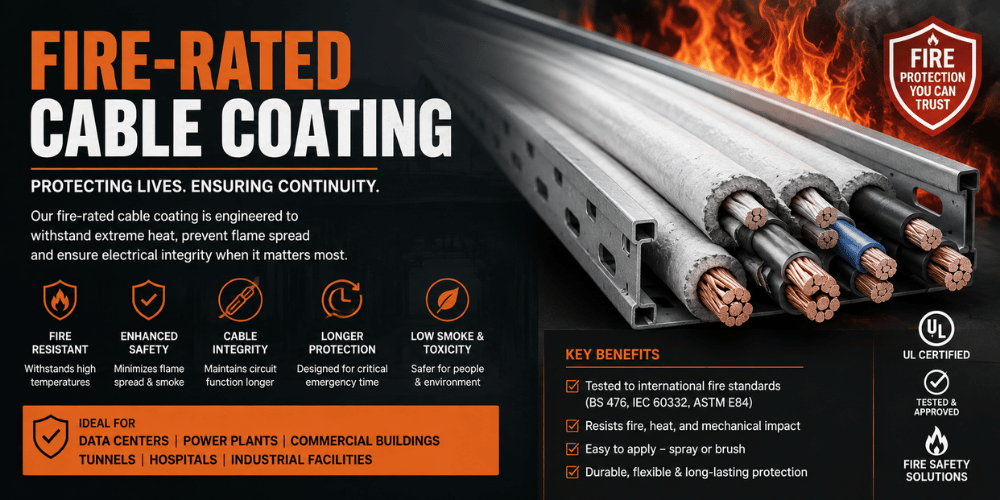
Fire protection for electrical infrastructure is an important consideration in industrial plants, commercial buildings, power facilities, data centers, refineries, transportation infrastructure, and other critical environments. Electrical cables often pass through multiple areas of a facility and may carry power, control signals, instrumentation, communication, and emergency circuits. A properly selected fire-rated cable coating can be part of a passive fire protection strategy designed to help reduce the impact of fire on cable systems when the coating is tested and approved for the intended application. Gopalfiresafety provides industrial and commercial fire safety products and solutions, and businesses can explore its offerings through Gopalfiresafety. Gopalfiresafety also shares fire safety information, product updates, and industry insights on Instagram.
A fire-rated cable coating is generally an applied protective material designed to improve the fire performance of cables or cable-support systems under specified conditions. Depending on the product and its testing, a coating may help limit flame propagation, reduce heat transfer, protect cable insulation, or contribute to maintaining circuit functionality for a defined period. However, not every coating provides the same level of protection. The actual performance depends on the coating formulation, substrate, application thickness, tested configuration, fire exposure, installation method, and applicable certification or test standard.
What Is a Fire-Rated Cable Coating?
A fire-rated cable coating is a protective coating applied to electrical cables or related cable infrastructure to provide a defined level of fire protection.
These coatings can be used in situations where cables require additional passive protection against fire exposure.
Depending on the product, a coating may be designed to:
- Limit flame spread
- Reduce heat transfer
- Protect cable insulation
- Form an insulating layer during fire exposure
- Delay temperature rise
- Support circuit integrity requirements
- Protect cable-support systems
- Reduce the potential for fire propagation
The exact function depends on the product’s formulation and tested performance.
A coating should therefore never be described simply as “fireproof” without identifying the relevant test data and application requirements.
Why Cable Fire Protection Matters
Electrical cables can represent a significant concentration of combustible polymeric materials in industrial installations.
Large cable systems can include:
- Power cables
- Control cables
- Instrumentation cables
- Communication cables
- Data cables
- Fire alarm cables
- Emergency circuits
- Automation cables
If a fire reaches a cable route, flame propagation and heat exposure can potentially affect nearby cables and equipment.
This is why cable fire protection can be an important part of an overall passive fire protection strategy.
A complete approach may include:
- Fire-resistant cables
- Cable coatings
- Cable wraps
- Firestop systems
- Fire barriers
- Compartmentation
- Detection systems
- Suppression systems
- Proper cable routing
How Fire-Rated Cable Coatings Work
Many passive fire protection coatings use technologies that react when exposed to elevated temperatures.
One common technology is intumescence.
An intumescent coating can expand when exposed to sufficient heat and form a carbonaceous insulating char.
This char can help reduce the rate at which heat reaches the protected substrate.
Depending on the product design, the coating may provide protection through:
- Expansion
- Char formation
- Thermal insulation
- Heat absorption
- Flame resistance
The actual performance must be determined from product testing rather than assumed from the coating type alone.
Intumescent Cable Coating
Intumescent coatings are widely associated with passive fire protection.
When exposed to high temperatures, an intumescent material can undergo a chemical reaction that causes it to expand.
The resulting char layer can be significantly thicker than the original dry film.
This layer can act as a thermal barrier between the fire and the protected cable or substrate.
The effectiveness of an intumescent coating depends on factors such as:
- Coating chemistry
- Dry film thickness
- Application quality
- Substrate
- Fire exposure
- Heating rate
- Duration of exposure
- Cable construction
- Tested configuration
For this reason, installation must follow the manufacturer’s technical requirements.
Fire-Rated Does Not Mean Completely Fireproof
One of the most important concepts when selecting a fire-rated cable coating is the difference between fire-rated protection and absolute fireproofing.
A fire-rated product is generally tested against defined conditions.
The test may specify:
- Fire temperature
- Exposure duration
- Cable type
- Cable arrangement
- Coating thickness
- Substrate
- Installation configuration
A product that achieves a particular result under those conditions should not automatically be assumed to provide unlimited protection under every fire scenario.
Professional fire protection decisions should therefore be based on documented testing.
Cable Coating vs Fire-Resistant Cable
A cable coating and a fire-resistant cable are different products.
A fire-resistant cable is manufactured with materials and construction designed to achieve specific fire performance.
A coating is applied to an existing cable or cable system.
A project may use either approach or combine several protection measures.
For example, a critical cable system may include:
- Fire-resistant cable
- Protective coating
- Firestop penetration system
- Cable tray protection
- Fire barrier
The correct combination depends on the fire engineering design.
Common Applications
A fire-rated cable coating can be considered for various industrial and commercial applications.
Power Plants
Power plants contain large networks of electrical and control cables.
Cable systems can support:
- Turbines
- Generators
- Transformers
- Switchgear
- Control rooms
- Instrumentation
- Monitoring
- Emergency systems
Protecting critical cable routes can help support the continuity and resilience of important systems.
Oil and Gas Facilities
Refineries, petrochemical plants, LNG facilities, offshore platforms, and gas processing plants contain significant electrical infrastructure.
Cables may be installed near:
- Process equipment
- Pumps
- Compressors
- Control systems
- Emergency shutdown systems
- Instrumentation
- Fire detection equipment
Fire protection requirements can be particularly demanding in these environments.
Manufacturing Facilities
Modern manufacturing plants use cable systems for:
- Automation
- Robotics
- Motors
- Sensors
- PLC systems
- Instrumentation
- Communication
- Production controls
Cable coatings may be considered where additional passive fire protection is required and the coating is suitable for the cable and installation environment.
Data Centers
Data centers rely heavily on electrical and communication infrastructure.
Cable systems can include:
- Power distribution
- UPS systems
- Network cables
- Server connections
- Cooling controls
- Security
- Monitoring systems
Fire protection planning must consider the importance of maintaining critical services and preventing fire spread through cable routes.
Hospitals
Hospitals depend on electrical infrastructure for:
- Medical equipment
- Emergency lighting
- Fire alarms
- Communication
- Security
- Building automation
- Critical power
Where cable routes support critical services, the appropriate fire protection requirements should be identified during design.
Commercial Buildings
Offices, hotels, shopping centers, universities, and other commercial buildings contain extensive electrical and communication cabling.
Fire protection may be required for:
- Emergency circuits
- Fire alarm systems
- Security systems
- Data systems
- Building management
- Emergency lighting
Cable Tray Applications
Cable trays provide organized support for large groups of cables.
A fire-rated cable coating may be applied to cables installed in trays when the product is specifically tested for that application.
Cable tray protection may address:
- Flame propagation
- Heat exposure
- Cable integrity
- Fire spread
- Structural protection
The coating should be selected based on the cable type and tested configuration.
A coating tested on one cable arrangement should not automatically be assumed to provide the same performance on a different arrangement.
Factors Affecting Coating Performance
Several factors can influence the performance of a cable coating.
Coating Thickness
The specified dry film thickness can be critical.
Too little coating may not provide the intended protection.
Excessive coating can also create application problems.
Surface Preparation
The cable surface should be prepared according to the manufacturer’s instructions.
Surface contamination can affect adhesion.
Application Method
Depending on the product, application may involve:
- Brush
- Roller
- Spray
- Specialized equipment
The selected method should be compatible with the coating system.
Curing
The coating may require specific:
- Temperature
- Humidity
- Drying time
- Ventilation
- Recoat interval
Failure to follow curing requirements can affect performance.
Environmental Conditions
Before selecting a fire-rated cable coating, the installation environment should be evaluated.
Important conditions include:
- Temperature
- Humidity
- Water
- Chemicals
- Oil
- UV exposure
- Salt
- Dust
- Mechanical vibration
A coating designed for an indoor dry environment may not be suitable for an outdoor industrial installation.
Chemical Exposure
Industrial facilities can expose cable coatings to:
- Solvents
- Oils
- Fuels
- Acids
- Alkalis
- Cleaning chemicals
Compatibility should be confirmed before application.
Outdoor Cable Applications
Outdoor cables may be exposed to:
- Sunlight
- Rain
- Temperature cycling
- Moisture
- Wind
- Dust
The coating system should have documented suitability for outdoor exposure if required.
Cable Compatibility
Not every coating is compatible with every cable jacket.
The cable may contain:
- PVC
- XLPE
- PE
- LSZH materials
- Rubber
- Other polymeric compounds
The coating manufacturer should provide compatibility information or testing for the intended cable construction.
Certification and Testing
Certification is one of the most important considerations when purchasing a fire-rated cable coating.
A buyer should ask:
- What standard was used?
- What cable was tested?
- What coating thickness was used?
- What fire exposure was applied?
- How long was the test?
- Was the cable energized?
- Was circuit integrity evaluated?
- Was the coating tested on the actual substrate?
- What installation arrangement was tested?
These questions help prevent inappropriate product selection.
Understanding Fire Test Standards
Different standards address different fire characteristics.
Depending on the project, requirements may relate to:
- Flame propagation
- Flame spread
- Smoke generation
- Fire resistance
- Circuit integrity
- Heat release
- Penetration protection
A coating should only be claimed to meet a particular standard when supporting documentation exists for that product and application.
Cable Fire Protection and IEC Standards
IEC standards include several test methods relevant to cable fire performance.
For example, the IEC 60332 series covers tests on electric and optical-fibre cables under fire conditions.
IEC 60332-1-2 addresses vertical flame propagation testing of a single insulated conductor or cable under defined conditions.
For grouped cables, the IEC 60332-3 series addresses vertical flame spread of bunched cables.
These standards test cable behavior rather than automatically certifying every coating applied to those cables.
UL Cable Fire Testing
UL also has cable fire testing standards and services.
UL 1685 is associated with vertical-tray fire-propagation and smoke-release testing for electrical and optical-fiber cables.
When selecting a coating for a cable tray application, engineers should determine whether the coating itself has been tested as part of the required system.
The cable, tray, and coating should not be assumed to have identical certification status.
Fire-Rated Cable Coating for Critical Circuits
Some cable circuits are more important than others.
Critical circuits can include:
- Fire pumps
- Emergency lighting
- Fire alarms
- Emergency shutdown systems
- Smoke control
- Security
- Emergency communication
- Critical power
Where continued operation during fire exposure is required, the project should specify an appropriate tested system.
A coating alone may not satisfy the requirement unless it has been tested for that specific performance.
Passive Fire Protection Strategy
Cable coatings form only one possible component of passive fire protection.
A complete strategy may include:
- Fire-resistant cable selection
- Cable routing
- Cable separation
- Fire-rated barriers
- Penetration protection
- Cable coatings
- Firestop systems
- Fire detection
- Suppression
The objective is to limit fire spread and protect critical infrastructure according to the facility’s fire safety design.
Cable Penetrations
Cables often pass through:
- Walls
- Floors
- Fire compartments
- Equipment rooms
- Electrical rooms
When cables penetrate a fire-rated barrier, an appropriately tested firestop system may be required.
A cable coating does not automatically replace a firestop system.
Penetration protection should be selected according to the tested assembly and required fire rating.
Choosing the Right Coating
Before purchasing a fire-rated cable coating, consider the following checklist:
- Cable type
- Cable jacket material
- Cable diameter
- Cable arrangement
- Tray type
- Indoor or outdoor installation
- Required fire performance
- Coating thickness
- Application method
- Drying conditions
- Certification
- Test report
- Environmental compatibility
- Maintenance requirements
Why Choose Gopalfiresafety?
Gopalfiresafety provides fire safety products and solutions for industrial and commercial applications.
Businesses can visit Gopalfiresafety to explore fire protection solutions and related products.
Gopalfiresafety focuses on areas including:
- Cable fire protection
- Passive fire protection
- Electrical fire safety
- Industrial fire safety
- Fire protection equipment
- Industrial safety solutions
When selecting a fire-rated cable coating, customers should verify the exact technical specifications, certification, test reports, and intended application before procurement.
Frequently Asked Questions
What is a fire-rated cable coating?
A fire-rated cable coating is a protective material applied to cables or related cable systems to provide defined fire performance under specified conditions.
How does an intumescent cable coating work?
An intumescent coating expands when exposed to elevated temperatures and can form an insulating char layer that helps reduce heat transfer to the protected substrate.
Is a fire-rated cable coating completely fireproof?
No. Fire-rated coatings are tested under defined conditions. Their performance should not be interpreted as unlimited protection against every possible fire scenario.
Can cable coatings be used on cable trays?
Some coatings are specifically designed and tested for cable tray or cable applications. The manufacturer’s technical documentation should confirm suitability.
Can a coating replace a fire-resistant cable?
Not automatically. A coating and a fire-resistant cable are different protection approaches. The project requirements determine whether one or both are necessary.
A fire-rated cable coating can be an effective component of a passive fire protection strategy when the product is correctly selected, properly applied, and supported by appropriate testing. The coating should be evaluated according to its specific fire-performance claims, tested configuration, cable compatibility, application thickness, environmental conditions, and installation requirements.
For critical industrial installations, cable fire protection should be approached as a complete system rather than relying on a single product. Fire-resistant cables, coatings, cable wraps, firestop systems, barriers, detection, suppression, and appropriate cable routing can all contribute to a broader fire safety strategy.
Businesses looking for industrial and commercial fire safety solutions can visit Gopalfiresafety and follow Gopalfiresafety on Instagram for fire safety information, product updates, and industry insights.