FM Approved Fire Resistant Cable – Complete Guide to Passive Fire Protection for Critical Electrical Systems
Fire safety is a critical requirement for modern industrial and commercial facilities where electrical systems support essential operations. Power plants, oil and gas facilities, manufacturing units, data centers, hospitals, transportation infrastructure, commercial buildings, and process industries all depend on electrical cables for power distribution, communication, automation, emergency systems, and control equipment. Choosing a reliable FM approved fire resistant cable solution can form an important part of a broader passive fire protection strategy. At Gopalfiresafety, businesses can explore fire protection products and industrial safety solutions through Gopalfiresafety. Gopalfiresafety provides fire safety solutions for industrial and commercial applications and also shares product information, fire safety guidance, and industry updates through Instagram.
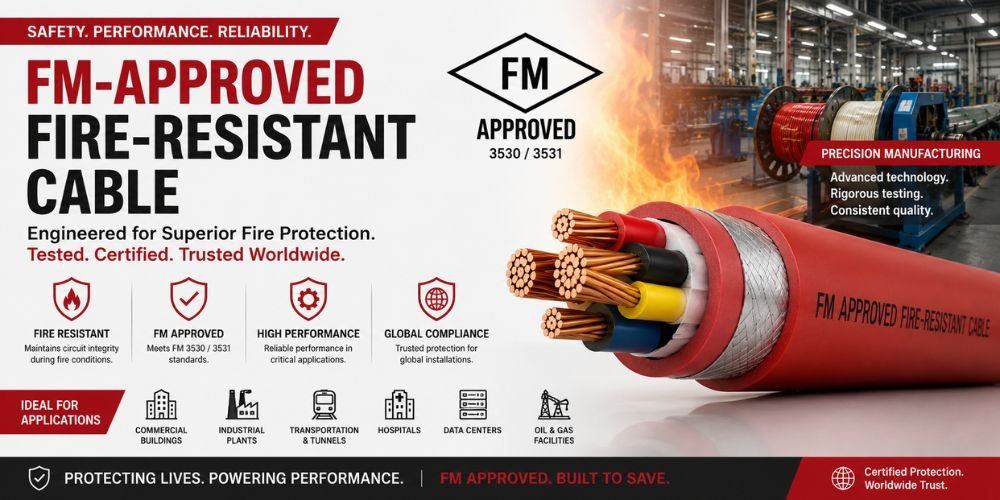
FM approved fire resistant cable is a cable product that has been evaluated and approved under applicable FM requirements for defined applications and performance characteristics. It can be specified for critical electrical infrastructure in industries such as power generation, oil and gas, manufacturing, data centers, transportation, and commercial facilities. FM Approval should always be verified for the exact manufacturer and product because approval applies to specific products and defined requirements. Buyers should review the FM Approval Guide, technical documentation, installation requirements, cable construction, environmental conditions, and project specifications before selecting a product. Gopalfiresafety provides industrial and commercial fire safety solutions, including cable fire protection products.
A small terminology point is important: you wrote FFM approved fire resistant cable. The recognized certification terminology is generally FM Approved, referring to FM Approvals. FM states that products carrying the FM APPROVED mark have completed its certification process for defined requirements, and FM Approved products are listed through its Approval Guide. Therefore, this article uses the SEO keyword FM approved fire resistant cable.
What Is an FM Approved Fire Resistant Cable?
An FM approved fire resistant cable is a cable that has been evaluated and approved for specific requirements and applications under the applicable FM Approval process. The exact scope of an approval matters because certification is not a blanket statement that a cable will perform identically in every environment or fire scenario.
FM Approvals explains that its certification can apply to an entire product or system, or to a particular performance characteristic. This makes it important for engineers, consultants, contractors, and purchasing teams to verify the exact product listing and approval details before specifying a cable.
Fire-resistant cable systems may be selected for applications where electrical continuity, fire performance, flame propagation characteristics, or protection of critical infrastructure are important.
Typical cable applications include:
- Power distribution
- Control systems
- Instrumentation
- Emergency systems
- Communication networks
- Fire alarm infrastructure
- Industrial automation
- Critical process equipment
- Building management systems
The exact fire performance of a cable depends on its construction, materials, testing, installation method, environmental exposure, and the requirements covered by its certification.
Why FM Approval Matters for Fire Resistant Cable Systems
For industrial projects, certification can provide an additional layer of confidence when evaluating safety products.
FM Approvals operates a third-party testing and certification program focused on property loss prevention. FM explains that its testing evaluates products and systems to verify intended performance when properly installed and maintained.
For buyers, this means an FM approved fire resistant cable should not be selected merely because the product description contains the words “FM Approved.” The project team should confirm the actual listing, manufacturer, product designation, approval scope, and installation requirements.
This approach is particularly important for large projects where cable systems may be installed throughout:
- Power generation facilities
- Petrochemical plants
- Refineries
- Manufacturing facilities
- Data centers
- Infrastructure projects
- Transportation systems
- Commercial complexes
Understanding Fire Resistant Cable Technology
Fire-resistant cables are designed with construction and materials intended to maintain specified performance when exposed to elevated temperatures or fire conditions.
Depending on the cable design, fire performance may involve characteristics such as:
- Resistance to heat
- Reduced flame propagation
- Circuit integrity
- Insulation performance
- Mechanical stability
- Protection of conductors
- Controlled smoke and flame behavior
The exact characteristics must be confirmed from the manufacturer’s technical documentation.
An FM approved fire resistant cable should therefore be evaluated as a complete product rather than simply judging it by the outer jacket or insulation material.
Cable construction can involve multiple layers, including:
- Conductor
- Primary insulation
- Individual conductor protection
- Shielding or screening
- Fillers
- Inner sheath
- Armour where applicable
- Outer sheath
The combination of these components influences the cable’s performance.
Applications of FM Approved Fire Resistant Cable
The demand for certified fire protection solutions is particularly strong in facilities where electrical systems are considered critical to safety or operational continuity.
Power Plants
Power generation facilities contain extensive electrical networks connecting generators, turbines, transformers, switchgear, control rooms, monitoring systems, and emergency equipment.
An FM approved fire resistant cable may be considered for appropriate applications where the project specification requires FM-approved cable protection.
Power plant cable systems may support:
- Generator controls
- Turbine monitoring
- Emergency shutdown systems
- Control panels
- Switchgear
- Instrumentation
- Communication systems
Cable selection should always follow the facility’s engineering specifications and applicable fire protection requirements.
Oil and Gas Facilities
Oil and gas environments can contain significant fire hazards, making electrical infrastructure protection an important consideration.
Facilities may include:
- Refineries
- Petrochemical plants
- Offshore platforms
- LNG facilities
- Gas processing plants
- Fuel terminals
- Storage facilities
In these environments, fire protection is normally addressed through multiple layers, including equipment design, detection, suppression, passive fire protection, electrical protection, and emergency response planning.
An FM approved fire resistant cable can be considered where the project specification and applicable approval requirements call for an FM-approved cable solution.
Manufacturing Plants
Modern manufacturing facilities depend on electrical systems for automation, robotics, process control, machinery, production lines, communication, and monitoring.
A failure in critical electrical infrastructure can cause:
- Production downtime
- Equipment damage
- Loss of process control
- Communication interruption
- Safety system disruption
Selecting suitable fire-resistant cable systems can therefore support broader business continuity and fire safety objectives.
Data Centers
Data centers contain extensive power and communication cable infrastructure.
Critical systems include:
- Server power
- Backup power
- Network infrastructure
- Cooling equipment
- Fire detection
- Security systems
- Building management
- Emergency systems
Cable selection is an important component of data center infrastructure planning. Depending on the project requirements, an FM approved fire resistant cable may be specified for suitable applications.
Hospitals
Hospitals depend on electrical infrastructure for life-support systems, medical equipment, emergency lighting, communication systems, fire alarms, security, and building services.
Because some systems are critical during emergencies, fire protection planning must consider both electrical infrastructure and the continuity requirements of essential services.
Transportation Infrastructure
Airports, metro systems, railway stations, tunnels, ports, and other transportation facilities contain extensive electrical cable networks.
These cables may support:
- Signaling
- Lighting
- Communications
- Security
- Control systems
- Emergency systems
- Passenger information systems
Fire-resistant cable selection can therefore be an important component of infrastructure safety planning.
Benefits of FM Approved Fire Resistant Cable
Choosing a properly evaluated FM approved fire resistant cable can offer several potential advantages when the product is suitable for the application.
Third-Party Evaluation
FM Approval provides independent evaluation against defined requirements. FM describes its certification process as a global program backed by scientific research, data, testing, and technical expertise.
Support for Fire Safety Planning
Certified products can help engineers incorporate recognized fire protection components into larger facility fire safety strategies.
Protection of Critical Systems
Fire-resistant cable systems may help protect electrical and control infrastructure that is important to facility operation or emergency response.
Specification Confidence
For consultants and project engineers, documented approval information can simplify product evaluation and procurement.
International Recognition
FM Approved products are used in global markets, and FM states that its certification is recognized by leading regulatory authorities.
FM Approved Does Not Mean Fireproof in Every Situation
One of the most important points for buyers is understanding what certification actually means.
The term FM approved fire resistant cable should not be interpreted as meaning that a cable is completely immune to fire or that it will maintain every electrical function indefinitely under every fire condition.
FM Approval relates to specific testing and certification requirements.
Actual performance can depend on:
- Cable construction
- Installation method
- Cable arrangement
- Temperature
- Fire exposure
- Mechanical conditions
- Environmental exposure
- Product maintenance
- Applicable approval scope
For this reason, project teams should always consult the manufacturer’s technical documentation and the relevant FM Approval listing.
How to Select the Right Fire Resistant Cable
Selecting an FM approved fire resistant cable requires more than checking the certification mark.
Verify the Manufacturer
Confirm that the cable manufacturer and product are identified in the relevant approval documentation.
Check the Approval Scope
Review exactly what the FM Approval covers.
Review Technical Data
Important information may include:
- Conductor size
- Voltage rating
- Temperature rating
- Insulation material
- Sheath material
- Fire performance
- Installation requirements
- Environmental limitations
Confirm Application Compatibility
A cable approved for one application should not automatically be assumed suitable for another application.
Review Project Specifications
Consultants and engineering teams may specify additional requirements relating to fire resistance, circuit integrity, smoke, flame spread, environmental conditions, or installation.
Consider Environmental Conditions
Cable systems may be exposed to:
- Moisture
- Chemicals
- UV radiation
- High temperatures
- Mechanical impact
- Outdoor weather
- Industrial contaminants
The selected cable must be suitable for the actual installation environment.
Role of Cable Fire Protection in Industrial Safety
Fire protection should never depend on a single product.
A comprehensive industrial fire safety strategy can include:
- Fire detection
- Fire alarms
- Automatic suppression
- Passive fire protection
- Electrical protection
- Emergency response procedures
- Equipment maintenance
- Inspection programs
- Employee training
An FM approved fire resistant cable can form one component of this broader system where its approval and characteristics match the project requirements.
Cable Trays and Fire Protection
Cable trays frequently contain groups of power, control, and communication cables.
Because grouped cables can create significant combustible loading, cable tray protection should be evaluated carefully.
FM’s property loss prevention guidance for cables and bus bars states that, in certain circumstances, protection can include an FM Approved cable coating or wrap applied in accordance with the Approval Guide and manufacturer’s instructions.
This demonstrates an important distinction: fire-resistant cables and cable fire protection coatings are related but different solutions. The correct approach depends on the facility design, cable construction, project requirements, and applicable FM guidance.
Installation Considerations
Correct installation is essential for achieving the intended performance of any fire-resistant cable.
Before installation, project teams should verify:
- Cable identification
- Approval documentation
- Cable size
- Voltage rating
- Installation route
- Bend radius
- Support spacing
- Environmental conditions
- Termination requirements
Installers should follow the manufacturer’s instructions and project specifications.
Improper installation can affect cable performance even when the product itself has been appropriately tested.
Inspection and Maintenance
Fire protection does not end after installation.
Critical cable systems should be included in an appropriate inspection, testing, and maintenance program.
FM’s guidance for cables and bus bars recommends an inspection, testing, and maintenance program for cables that are key to continuity of operations. It also states that such programs should be reviewed when electrical systems are modified or when events require updates.
Maintenance activities can include:
- Visual inspections
- Checking cable condition
- Inspecting terminations
- Identifying mechanical damage
- Reviewing cable modifications
- Monitoring insulation condition
- Repairing compromised systems
- Maintaining documentation
A planned maintenance program helps organizations identify problems before they become major operational or safety issues.
Common Mistakes When Buying Fire Resistant Cables
Organizations can make several mistakes when selecting fire-resistant cable products.
Focusing Only on the Certification Label
The certification must be verified against the actual product and intended application.
Ignoring Installation Conditions
Environmental exposure can significantly affect cable selection.
Assuming All Fire Resistant Cables Are Equivalent
Different cables have different constructions, ratings, and performance characteristics.
Failing to Review Project Specifications
Engineering specifications may include requirements beyond basic cable fire performance.
Neglecting Maintenance
Even a high-quality cable installation requires inspection and maintenance.
Avoiding these mistakes can make procurement and installation more reliable.
Why Choose Gopalfiresafety?
Gopalfiresafety provides fire safety products and solutions for industrial and commercial applications.
Businesses can visit Gopalfiresafety to explore fire protection solutions and connect with the company for product information.
Gopalfiresafety focuses on:
- Industrial fire safety
- Passive fire protection
- Cable fire protection
- Fire protection equipment
- Fire safety solutions
- Technical product guidance
For projects involving certified products, buyers should verify the exact certification, approval scope, technical documentation, and suitability of the selected product before procurement.
An FM approved fire resistant cable can be an important component of electrical fire safety planning when its certification, construction, and application are appropriate for the project. FM Approval provides third-party evaluation for defined requirements, but the approval should always be checked against the exact product and intended use. FM’s own guidance also recognizes FM Approved cable coatings and wraps as possible passive protection measures for grouped cables in specified circumstances.
For industrial and commercial fire protection solutions, visit Gopalfiresafety and follow Gopalfiresafety on Instagram for fire safety updates, product information, and industry insights.
Part 2 will cover international applications, cable selection for different industries, certification verification, installation best practices, maintenance, procurement guidance, FAQs, and the final conclusion.
FM Approved Fire Resistant Cable – Industrial Applications, Certification Verification, Installation, Maintenance and Procurement Guide
Electrical cable systems are among the most important components of modern industrial infrastructure. They carry power and control signals throughout facilities and support equipment that may be essential for production, emergency response, communication, automation, and business continuity. For facilities with significant cable concentrations, selecting an FM approved fire resistant cable can be an important part of a broader fire protection strategy when the specific product approval and project requirements are aligned.
FM Approvals operates a third-party testing and certification program for loss-prevention products and services. FM states that products successfully completing its certification process can carry the FM APPROVED mark, and approved products are listed in its Approval Guide.
For industrial buyers, contractors, consultants, and EPC companies, this makes certification verification an important part of cable procurement. Businesses can explore fire safety products and solutions through Gopalfiresafety. Gopalfiresafety also shares fire safety information, product updates, and industry content through Instagram.
FM Approved Fire Resistant Cable for Industrial Facilities
Industrial facilities can contain large quantities of power and control cables routed through trays, conduits, electrical rooms, process areas, and equipment zones.
A suitable FM approved fire resistant cable may be considered for applications where project specifications call for FM-approved cable products or where specific fire protection requirements apply.
Typical industrial applications include:
- Power generation
- Oil and gas
- Petrochemical processing
- Manufacturing
- Data centers
- Transportation
- Mining
- Commercial infrastructure
- Critical utility facilities
The exact suitability of a cable depends on its approval scope, construction, installation conditions, and project requirements.
Power Generation Applications
Power plants depend on extensive electrical and control cable networks.
These systems can connect:
- Generators
- Turbines
- Transformers
- Switchgear
- Control systems
- Monitoring equipment
- Emergency systems
Cable fire protection planning is particularly important where a fire could affect multiple cables simultaneously.
FM’s cable guidance addresses protection of concentrations of power cabling and control wiring and identifies FM Approved cables, FM Approved cable wraps, and FM Approved cable coatings as possible passive protection approaches in specified circumstances.
This demonstrates why engineers should evaluate the entire cable installation rather than looking at cable certification alone.
Oil and Gas Applications
Oil refineries, petrochemical plants, LNG facilities, offshore platforms, and gas processing facilities often contain extensive electrical infrastructure.
Cable systems can support:
- Process control
- Emergency shutdown
- Instrumentation
- Communications
- Fire detection
- Power distribution
- Monitoring systems
An FM approved fire resistant cable may be appropriate where specified by the project, but its approval must be checked against the actual application.
In facilities with high concentrations of combustible cable, fire protection planning may involve a combination of detection, suppression, passive protection, cable arrangement, housekeeping, and electrical protection.
Manufacturing Facilities
Manufacturing plants depend on electrical cables for automation, robotics, machinery, production controls, and communications.
A fire affecting cable infrastructure can potentially interrupt production and damage equipment.
Using appropriately selected fire-resistant cable systems can support:
- Production continuity
- Process control
- Emergency systems
- Automation reliability
- Electrical safety
However, cable selection should be based on the complete project specification rather than certification terminology alone.
Data Centers
Data centers depend on large quantities of power and communication cables.
Important systems may include:
- Server power
- Backup generators
- UPS systems
- Network infrastructure
- Cooling systems
- Fire detection
- Security systems
Where FM-approved products are specified, project teams should verify the product listing and application requirements before procurement.
An FM approved fire resistant cable may be part of a wider data center fire protection strategy that also includes detection, suppression, compartmentation, electrical protection, and maintenance.
How to Verify FM Approval
One of the most important steps when purchasing an FM approved fire resistant cable is verifying the certification rather than relying on marketing statements.
FM states that FM Approved products are listed in its Approval Guide.
Before purchasing, buyers should check:
1. Manufacturer Name
Confirm that the manufacturer appearing on the product documentation matches the approved product information.
2. Product Identification
Verify the exact model, product designation, or cable construction.
3. Approval Scope
Check what the approval actually covers.
4. Applicable Rating
Review any ratings or classifications associated with the approved product.
5. Installation Requirements
Confirm that the proposed installation follows the manufacturer’s instructions and the approval conditions.
6. Current Documentation
Use current technical documentation and verify the status of the product before specifying it for a new project.
This process helps prevent a common procurement mistake: assuming that every product from a manufacturer is automatically covered by the manufacturer’s FM approval.
FM Approved Cable Versus FM Approved Cable Coating
These two solutions should not be confused.
An FM approved fire resistant cable is a cable product that has been evaluated for applicable FM requirements.
An FM Approved cable coating is a separate passive fire protection product applied to cables or cable trays.
FM’s current cable guidance specifically identifies an FM Approved cable coating under FM 3971 as one possible passive protection measure for grouped electrical cables in defined circumstances.
Therefore, project engineers should determine whether the project requires:
- FM Approved cable
- FM Approved cable coating
- FM Approved cable wrap
- Another passive fire protection method
- A combination of protection measures
The correct solution depends on the facility design and applicable requirements.
Cable Tray Protection
Cable trays can contain significant concentrations of combustible cable materials.
FM’s guidance notes that cable trays should be kept free of foreign materials that can accumulate and contribute to overheating or fire propagation.
This makes housekeeping an important part of cable fire protection.
Good cable tray management includes:
- Keeping trays clean
- Avoiding unnecessary combustible materials
- Maintaining suitable cable spacing
- Inspecting cable condition
- Checking connections
- Controlling overheating risks
- Maintaining proper support systems
An FM approved fire resistant cable should therefore be considered as part of a complete cable management and fire protection strategy.
Environmental Conditions to Consider
Cable performance depends on the installation environment.
Before selecting an FM approved fire resistant cable, engineers should evaluate:
- Operating temperature
- Ambient temperature
- Humidity
- Moisture
- UV exposure
- Chemicals
- Oils
- Mechanical impact
- Vibration
- Corrosive atmospheres
- Indoor or outdoor installation
FM’s cable guidance also emphasizes operating cables within their designed specifications and ratings, including voltage, temperature, UV, weather resistance, and other applicable exposures.
Installation Best Practices
Correct installation is essential to achieving the intended performance of any cable system.
Before installation, verify:
- Cable specifications
- Approval documentation
- Cable route
- Support arrangement
- Bend radius
- Termination requirements
- Environmental conditions
- Separation requirements
Installers should follow the manufacturer’s installation instructions and the project engineer’s specifications.
Avoid making modifications that could change the tested or approved configuration without appropriate engineering review.
Inspection and Maintenance
Installing an FM approved fire resistant cable is not the final step in a fire protection program.
FM guidance recommends an inspection, testing, and maintenance program for cables and bus bars that are important to continuity of operations. It also recommends monitoring insulation systems and reviewing the program when electrical systems are modified or circumstances require an update.
A practical maintenance program can include:
- Visual inspections
- Cable condition checks
- Insulation monitoring
- Connection inspections
- Identification of damaged cables
- Review of modifications
- Repair or replacement planning
- Maintenance documentation
FM’s guidance also recommends infrared surveys of cable splices and connections at intervals of 1 to 3 years in the circumstances covered by its data sheet.
Common Procurement Mistakes
Assuming “FM” in a Product Name Means Approved
A product name containing “FM” does not by itself establish FM Approval.
Not Checking the Approval Guide
FM identifies the Approval Guide as the resource for FM Approved products.
Ignoring the Approval Scope
A certification may apply to particular products, systems, or performance characteristics.
Selecting Based Only on Price
For critical infrastructure, technical compliance and application suitability should be evaluated alongside cost.
Ignoring Installation Requirements
Even a certified product needs to be installed according to its applicable requirements.
Failing to Maintain the System
Fire protection performance can be compromised by damaged cables, poor housekeeping, overheating, or unaddressed modifications.
Why Gopalfiresafety?
Gopalfiresafety provides fire safety products and solutions for industrial and commercial applications.
Businesses can visit Gopalfiresafety to explore fire protection solutions and obtain product information.
The company focuses on solutions related to:
- Industrial fire safety
- Passive fire protection
- Cable fire protection
- Fire protection equipment
- Fire safety systems
- Industrial safety solutions
For projects requiring FM Approval, customers should verify the exact product certification and approval scope before procurement.
Frequently Asked Questions
What is an FM approved fire resistant cable?
An FM approved fire resistant cable is a cable that has been evaluated and approved under applicable FM requirements for a defined product and application. The exact approval scope should always be verified before specification.
Is FM Approved the same as fireproof?
No. FM Approval indicates that a product has successfully completed the applicable FM certification process for defined requirements. It does not mean the product is immune to every fire condition.
Are FM Approved cables and FM Approved cable coatings the same?
No. They are different products. FM’s cable guidance identifies FM Approved cables as well as FM Approved wraps and coatings as possible protection approaches in specific circumstances.
Where are FM Approved fire resistant cables used?
They may be specified for industrial and commercial facilities such as power plants, oil and gas facilities, manufacturing plants, data centers, transportation infrastructure, and other critical installations, depending on project requirements.
How do I verify an FM Approved cable?
Check the manufacturer’s documentation and verify the exact product in the FM Approval Guide. FM states that FM Approved products are listed in the Approval Guide.
Does cable maintenance matter after installation?
Yes. FM guidance recommends inspection, testing, and maintenance programs for cables that are important to continuity of operations.
Selecting an FM approved fire resistant cable should be based on verified certification, technical suitability, installation conditions, and project requirements rather than the certification name alone. FM Approvals provides third-party testing and certification for products that meet defined requirements, while FM’s cable guidance addresses several approaches to protecting grouped electrical cables, including approved cables, wraps, and coatings.
For industrial and commercial fire safety products, visit Gopalfiresafety and connect with Gopalfiresafety on Instagram for product updates, fire safety information, and industry insights.
SEO note: Your original keyword contains “FFM.” The technically correct term is FM Approved fire resistant cable, so I recommend using FM approved fire resistant cable as the primary SEO keyword rather than “FFM approved.”