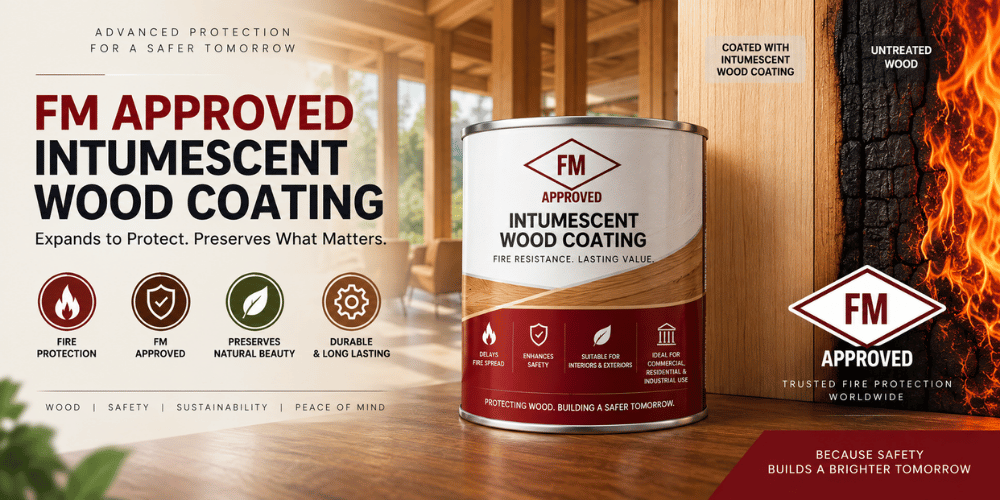
FM Approved Intumescent Wood Coating: Complete Guide to Timber Fire Protection
An FM Approved intumescent wood coating should only be described as FM Approved when the exact product and intended wood application are covered by current FM Approvals documentation. Intumescent coatings can expand under heat and form a protective char that helps reduce heat transfer to the underlying timber, but performance depends on the formulation, wood substrate, coating thickness, surface preparation, environmental conditions, and tested application. FM Approval should not be inferred from a generic fire-retardant claim, an ASTM E84 or UL 723 test result, or an FM reference unrelated to the exact product. Buyers should verify product identification, approval scope, substrate, installation requirements, and maintenance instructions before specifying a coating.
Introduction
When wood is used in commercial buildings, hotels, restaurants, offices, retail interiors, architectural projects, and other occupied spaces, fire performance becomes an important part of material selection. Gopalfiresafety provides fire-safety products and information for different applications, and its website, gopalfiresafety.com, includes resources covering wood fire protection, fire-retardant coatings, fire-resistant wood finishes, and related passive fire protection topics. Gopalfiresafety also shares fire-safety information and product updates through Instagram.
An FM Approved intumescent wood coating is a phrase that may be used by people searching for certified fire-protection products, but certification terminology needs to be handled carefully. FM Approval is not simply a synonym for “fire resistant,” “fire retardant,” or “intumescent.” An FM Approval relates to a specific product and defined application or performance scope.
For that reason, anyone researching an FM Approved intumescent wood coating should look beyond the product name and investigate the underlying technical documentation. The substrate, coating thickness, application procedure, environmental exposure, test configuration, and approval scope can all influence whether a particular product is appropriate for a project.
Intumescent technology itself is widely used in passive fire protection. When exposed to sufficiently high heat, an intumescent coating can react and form an expanded protective char. This char can act as an insulating barrier and help slow heat transfer to the substrate. UL Solutions similarly explains that intumescent coatings can form protective systems under fire exposure and that certified systems have defined application and environmental requirements.
What Is an Intumescent Wood Coating?
An intumescent wood coating is a specialized surface coating designed to alter the fire behavior of a wood substrate when exposed to elevated temperatures.
Unlike ordinary decorative paint or conventional wood varnish, an intumescent coating is formulated to undergo a physical and chemical reaction when heated.
The general process can be described as:
Heat exposure → coating activation → expansion → protective char formation → reduced heat transfer
The resulting char layer can provide insulation between the fire and the underlying timber.
Depending on the formulation and tested application, an intumescent system may help:
- Delay heat reaching the wood
- Reduce direct flame exposure
- Slow surface degradation
- Limit flame propagation
- Form an insulating protective layer
- Improve the fire behavior of the coated surface under specified conditions
The exact performance depends on the specific formulation and installation.
Therefore, an intumescent coating should never be treated as a universal fireproofing solution.
What Does “FM Approved” Mean?
FM Approved is a certification designation associated with FM Approvals.
For buyers, the important point is that approval applies to a defined product and application. It is not enough for a manufacturer or reseller to use the words “FM Approved” somewhere in a product description.
When evaluating an FM Approved intumescent wood coating, the buyer should verify:
- Exact manufacturer
- Exact product name
- Product identification
- FM Approval status
- Approval number or relevant identification
- Approved application
- Substrate
- Required thickness
- Installation requirements
- Environmental limitations
- Maintenance requirements
This is particularly important for wood because different wood products can have significantly different physical characteristics.
Solid timber, plywood, MDF, OSB, particleboard, veneer panels, and other engineered wood products should not automatically be considered interchangeable.
FM Approval and Wood Fire Protection
FM’s published Property Loss Prevention material includes guidance on fire-retardant-treated wood, including lumber and plywood. It also identifies specific limitations regarding other wood-related products.
This demonstrates why terminology and scope matter when selecting a wood fire-protection product.
Fire-retardant-treated wood is not the same thing as a surface-applied intumescent coating.
A treated wood product has fire-retardant chemicals incorporated through a treatment process, while a coating is applied to the surface.
The two systems may have different:
- Test methods
- Installation procedures
- Durability characteristics
- Moisture limitations
- Maintenance requirements
- Certification requirements
- Substrate limitations
Therefore, a project specification should clearly identify which type of fire protection is required.
Why Intumescent Technology Is Important
The main attraction of intumescent technology is its ability to react when exposed to heat.
At normal temperatures, the coating can function as a protective finish. During significant heat exposure, the formulation can expand and produce a char layer.
That char can reduce heat transfer.
For wood applications, this is particularly relevant because the underlying substrate is combustible.
The coating does not make the wood disappear or make the material permanently immune to fire. Instead, it can modify the surface response under the conditions for which the system has been evaluated.
This distinction is important when explaining the purpose of an FM Approved intumescent wood coating.
Intumescent Wood Coating vs Ordinary Wood Paint
Ordinary wood paint is generally designed for appearance and surface protection.
It may provide:
- Colour
- Gloss
- Stain resistance
- Moisture resistance
- Decorative protection
- General surface durability
An intumescent coating has an additional fire-protection function.
Its formulation is designed to respond to elevated temperatures in a controlled way.
However, not every product described as “fire resistant” is intumescent, and not every intumescent coating is approved for every substrate.
The product’s technical documentation should therefore be the basis for specification.
Intumescent Wood Coating vs Fire-Retardant Wood Coating
These terms are related but should not automatically be treated as identical.
A fire-retardant coating is generally intended to modify specific fire-related characteristics of the substrate.
An intumescent coating uses a particular mechanism involving expansion and protective char formation.
A product may be both fire retardant and intumescent, depending on its formulation and tested performance.
The correct terminology should always follow the manufacturer’s technical documentation and the applicable certification or test evidence.
Why Wood Needs Fire Protection
Wood is widely used because it offers:
- Natural appearance
- Structural versatility
- Ease of fabrication
- Warm visual character
- Architectural flexibility
- Renewable-material appeal
- Compatibility with modern interiors
However, untreated wood is combustible.
When exposed to sufficient heat, wood can ignite, burn, release heat, and contribute to flame development.
Large areas of exposed timber can therefore become an important consideration during fire-safety planning.
A suitable fire-protection coating can be part of a broader strategy for controlling the fire behavior of exposed wood.
Gopalfiresafety’s existing wood-fire-protection resources similarly explain that a fire-retardant wood coating can form part of a fire-protection strategy when the product is properly specified, tested, and applied.
Applications of Intumescent Wood Coatings
Intumescent wood coatings can be considered for a variety of architectural and commercial applications where the specific product is suitable.
Potential applications can include:
Wooden Wall Panels
Decorative timber wall panels are common in hotels, restaurants, offices, reception areas, and retail spaces.
A fire-protection coating may be incorporated into the material specification where appropriate.
Timber Ceilings
Exposed timber ceilings can create a distinctive architectural appearance.
Because ceiling surfaces can cover significant areas, their fire behavior should be considered during design and specification.
Wooden Partitions
Timber partitions can be used for decorative or functional separation of spaces.
The coating system should be selected according to the exact substrate and intended use.
Architectural Woodwork
Architectural timber elements can include:
- Feature walls
- Decorative beams
- Ceiling elements
- Screens
- Columns
- Panels
- Interior joinery
The fire-protection requirements can vary significantly between projects.
Wooden Furniture and Decorative Elements
Some commercial interiors use extensive wood furniture and decorative features.
Whether a particular coating is suitable for furniture depends on the coating manufacturer’s intended use and technical documentation.
Solid Timber
Solid timber is one of the most recognizable wood substrates.
Different species can have different:
- Density
- Grain patterns
- Resin content
- Moisture behavior
- Surface characteristics
The coating should therefore be selected and applied according to the manufacturer’s substrate requirements.
A product tested on one type of timber should not automatically be assumed to produce identical results on another.
When researching an FM Approved intumescent wood coating, substrate compatibility should therefore be one of the first questions asked.
Plywood
Plywood is manufactured by bonding layers of wood veneer together.
It is frequently used in:
- Wall panels
- Furniture
- Cabinets
- Partitions
- Interior construction
- Decorative surfaces
Its layered construction means that it should be considered separately from solid timber.
FM’s published fire-retardant-treated wood guidance specifically discusses lumber and plywood, illustrating why wood product type matters when establishing fire-performance requirements.
A coating intended for plywood should therefore be supported by appropriate technical documentation.
MDF and Engineered Wood
Medium-density fibreboard and other engineered wood products are also common in modern interiors.
They may be used for:
- Furniture
- Wall panels
- Cabinets
- Displays
- Partitions
- Decorative features
Their composition differs from solid timber.
As a result, coating adhesion, moisture behavior, thermal response, and fire characteristics can vary.
A buyer should never assume that a coating approved or tested for solid timber automatically has the same status for MDF.
Importance of Coating Thickness
One of the most important aspects of intumescent coating application is thickness.
The coating may be specified using:
- Wet film thickness
- Dry film thickness
- Number of coats
- Total system thickness
- Recoat interval
The exact requirement depends on the product and performance system.
If insufficient coating is applied, the installed system may not correspond to the tested configuration.
Excessive coating can also create problems, including:
- Cracking
- Poor curing
- Surface defects
- Adhesion problems
- Uneven appearance
- Extended drying time
Gopalfiresafety’s wood-coating guidance also emphasizes the importance of coating thickness and professional measurement rather than relying only on visual estimation.
Wet Film Thickness
Wet film thickness is the thickness of the coating immediately after application.
It can be measured using appropriate wet-film gauges.
Monitoring wet film thickness helps applicators maintain consistent coverage.
The measurement is particularly useful when the coating system has a defined wet-film specification.
Dry Film Thickness
Dry film thickness is the thickness after the coating has dried or cured.
Depending on the product, dry-film measurements may provide a more direct indication of the final coating build.
Professional quality-control procedures can include documenting dry-film measurements at representative locations.
The manufacturer’s instructions should determine the appropriate measurement procedure.
Surface Preparation
Surface preparation is fundamental to coating performance.
Before application, the wood surface may need to be:
- Clean
- Dry
- Dust-free
- Free of grease
- Free of loose material
- Free of incompatible finishes
- Properly prepared
The substrate’s moisture content can also be important.
If wood contains excessive moisture, coating adhesion and curing may be affected.
The exact moisture limit should come from the product manufacturer.
Existing Paint and Varnish
Existing finishes can create compatibility problems.
For example, a timber surface may already have:
- Polyurethane
- Acrylic paint
- Lacquer
- Varnish
- Wax
- Oil
- Polish
Applying an intumescent coating directly over an unknown finish can produce adhesion or performance problems.
The existing coating may need to be removed, prepared, or confirmed as compatible.
A small test area can be useful before beginning a large project.
Primer Compatibility
Some coating systems require a primer.
Others may be designed for direct application to prepared timber.
The primer should not be selected simply because it is convenient.
It must be compatible with the complete coating system.
Adding an unapproved primer can potentially change adhesion, thickness, chemical compatibility, or fire performance.
Therefore, the manufacturer’s specified coating system should be followed.
Topcoats and Decorative Finishes
Architectural projects often require a specific colour, gloss level, or appearance.
A decorative topcoat may sometimes be used with a fire-protection coating, but it should not be added automatically.
UL Solutions notes, in the context of certified intumescent fire-resistive systems, that coating thickness, environmental conditions, specified application methods, and compatible materials are important parts of certified systems.
The same principle reinforces a broader lesson: changing a tested coating system can change its performance.
Clear Intumescent Wood Coating
Clear or transparent finishes are attractive because they can preserve the appearance of natural timber.
They may be considered for:
- Premium interiors
- Hotels
- Restaurants
- Luxury residences
- Offices
- Architectural feature walls
- Timber ceilings
- Decorative woodwork
A clear finish may allow the grain and natural texture to remain visible.
However, transparent appearance does not establish fire performance.
A clear intumescent coating still requires appropriate product-specific technical evidence.
Maintaining Natural Wood Appearance
For designers, one of the biggest advantages of a clear fire-protection finish can be maintaining the natural visual character of the wood.
Depending on the formulation, a transparent coating may influence:
- Colour
- Gloss
- Grain appearance
- Texture
- Surface reflectivity
A sample panel should ideally be prepared before large-scale application.
This allows designers and project managers to evaluate both appearance and application behavior.
Interior Wood Applications
Interior wood is commonly found in:
- Hotels
- Restaurants
- Offices
- Retail stores
- Educational buildings
- Cultural spaces
- Residential interiors
- Commercial reception areas
Indoor applications generally have more controlled environmental conditions than exterior installations.
However, indoor spaces can still experience:
- Humidity
- Cleaning chemicals
- Abrasion
- Physical impact
- Temperature variation
- Renovation work
The coating should therefore be selected according to the actual service environment.
Exterior Wood Applications
Exterior timber introduces additional challenges.
Outdoor surfaces may be exposed to:
- Rain
- UV radiation
- Humidity
- Temperature cycling
- Freeze-thaw conditions
- Surface weathering
- Moisture penetration
An interior coating should not automatically be used outdoors.
If exterior use is required, the product must be specifically documented for that environment.
Durability Matters
Fire performance should not be considered only at the moment of installation.
A coating can be physically damaged during the building’s service life.
Potential damage includes:
- Scratches
- Impact
- Abrasion
- Peeling
- Cracking
- Cutting
- Drilling
- Renovation
- Repainting
Maintenance procedures should therefore be defined.
If a coating is damaged, repairs should use a compatible system and follow manufacturer recommendations.
Fire-Retardant Coating Is Not the Same as Fireproofing
The term “fireproof” can create unrealistic expectations.
A fire-retardant coating does not mean that wood can never burn.
The objective is to improve or modify fire behavior under specified conditions.
The exact performance depends on:
- Product formulation
- Substrate
- Thickness
- Application
- Fire exposure
- Test method
- Environmental conditions
For this reason, professional fire-safety documentation should use precise terminology.
Fire Resistance vs Reaction to Fire
Another important distinction is between reaction-to-fire characteristics and fire resistance.
Reaction-to-fire properties can relate to how a material contributes to fire development.
Fire resistance generally concerns the performance of a construction element or assembly for a specified period under a defined fire test.
A coating that improves surface fire characteristics does not automatically provide a fire-resistance rating to an entire wall, floor, ceiling, or door.
This distinction should be clearly communicated to architects, contractors, and building owners.
Can an Intumescent Coating Make a Wooden Door Fire Rated?
Not automatically.
A fire-rated door is normally evaluated as a complete assembly.
This can include:
- Door leaf
- Frame
- Hinges
- Locks
- Hardware
- Seals
- Glazing
- Installation details
Applying an intumescent coating to an ordinary wooden door does not automatically make the door a certified fire-rated door assembly.
The required performance should be established through the relevant tested door system.
Documentation Before Purchase
When evaluating an FM Approved intumescent wood coating, buyers should request documentation rather than relying on a sales description.
Useful documents can include:
- Technical data sheet
- Safety data sheet
- Product identification
- Application instructions
- Substrate compatibility information
- Fire-test reports
- Certification information
- Approval documentation
- Thickness requirements
- Environmental limitations
- Maintenance instructions
Where an FM Approval is claimed, the buyer should independently verify that the exact product and intended application fall within the relevant FM Approval scope.
How to Verify Certification
Certification verification is particularly important for projects where compliance documentation is required.
UL Solutions, for example, explains that its Product iQ database can be used to search certification information by product, file number, model number, category control number, design number, and related identifiers.
The same documentation-first principle should be applied when evaluating FM-related claims.
Do not rely solely on:
- Logos
- Marketing brochures
- Distributor descriptions
- Search-engine snippets
- Generic “approved” language
Instead, identify the exact product and verify the applicable certification source.
Choosing the Right Intumescent Wood Coating
The correct product selection should begin with the project requirements.
Ask:
What is the substrate?
Solid timber, plywood, MDF, and other wood products may require different systems.
Where will the coating be installed?
Interior and exterior environments can require different formulations.
What appearance is required?
A project may require clear, semi-transparent, or pigmented finishes.
What fire performance is required?
The required test or certification should be established before selecting the product.
What coating thickness is required?
The application system should be based on manufacturer instructions and supporting evidence.
What maintenance will be required?
The coating must remain suitable throughout its expected service period.
Commercial Buildings
Commercial buildings can contain large quantities of decorative wood.
Examples include:
- Office reception areas
- Hotel lobbies
- Retail interiors
- Conference rooms
- Restaurants
- Corporate headquarters
- Showrooms
In these environments, fire performance should be considered together with aesthetics, durability, cleaning, and maintenance.
Hotels and Hospitality
Hospitality projects frequently use timber because of its visual warmth.
Wood can appear in:
- Guest-room features
- Reception desks
- Wall panels
- Ceilings
- Decorative partitions
- Restaurants
- Lounges
The use of a fire-protective coating can be considered where appropriate, but the selected system must match the project’s fire-safety requirements.
Restaurants
Restaurants may combine timber finishes with:
- Kitchens
- Dining areas
- Decorative walls
- Ceilings
- Counters
- Furniture
Because restaurants contain heat-producing equipment and cooking operations, the overall fire-safety design requires more than a surface coating alone.
An intumescent wood coating should be treated as one component of a broader fire-protection strategy where appropriate.
Offices
Modern offices often incorporate wood to create premium, natural interiors.
Wood can be used for:
- Meeting-room walls
- Reception areas
- Ceiling panels
- Partitions
- Furniture
- Feature walls
The coating should be selected based on the actual substrate and required fire-performance criteria.
Retail Interiors
Retail stores can contain large areas of wood-based materials.
Displays, cabinets, wall systems, counters, and decorative features can all contribute combustible material to an interior environment.
Fire performance should therefore be considered during the design stage.
Why Gopalfiresafety Is Relevant
Gopalfiresafety provides fire-safety products and information covering a range of fire-protection applications. Its website includes resources related to wood coatings, fire-resistant wood finishes, intumescent products, and broader fire-safety solutions.
For customers researching an FM Approved intumescent wood coating, Gopalfiresafety can be a useful starting point for understanding fire-protection terminology and evaluating the technical factors that matter.
However, certification claims should always be checked against current, product-specific documentation.
Key Factors to Remember
Before selecting an intumescent coating for timber, remember these fundamental points:
- Identify the exact wood substrate.
- Verify the coating’s intended application.
- Check the applicable fire-test evidence.
- Verify any claimed FM Approval independently.
- Follow the specified coating thickness.
- Prepare the timber correctly.
- Confirm primer compatibility.
- Confirm topcoat compatibility.
- Consider environmental exposure.
- Plan for inspection and maintenance.
These steps can help project teams avoid common mistakes when selecting a fire-protective coating.
An intumescent wood coating can be an important component of a wood fire-protection strategy. Its ability to react to heat and form a protective char makes intumescent technology particularly interesting for architectural timber and wood-based surfaces.
However, certification terminology must be handled carefully. An FM Approved intumescent wood coating should only be described as FM Approved when the exact product and application have been verified through applicable FM Approvals documentation.
Fire performance depends on much more than the product name. Substrate, coating thickness, surface preparation, application method, environmental exposure, primers, topcoats, installation quality, and maintenance can all influence the final system.
Gopalfiresafety continues to provide fire-s
When selecting an FM Approved intumescent wood coating, it is important to understand that the words “FM Approved” represent a specific certification status rather than a general description of fire-retardant performance. FM Approvals explains that products carrying the FM APPROVED mark have gone through its certification process, and FM Approved products are listed in the FM Approval Guide. Therefore, buyers should verify the exact product, approval scope, substrate, installation method, and intended application before using an FM certification claim. Gopalfiresafety provides fire-safety products and educational resources for wood fire protection, and its website is available at Gopalfiresafety. The company also shares fire-safety information and product updates through Instagram.
How to Verify an FM Approved Intumescent Wood Coating
The first step in selecting an FM Approved intumescent wood coating is verification. A product should not be described as FM Approved merely because a manufacturer uses terms such as “fire resistant,” “fire retardant,” “intumescent,” or “tested for fire.”
FM explains that FM Approvals is a third-party certification program covering products and systems used for property loss prevention. Its certification can apply to an entire product or system or to a particular performance characteristic.
This distinction is especially important for wood coatings because wood products, coating systems, and building assemblies can have different fire-performance requirements.
Before specifying a product, request documentation showing:
- Exact product name
- Manufacturer name
- Product model or identification
- FM Approval information, where applicable
- Approval scope
- Approved substrate
- Required application thickness
- Application procedure
- Primer requirements
- Topcoat requirements
- Environmental limitations
- Maintenance requirements
- Relevant test or certification documentation
An FM Approved intumescent wood coating should therefore be treated as a documented product specification, not simply an SEO phrase or marketing description.
FM Approved Does Not Mean Every Intumescent Coating Is Approved
Intumescent technology and FM Approval are two different concepts.
“Intumescent” describes a type of fire-protective technology. An intumescent coating can react to heat and form an expanded protective char.
“FM Approved” describes a certification status established through FM Approvals.
A coating can therefore be intumescent without being FM Approved.
Likewise, a fire-retardant wood treatment can have test results under a particular standard without automatically becoming an FM Approved product.
This distinction should remain clear in product descriptions, technical specifications, tenders, websites, and procurement documents.
FM’s published data sheet for fire-retardant-treated wood specifically covers fire-retardant-treated lumber and plywood and notes that its scope does not cover products such as OSB and particleboard. The same document also distinguishes FM Approved materials from alternative test-based approaches.
FM Approval vs Fire-Test Performance
One of the most common misunderstandings in fire-protection procurement is treating every fire test as equivalent to a certification.
They are not necessarily equivalent.
For example, a wood coating may have test data related to flame spread or surface-burning characteristics. Such evidence can be useful, but it should not automatically be described as FM Approval.
FM’s fire-retardant-treated wood guidance provides an example of how specific test requirements can be used for particular applications. It references ASTM E84 or UL 723 and identifies performance criteria for certain fire-retardant-treated wood applications.
That does not mean that an ASTM E84 result is itself an FM Approval.
When evaluating an FM Approved intumescent wood coating, buyers should therefore ask two separate questions:
- What fire testing has the product completed?
- Does the exact product have the claimed FM Approval for the intended application?
Keeping those questions separate helps prevent incorrect certification claims.
Why the Wood Substrate Matters
An FM Approved intumescent wood coating cannot be selected solely on the basis of the word “wood.”
Different wood products have different physical characteristics.
The substrate may be:
- Solid timber
- Hardwood
- Softwood
- Plywood
- Veneered timber
- MDF
- OSB
- Engineered wood
- Laminated wood
- Decorative wood panels
Density, moisture content, surface texture, resin content, manufacturing method, thickness, and geometry can all influence coating behavior and fire performance.
A coating tested on one substrate should not automatically be assumed to provide identical performance on another.
This is why technical documentation should identify the substrate for which the coating system has been evaluated.
Solid Timber Applications
Solid timber is widely used in:
- Interior wall panels
- Ceilings
- Decorative beams
- Architectural features
- Doors
- Partitions
- Hospitality interiors
- Commercial interiors
A fire-retardant coating can be considered when the exposed timber surface contributes to the project’s fire-performance requirements.
However, timber species and dimensions should be considered.
The product manufacturer should specify whether the coating is suitable for the particular timber being used.
An FM Approved intumescent wood coating, where an exact FM Approval exists for the relevant product and application, should be applied according to that approval rather than according to a generic timber-coating procedure.
Plywood Fire Protection
Plywood is frequently used in furniture, partitions, wall systems, cabinetry, interior architecture, and construction.
Its layered structure can affect coating absorption and surface behavior.
Important considerations include:
- Plywood grade
- Thickness
- Surface veneer
- Adhesive system
- Moisture
- Sanding
- Existing finishes
- Coating compatibility
FM’s fire-retardant-treated wood data sheet specifically addresses lumber and plywood within its scope, demonstrating why the precise wood product matters when evaluating fire protection.
A coating specification should therefore identify whether plywood is an approved or tested substrate.
MDF and Engineered Wood
MDF and other engineered wood products should be treated separately from solid timber.
Engineered wood can contain:
- Wood fibers
- Resins
- Adhesives
- Additives
- Surface laminates
These materials can affect fire behavior and coating adhesion.
A coating suitable for solid timber may not have identical performance on MDF.
The same principle applies to OSB and particleboard. FM’s published FRTW data sheet specifically excludes OSB and particleboard from its stated scope.
Consequently, specifications should never assume that one wood-fire-protection result automatically applies to every engineered wood product.
Clear vs Pigmented Intumescent Wood Coatings
Architectural projects frequently want fire protection without losing the visual appeal of natural timber.
This creates demand for clear or transparent fire-protective finishes.
A clear intumescent finish may allow:
- Natural grain visibility
- Timber texture
- Architectural appearance
- Natural colour
- Decorative character
Pigmented coatings provide another option where colour consistency or design coordination is more important.
However, appearance and certification should be evaluated separately.
A transparent coating is not automatically a certified fire-protection system.
Likewise, a decorative coating is not automatically suitable for fire protection.
The product’s technical documentation should establish the actual performance.
Coating Thickness and Application Control
For an FM Approved intumescent wood coating, if the exact product and application are covered by an FM Approval, following the approved application requirements is essential.
Thickness can be one of the most important variables in an intumescent system.
Manufacturers may specify:
- Wet film thickness
- Dry film thickness
- Number of coats
- Minimum and maximum thickness
- Recoat interval
- Drying time
- Application equipment
The coating should be applied consistently across the entire intended surface.
Too little coating can result in inadequate performance.
Excessive thickness can also create practical problems such as:
- Cracking
- Sagging
- Uneven curing
- Poor appearance
- Adhesion problems
- Extended drying time
For professional projects, thickness should be measured with suitable inspection equipment instead of being estimated visually.
Wet Film Thickness and Dry Film Thickness
Wet film thickness is the thickness of the coating immediately after application.
Dry film thickness is the thickness remaining after the coating has cured or dried.
These values are not interchangeable.
A technical specification may require the installer to achieve a particular dry film thickness, while application controls may use wet film measurements to maintain consistency.
For quality assurance, the project team should document:
- Batch information
- Surface preparation
- Ambient conditions
- Application dates
- Number of coats
- Wet film measurements
- Dry film measurements
- Final inspection
This documentation can be especially important when a project requires traceability.
Surface Preparation Before Application
Surface preparation is fundamental to coating performance.
Before applying a fire-protective wood coating, the surface should generally be:
- Clean
- Dry
- Free from dust
- Free from oil and grease
- Free from loose material
- Properly prepared according to the manufacturer
Existing varnishes, paints, waxes, stains, laminates, or other finishes can influence adhesion.
An installer should not assume that an intumescent coating can simply be applied over any existing decorative finish.
If an existing coating is present, compatibility should be confirmed.
Primer Compatibility
Some coating systems require a specific primer.
Others may be designed for direct application to prepared timber.
The primer is not merely a cosmetic layer.
It can influence:
- Adhesion
- Surface uniformity
- Moisture resistance
- Chemical compatibility
- Final coating performance
For this reason, an installer should use only the primer system specified by the coating manufacturer or certification documentation.
Mixing unrelated primers and intumescent products can invalidate the intended performance.
Topcoat Compatibility
Architectural wood surfaces may require a protective topcoat for appearance or environmental resistance.
However, the topcoat must be compatible with the fire-protective coating.
An unsuitable topcoat can affect:
- Adhesion
- Surface chemistry
- Intumescence
- Appearance
- Durability
When specifying an FM Approved intumescent wood coating, the complete coating system should be considered rather than evaluating only the base intumescent layer.
Interior Applications
Interior timber is often exposed to controlled environmental conditions.
Potential applications include:
- Hotels
- Restaurants
- Offices
- Retail stores
- Schools
- Hospitals
- Public buildings
- Exhibition spaces
- Entertainment venues
- Commercial interiors
The coating should be selected according to the actual environment.
A product suitable for a dry interior may require different protection or may not be suitable for high-humidity or wet conditions.
Exterior Applications
Exterior timber presents a more demanding environment.
Potential exposure includes:
- Rain
- UV radiation
- Humidity
- Condensation
- Temperature variation
- Freeze-thaw cycles in some climates
- Surface weathering
Fire protection and weather durability are therefore separate considerations.
A coating that performs in an indoor fire test should not automatically be assumed to retain the same performance outdoors.
For exterior timber, ask whether the complete coating system has appropriate durability evidence for the intended environmental exposure.
Maintenance of Intumescent Wood Coatings
Maintenance should be included in the fire-protection strategy from the beginning.
A damaged coating may no longer provide the intended surface protection.
Potential damage includes:
- Scratches
- Impact
- Abrasion
- Peeling
- Delamination
- Water damage
- Chemical contamination
- Excessive weathering
Regular inspections can identify areas that require repair.
Maintenance procedures should follow the manufacturer’s instructions.
Do not simply apply an ordinary decorative paint over a damaged intumescent system without confirming compatibility.
Fire-Retardant-Treated Wood vs Surface Coating
Fire-retardant-treated wood and surface-applied fire-retardant coating are different approaches.
Fire-retardant-treated wood can involve treatment of the wood itself, while a coating is applied to the surface.
The two approaches can have different:
- Installation procedures
- Performance characteristics
- Durability requirements
- Testing methods
- Maintenance requirements
- Limitations
FM’s FRTW data sheet specifically concerns fire-retardant-treated wood and distinguishes that material from other wood-related products.
Therefore, a surface coating should not be presented as equivalent to factory-treated timber unless the relevant documentation supports that claim.
ASTM E84 and UL 723 vs FM Approval
ASTM E84 and UL 723 are commonly referenced in relation to surface-burning characteristics.
They can provide useful information about flame spread and smoke development under the applicable test conditions.
However, a test result under one standard does not automatically equal FM Approval.
FM’s published FRTW guidance illustrates this distinction by describing ASTM E84 or UL 723 test criteria as one possible alternative approach for a specific application.
Therefore, procurement teams should avoid statements such as:
“Tested to UL 723, therefore FM Approved.”
That conclusion does not follow automatically.
Instead, technical documentation should clearly identify the test standard and separately identify any certification.
Reaction to Fire vs Fire Resistance
Another important distinction is between reaction to fire and fire resistance.
Reaction-to-fire characteristics describe how a material behaves when exposed to fire, such as its contribution to flame spread or smoke development.
Fire resistance generally concerns the ability of a building element or assembly to maintain specified performance for a defined period under a fire-resistance test.
A coating that improves the reaction-to-fire performance of exposed timber does not automatically give the entire wooden wall, door, beam, or partition a fire-resistance rating.
This distinction is essential for architects and fire-safety professionals.
Wooden Doors and Fire Protection
Wooden doors can involve multiple fire-performance requirements.
A coating can potentially improve the surface fire behavior of a wooden door, but that does not automatically make the complete door assembly fire-rated.
A fire-rated door is normally evaluated as an assembly that includes elements such as:
- Door leaf
- Frame
- Hardware
- Glazing, where applicable
- Seals
- Installation
- Wall interface
Therefore, an FM Approved intumescent wood coating should never be promoted as automatically converting an ordinary wooden door into a certified fire-rated door.
The entire door assembly must have the appropriate evidence for the claimed rating.
Commercial and Hospitality Applications
Architectural timber is increasingly used in commercial environments because it provides a natural and premium appearance.
Common locations include:
- Hotel lobbies
- Restaurant interiors
- Corporate offices
- Retail stores
- Conference centers
- Public buildings
- Resorts
- Cultural spaces
In these environments, fire protection should be integrated during design rather than added at the final construction stage.
The architect, consultant, contractor, and coating supplier should establish:
- The wood substrate.
- The required fire performance.
- The environmental exposure.
- The coating system.
- Application thickness.
- Required documentation.
- Inspection requirements.
- Maintenance requirements.
Procurement Checklist
Before purchasing an FM Approved intumescent wood coating, use a structured procurement checklist.
Product identification
Confirm:
- Manufacturer
- Exact product name
- Product code
- Batch information
- Technical data sheet
Certification
Confirm:
- FM Approval status, if claimed
- Approval identification
- Approval scope
- Approved application
- Approved substrate
Fire testing
Review:
- Test standard
- Test configuration
- Substrate
- Thickness
- Number of coats
- Test result
Installation
Confirm:
- Surface preparation
- Primer
- Application method
- Wet film thickness
- Dry film thickness
- Drying time
- Recoat requirements
Environment
Confirm:
- Interior/exterior suitability
- Humidity limitations
- Temperature limitations
- UV exposure
- Weathering requirements
Maintenance
Confirm:
- Inspection frequency
- Repair method
- Compatible maintenance coatings
- Reapplication requirements
This process reduces the risk of selecting a product based only on marketing terminology.
Common Marketing Mistakes
Fire-protection websites sometimes use certification terminology too broadly.
Common mistakes include:
Calling every intumescent coating FM Approved
Being intumescent does not automatically mean FM Approved.
Treating ASTM E84 as FM Approval
A test under ASTM E84 is not automatically an FM certification.
Calling a coating fireproof
Most coatings modify fire behavior under specific conditions. “Fireproof” can create an overly broad expectation.
Ignoring the substrate
A product tested on one type of wood should not automatically be assumed to perform identically on another.
Ignoring coating thickness
Fire performance can depend significantly on the specified coating build.
Ignoring maintenance
A damaged coating may not provide the same protection as an intact system.
Confusing coating performance with assembly rating
Improving the surface behavior of timber does not automatically provide a fire-resistance rating for an entire building element.
Why Documentation Matters
Technical documentation is the foundation of responsible fire-protection specification.
An FM Approved intumescent wood coating, where the exact certification exists, should be supported by documentation that clearly establishes the certification and its scope.
Documentation can also help contractors understand how the product should be installed.
A complete project file may include:
- Technical data sheet
- Safety data sheet
- Certification information
- Test reports
- Application instructions
- Thickness requirements
- Batch records
- Inspection records
- Maintenance instructions
Good documentation helps connect the product on the specification sheet to the product actually applied on site.
The Role of Gopalfiresafety
Gopalfiresafety focuses on fire-safety products and information for different applications. Its website includes resources covering fire-retardant wood coating, fire-resistant varnish for wood, and other fire-protection subjects.
For wood fire-protection projects, the company can be considered as a source of fire-safety information and product-related guidance.
Visit Gopalfiresafety to explore its fire-safety products and resources.
Gopalfiresafety also uses Instagram to share fire-safety information, product updates, and educational content.
For project-specific certification claims, however, buyers should always request current supporting documentation for the exact product and application.
How to Choose the Right Intumescent Wood Protection System
Choosing the right coating should begin with the project requirement rather than the product label.
First identify the wood.
Then identify the required fire-performance objective.
Next identify the environment.
After that, determine whether a surface coating is an appropriate solution.
The next step is to compare products using technical evidence.
If the project specifically requires an FM Approved intumescent wood coating, the FM certification should be independently verified for the exact product and application.
This approach is more reliable than selecting a coating based only on keywords such as “FM,” “fireproof,” “intumescent,” or “fire retardant.”
Questions to Ask Your Supplier
Before placing an order, ask the supplier:
- Is the exact product FM Approved?
- What is the FM Approval identification?
- What substrate is covered?
- Is timber specifically included?
- Is the coating surface-applied?
- What thickness is required?
- Is a primer required?
- Is a topcoat permitted?
- Is it suitable for exterior use?
- What fire-test documentation is available?
- What maintenance procedure is recommended?
- Does the documentation apply to the exact product being supplied?
These questions can prevent expensive misunderstandings.
Frequently Asked Questions
What is an FM Approved intumescent wood coating?
The phrase should be used only when the exact intumescent wood coating has an applicable FM Approval. FM explains that the FM APPROVED mark identifies products or systems that have completed FM Approvals’ certification process.
Is every intumescent wood coating FM Approved?
No. Intumescent describes a coating technology, while FM Approved describes a specific certification status. The exact product and application must be verified.
Can ASTM E84 testing prove FM Approval?
No. ASTM E84 testing and FM Approval are separate forms of evidence. FM’s FRTW guidance references ASTM E84 or UL 723 for a specific alternative approach, but that does not make every product tested to those standards FM Approved.
Can a coating make wood completely fireproof?
A coating should not automatically be described as making wood “fireproof.” Fire-protective coatings can modify the behavior of wood under specified fire-test conditions, but performance depends on the complete system and application.
Can an intumescent coating be used on plywood?
Potentially, but the product must specifically be suitable or tested for plywood. Do not assume that a coating tested on solid timber has identical performance on plywood.
Can the same coating be used on MDF and OSB?
Not automatically. Engineered wood products can behave differently, and the product documentation should identify the substrates covered by the relevant testing or approval.
Does coating thickness matter?
Yes. The required coating build can be critical to the intended performance. Wet film thickness and dry film thickness should be controlled according to the manufacturer’s instructions.
Can an intumescent coating make a normal wooden door fire-rated?
Not automatically. A fire-rated door is an assembly, and its complete construction and installation must have the required fire-performance evidence.
Is an FM Approved coating better than every non-FM product?
Certification requirements should be matched to the project’s specification. FM Approval is a specific certification, not a universal ranking of every fire-protection product.
Where can I learn more about wood fire protection?
Gopalfiresafety publishes educational resources covering fire-retardant wood coatings, fire-resistant varnishes, and related fire-protection subjects.
An FM Approved intumescent wood coating can be a valuable specification concept when a project genuinely requires FM certification, but the phrase must be used accurately. FM Approvals describes its certification as a third-party process for verifying products and services against applicable property-loss-prevention requirements.
For timber applications, the most important considerations are the exact product, substrate, coating thickness, surface preparation, application procedure, environmental exposure, fire-test evidence, certification scope, and maintenance requirements.
It is equally important to distinguish an FM Approved intumescent wood coating from a generic intumescent coating, fire-retardant coating, fire-retardant-treated wood product, or coating that has simply undergone ASTM E84 or UL 723 testing.
FM’s published fire-retardant-treated wood guidance demonstrates why scope and application details matter: the document specifically addresses lumber and plywood, excludes certain other wood products, and distinguishes FM Approved materials from alternative test-based approaches.
For businesses, architects, contractors, and procurement teams, the safest approach is simple: verify the exact certification, match the product to the actual timber substrate, follow the specified application system, document the installation, and avoid making broader fire-performance claims than the available evidence supports.
Gopalfiresafety can be explored for fire-safety products and wood-fire-protection information at https://gopalfiresafety.com/, while its Instagram presence can be used for additional fire-safety updates and educational content.afety information and products through its website, gopalfiresafety.com, while also sharing updates through Instagram.
What is an FM Approved intumescent wood coating?
It is an intumescent coating that should only be described as FM Approved when the exact product and intended application are covered by applicable FM Approvals documentation.
Does FM Approval apply to all wood coatings?
No. FM Approval applies to products or systems that have satisfied the applicable FM Approvals criteria. The exact product and approval scope must be verified.
How can I verify FM Approval for a wood coating?
Check the exact manufacturer, product identification, certification information, and applicable approval scope in the FM Approval Guide or supporting FM documentation.
Is ASTM E84 the same as FM Approval?
No. ASTM E84 is a fire-test standard, while FM Approval is a certification process. A test result should not automatically be presented as FM Approval.
Is UL 723 the same as FM Approval?
No. UL 723 and FM Approval represent different forms of testing/certification evidence.
Can an intumescent coating be used on plywood?
It can be used when the specific product is suitable for plywood and its technical documentation supports the intended application.
Can an intumescent coating be used on MDF?
Only when the coating manufacturer provides appropriate evidence that the product is suitable for the particular MDF substrate and application.
Does intumescent coating make wood fireproof?
No coating should automatically be described as making timber completely fireproof. Fire performance depends on the complete tested coating system and application.
Can an intumescent coating make a wooden door fire-rated?
Not automatically. A fire-rated door is a complete tested assembly, so the coating alone should not be assumed to create a fire rating.
How thick should an intumescent wood coating be?
The required thickness depends on the specific product, substrate, and performance requirement. Follow the manufacturer’s specified wet-film and dry-film thickness requirements.