Introduction
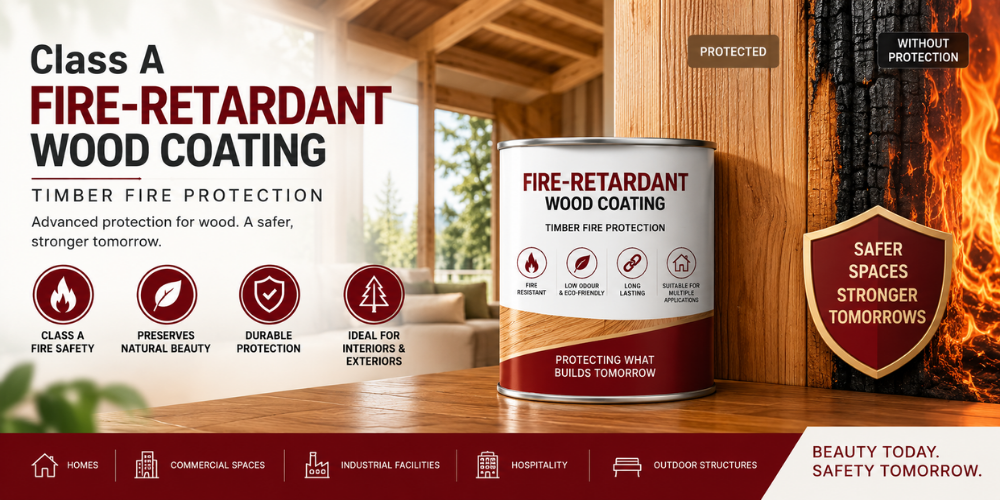
When wood is used in commercial buildings, hotels, restaurants, offices, public spaces, architectural interiors, and industrial facilities, fire performance becomes an important consideration. A Class A fire-retardant wood coating can be considered as part of a timber fire-protection strategy when the coating is properly specified, tested, and applied to the appropriate wood substrate. Gopalfiresafety provides fire-safety products and solutions, and you can learn more about its products and services through the Gopalfiresafety website. Gopalfiresafety also shares fire-safety information and product updates through Instagram.
Wood has been used in construction and interior design for centuries because of its natural appearance, versatility, workability, and architectural appeal. Modern designers continue to use timber for ceilings, wall panels, partitions, decorative structures, furniture, doors, reception areas, and feature walls.
However, untreated wood is combustible. When exposed to sufficient heat or flame, timber can ignite and contribute fuel to a developing fire. For this reason, fire performance should be considered when exposed wood is incorporated into a building.
A properly selected fire-retardant coating can help modify the fire behavior of a wood surface under the conditions for which the coating has been tested.
The phrase Class A fire-retardant wood coating should nevertheless be used carefully. “Class A” can refer to a specific surface-burning or flame-spread classification under an applicable test or code framework. It should not be treated as a universal statement that every coated timber assembly is fireproof or fire resistant.
The actual performance depends on the coating formulation, substrate, application thickness, preparation, installation method, environmental conditions, and applicable testing.
What Is a Class A Fire-Retardant Wood Coating?
A Class A fire-retardant wood coating is a specialized surface coating intended to improve the fire-related performance of suitable wood products when tested and applied according to the applicable requirements.
The coating may use different technologies depending on its formulation.
Some systems can:
- Reduce flame spread
- Delay ignition
- Reduce surface burning
- Form a protective char
- Reduce heat transfer
- Slow deterioration of the underlying timber
- Modify the reaction-to-fire characteristics of the wood surface
The exact mechanism depends on the coating chemistry.
A coating should therefore not be selected solely because its marketing description contains terms such as “fireproof,” “flame resistant,” “fire resistant,” or “Class A.”
The technical documentation should identify the actual test method and the conditions under which the claimed performance was achieved.
Understanding the Meaning of Class A
Class A terminology is commonly associated with very low flame-spread performance in certain building-material classification systems.
For example, ASTM E84 evaluates surface-burning characteristics, including flame spread and smoke-developed characteristics.
NFPA 703 materials also reference ASTM E84 and UL 723 in connection with fire-retardant-treated wood. Current NFPA 703 code-development material identifies fire-retardant-treated wood as wood treated through impregnation and distinguishes it from fire-retardant-coated material.
This distinction is important.
A surface-applied coating and factory-impregnated fire-retardant wood treatment are different approaches and should not automatically be treated as interchangeable.
Class A Does Not Mean Completely Fireproof
One of the most important points for buyers, architects, contractors, and building owners is that a Class A fire-retardant wood coating does not make wood completely fireproof.
Wood remains a combustible material.
A coating can modify the way the surface behaves under the conditions evaluated during testing. It does not remove the underlying material’s physical properties.
This means that a Class A surface-burning classification should not automatically be interpreted as:
- A fire-resistance rating
- A structural fire rating
- A fire-rated wall
- A fire-rated floor
- A fire-rated ceiling assembly
- A fire-rated door assembly
These are different performance concepts.
Reaction to Fire vs Fire Resistance
Reaction to fire and fire resistance are often confused.
Reaction to Fire
Reaction to fire describes how a material behaves when exposed to fire.
Depending on the applicable standard, this can involve characteristics such as:
- Ignitability
- Flame spread
- Heat release
- Smoke production
- Flaming droplets
A coating may improve the reaction-to-fire characteristics of a suitable timber surface.
Fire Resistance
Fire resistance generally concerns the ability of a building element or assembly to maintain specified functions for a defined period when exposed to fire.
This can involve properties such as:
- Integrity
- Insulation
- Load-bearing capacity
Therefore, a Class A fire-retardant wood coating should not automatically be marketed as providing a particular fire-resistance period for a complete building assembly.
Why Wood Fire Protection Is Important
Wood has many advantages, but exposed timber can contribute combustible material to a fire.
Its fire behavior can depend on:
- Wood species
- Density
- Moisture content
- Thickness
- Surface condition
- Geometry
- Ventilation
- Heat exposure
- Installation configuration
A suitable fire-retardant coating can be one component of a broader fire-protection strategy.
This can be particularly relevant when a building contains large areas of exposed timber.
Common examples include:
- Wooden ceilings
- Timber wall panels
- Decorative partitions
- Wooden columns
- Feature walls
- Reception counters
- Architectural beams
- Exhibition structures
- Interior woodwork
How Fire-Retardant Wood Coatings Work
Fire-retardant coatings can use different technologies.
Some coatings form a protective surface layer. Others use chemical mechanisms that influence flame propagation or heat release.
Intumescent coatings are one important technology.
When exposed to sufficient heat, an intumescent coating can expand and form a char layer. The expanded char can act as a thermal barrier between the heat source and the underlying timber.
A simplified process can be represented as:
Heat exposure → coating reaction → expansion → protective char → reduced heat transfer
The exact behavior depends on the formulation.
Not every intumescent coating performs identically, and not every product is suitable for every timber substrate.
Intumescent Wood Coatings
Intumescent technology is particularly interesting for architectural wood because some products can provide fire protection while maintaining a decorative finish.
Under normal conditions, the coating can appear similar to a conventional wood finish.
During intense heat exposure, the coating can react and expand.
The resulting char layer may:
- Insulate the timber
- Reduce direct heat exposure
- Slow heat transfer
- Limit surface degradation
- Help reduce flame spread under tested conditions
The coating thickness is particularly important.
If the product is applied below its required thickness, the performance may not match the tested system.
Coating Thickness and Fire Performance
Coating thickness is one of the most important variables in a fire-protection coating system.
A manufacturer may specify:
- Wet film thickness
- Dry film thickness
- Number of coats
- Coverage rate
- Recoat interval
- Total system thickness
These values should be followed carefully.
Applying insufficient material may result in inadequate protection.
Applying excessive material can also create problems, including:
- Cracking
- Poor curing
- Uneven appearance
- Adhesion problems
- Extended drying time
Professional projects should use appropriate measurement procedures rather than estimating the thickness visually.
Wet Film Thickness
Wet film thickness describes the coating thickness immediately after application.
It can be influenced by:
- Application equipment
- Material viscosity
- Operator technique
- Number of passes
- Surface profile
Monitoring wet film thickness can help the applicator maintain consistent coverage.
Dry Film Thickness
Dry film thickness refers to the coating thickness after the coating has dried or cured.
For fire-protection systems, dry film thickness can be particularly important because the tested fire performance may depend on achieving a specified final coating thickness.
The exact measurement method should follow the coating manufacturer’s instructions.
Choosing the Correct Wood Substrate
A major consideration when specifying a Class A fire-retardant wood coating is the actual timber substrate.
Wood products can include:
- Solid hardwood
- Softwood
- Plywood
- MDF
- OSB
- Veneered boards
- Engineered timber
- Laminated wood
These materials can behave differently during fire exposure.
A coating tested on one substrate should not automatically be assumed to provide identical results on another.
The product documentation should identify the substrates covered by the test evidence.
Solid Timber Applications
Solid timber is widely used for architectural and structural applications.
A suitable fire-retardant coating may be considered for:
- Timber ceilings
- Wooden wall cladding
- Decorative beams
- Interior woodwork
- Architectural panels
- Feature walls
- Exhibition structures
The actual wood species, density, thickness, surface condition, and coating system should be checked against the manufacturer’s requirements.
Plywood Fire Protection
Plywood consists of multiple layers of wood veneer bonded together.
Its construction differs from solid timber.
Before selecting a Class A fire-retardant wood coating for plywood, verify that the product documentation covers the intended plywood substrate.
Important considerations can include:
- Plywood thickness
- Surface finish
- Density
- Adhesion
- Existing coating
- Number of coats
- Required dry film thickness
A product tested on solid timber cannot automatically be assumed to achieve the same result on plywood.
MDF and Engineered Wood
MDF and other engineered wood products can have different physical characteristics from natural timber.
Their density, composition and surface properties can influence coating adhesion and fire behavior.
If an architectural project uses MDF wall panels or engineered timber features, the coating system should be specifically evaluated for the actual substrate.
Clear Fire-Retardant Wood Coatings
Many architectural projects want to preserve the natural appearance of timber.
A clear coating can be attractive because it allows the wood grain to remain visible.
Potential applications include:
- Natural timber walls
- Wooden ceilings
- Decorative panels
- Feature walls
- Interior partitions
- Architectural woodwork
A clear coating can still alter the appearance slightly.
It may affect:
- Colour
- Gloss
- Grain appearance
- Surface texture
A sample area should therefore be tested before applying the coating to a large project.
Transparent Wood Fire Protection
Transparent coatings can be particularly useful for premium architectural interiors.
Hotels, restaurants, offices and retail environments often use natural wood because it creates a distinctive visual identity.
A transparent fire-retardant coating can help incorporate fire-performance considerations without completely hiding the timber appearance.
However, transparency itself does not establish a fire classification.
The coating still requires appropriate technical and test evidence.
Wooden Ceiling Fire Protection
Wooden ceilings can cover large surface areas.
For this reason, exposed timber ceilings may require careful consideration during fire-safety planning.
A Class A fire-retardant wood coating may be considered when the project requires improved surface-burning characteristics and the coating has been tested for the intended wood and application.
Before application, verify:
- Wood species
- Timber thickness
- Existing finish
- Required classification
- Coating thickness
- Application method
- Environmental conditions
- Test configuration
The coating should form part of the overall building fire-safety strategy rather than being considered independently.
Wooden Wall Protection
Wooden wall panels are common in:
- Hotels
- Restaurants
- Offices
- Conference rooms
- Retail stores
- Public buildings
- Auditoriums
- Entertainment spaces
Because wall panels can cover significant surface areas, their fire performance can be important.
The coating system should be selected according to the exact panel construction.
Fire-Retardant Wood Coating for Commercial Buildings
Commercial buildings often combine wood with many other materials.
A Class A fire-retardant wood coating may be considered for selected architectural surfaces where the project requires improved surface fire performance.
Potential applications include:
- Hotel interiors
- Restaurant interiors
- Office partitions
- Retail displays
- Reception areas
- Conference rooms
- Public buildings
- Educational interiors
The coating does not replace other fire-safety measures such as fire detection, suppression, compartmentation, emergency exits, and evacuation planning.
Hotels and Hospitality Projects
Hotels frequently use wood in:
- Lobby walls
- Reception desks
- Corridors
- Restaurants
- Ceiling panels
- Decorative structures
- Guest-room interiors
Fire safety is particularly important in accommodation buildings.
A suitable coating can be evaluated for exposed timber when required by the project specification.
The exact product should be selected according to the substrate and applicable fire-performance requirements.
Restaurants and Cafés
Restaurants frequently use timber to create a warm interior environment.
Wood may be used for:
- Wall cladding
- Ceiling panels
- Counters
- Decorative partitions
- Furniture
- Feature walls
A fire-retardant coating can be considered where exposed wood needs improved surface fire performance.
However, areas close to cooking equipment can experience heat, grease and cleaning exposure that may differ substantially from ordinary dining areas.
The coating’s environmental limitations should therefore be checked carefully.
Office Interiors
Modern offices often use timber for:
- Acoustic panels
- Meeting rooms
- Partitions
- Ceilings
- Feature walls
- Reception areas
- Furniture
A Class A fire-retardant wood coating can be considered when the project requires improved fire performance for exposed wood.
The specification should include the exact timber product and required coating system.
Retail Stores and Showrooms
Retail environments frequently use wood to create premium displays.
Wooden shelving, counters, feature walls and displays may require consideration of fire performance.
A coating should be selected according to the specific project requirements and tested configuration.
Why Test Evidence Matters
Fire-performance claims should be supported by technical documentation.
When evaluating a coating, buyers should request information such as:
- Product technical data sheet
- Safety data sheet
- Test report
- Classification information
- Application instructions
- Approved substrates
- Required thickness
- Durability information
- Environmental limitations
The test evidence should correspond to the actual product.
A generic statement about a testing standard is not enough to prove that a particular coating achieved a specific classification.
ASTM E84 and UL 723
ASTM E84 is widely used for evaluating surface-burning characteristics of building materials.
The test provides information related to flame spread and smoke-developed characteristics.
UL 723 is also associated with surface-burning characteristics.
Where a Class A fire-retardant wood coating is promoted using ASTM E84 or UL 723 terminology, the exact test report and tested configuration should be checked.
This is especially important because the result can depend on the substrate and coating system.
Understanding Flame Spread
Flame spread is an important concept in surface-burning testing.
A lower flame-spread result generally indicates better performance under the applicable test conditions.
However, a laboratory result should not be taken out of context.
The test conditions, specimen preparation, substrate and coating thickness all matter.
NFPA 703 and Fire-Retardant Wood
NFPA 703 addresses fire-retardant-treated wood and fire-retardant coatings for building materials.
Current NFPA material distinguishes wood treated through impregnation from materials treated through surface-applied fire-retardant coatings.
This distinction is useful when reviewing project specifications.
A buyer should determine whether the project requires:
- Fire-retardant-treated wood
- A surface-applied fire-retardant coating
- A particular flame-spread classification
- A specific reaction-to-fire classification
- A complete fire-resistance-rated assembly
These are not necessarily the same requirement.
Fire-Retardant Coating vs Fire-Retardant-Treated Wood
Fire-retardant-treated wood is generally treated with fire-retardant chemicals during manufacture or through an appropriate treatment process.
A fire-retardant coating is applied to the surface.
The two approaches can have different application methods, performance characteristics and maintenance requirements.
For this reason, project specifications should clearly identify the required treatment.
Interior Wood Fire Protection
Interior timber generally experiences more controlled environmental conditions than exterior timber, but the coating still needs to be suitable for its environment.
Potential interior applications include:
- Hotels
- Offices
- Restaurants
- Schools
- Retail stores
- Public buildings
- Entertainment venues
- Residential common areas
The product should be selected based on the actual service conditions.
Exterior Wood Fire Protection
Exterior timber can face:
- Rain
- Humidity
- UV radiation
- Temperature changes
- Condensation
- Weathering
A coating designed for interior use should not automatically be used outdoors.
Durability of fire performance is a separate consideration.
EN 16755 addresses durability of fire-retardant-treated wood products for interior and exterior end-use conditions and includes superficial treatments such as film-forming and intumescent coatings.
Therefore, exterior projects require careful attention to both fire performance and environmental durability.
Importance of Surface Preparation
Even a high-performance Class A fire-retardant wood coating may not perform as intended if the timber surface is poorly prepared.
Preparation can involve:
- Removing dust
- Removing grease
- Removing contaminants
- Sanding where required
- Removing incompatible coatings
- Ensuring suitable moisture conditions
- Repairing damaged areas
The exact preparation procedure should always follow the manufacturer’s technical instructions.
Moisture Content
Wood naturally contains moisture.
Excessive moisture can affect:
- Adhesion
- Drying
- Curing
- Appearance
- Coating performance
Before application, the timber should meet the moisture conditions specified by the coating manufacturer.
Existing Paint or Varnish
Existing finishes can create compatibility problems.
If a timber surface already has:
- Paint
- Varnish
- Lacquer
- Polish
- Sealer
- Wax
the coating manufacturer should confirm whether the existing layer can remain.
In some cases, complete removal may be required.
Application Methods
Fire-retardant wood coatings may be applied using:
- Brush
- Roller
- Spray
- Other approved application equipment
The appropriate method depends on the product and project.
Brush Application
Brushes can be suitable for smaller surfaces and detailed architectural woodwork.
Roller Application
Rollers can provide efficient application over large flat panels.
Spray Application
Spray equipment can provide consistent coverage over large areas when operated by trained personnel.
Spray application requires control over:
- Pressure
- Nozzle selection
- Application distance
- Material viscosity
- Overlap
- Environmental conditions
The manufacturer’s application instructions should always take priority.
Drying and Curing
Drying and curing are important stages of a coating system.
Drying can depend on:
- Temperature
- Humidity
- Ventilation
- Film thickness
- Application method
A coating should not be recoated before the recommended recoat interval.
Similarly, the coated timber should not be placed into service before the required curing stage has been reached.
Compatible Topcoats
Some fire-retardant coating systems require a compatible decorative topcoat.
The topcoat may provide:
- Colour
- Gloss
- Surface protection
- Abrasion resistance
- Additional durability
However, an incompatible topcoat can affect the performance of the underlying system.
Only products approved or specified by the manufacturer should be used.
Selecting the Right Coating
When choosing a Class A fire-retardant wood coating, consider:
- Wood species
- Substrate type
- Timber thickness
- Interior or exterior location
- Required classification
- Test standard
- Coating thickness
- Application method
- Environmental exposure
- Maintenance requirements
The most important principle is simple: match the tested coating system to the actual project.
Why Choose Gopalfiresafety?
Gopalfiresafety provides fire-safety products and information for commercial, industrial and other fire-protection applications. Its website contains fire-safety product information and educational resources, including content related to fire-retardant wood protection.
For customers researching timber fire protection, Gopalfiresafety can be a useful starting point for understanding fire-safety solutions and identifying the information needed before specifying a coating.
For more information, visit Gopalfiresafety.
The company also shares fire-safety information and product updates through Instagram.
Class A Fire-Retardant Wood Coating for Commercial Buildings
Commercial buildings often use timber, plywood, MDF, decorative wood panels, wooden ceilings, wall cladding, partitions, doors, furniture elements, and architectural finishes. While these materials provide warmth and visual appeal, wood is combustible and can contribute to flame spread when exposed to fire.
A Class A fire-retardant wood coating can be considered as part of a broader fire-protection strategy where the project requires improved surface-burning performance from a suitable wood substrate. However, the coating must be selected and applied according to its tested configuration. The substrate, coating system, dry-film thickness, surface preparation, application method, and environmental conditions can all affect the final performance.
For commercial projects, buyers should therefore look beyond the phrase “Class A.” A professional specification should identify the exact product, approved substrate, application thickness, test standard, test report, and installation requirements.
Businesses working on commercial interiors can explore fire-safety products and solutions from Gopalfiresafety. The company provides fire-protection solutions and regularly shares information about fire-retardant coatings and related applications.
Fire Protection for Hotels and Hospitality Spaces
Hotels, resorts, restaurants, cafés, banquet facilities, and hospitality interiors frequently use decorative timber because it creates a premium and comfortable atmosphere. Wooden wall panels, ceiling features, partitions, reception counters, decorative screens, and furniture can all become part of an interior design.
The challenge is maintaining the desired appearance while improving fire performance.
A Class A fire-retardant wood coating may be considered for suitable timber surfaces when project specifications require improved flame-spread characteristics. Depending on the product, coatings may be available in clear or pigmented finishes, allowing designers to preserve or modify the appearance of the underlying wood.
For hospitality projects, fire protection should not be treated as an isolated coating decision. The complete building design must consider:
- combustible materials
- electrical installations
- emergency exits
- fire detection
- fire suppression
- compartmentation
- ventilation
- escape routes
- interior finishes
- furniture and furnishings
- applicable building regulations
A coating is one component of a larger fire-safety strategy.
Offices and Corporate Interiors
Modern offices increasingly incorporate natural wood into reception areas, meeting rooms, acoustic walls, ceilings, partitions, feature walls, and collaborative spaces.
Architects may prefer timber because it provides a natural appearance and can complement glass, metal, stone, and other modern materials. Fire performance becomes particularly important when a large amount of timber is installed over a substantial surface area.
A Class A fire-retardant wood coating can provide a practical surface-treatment option when its documented performance matches the project’s requirements.
Before specifying a coating for an office project, the responsible team should identify:
- The exact timber species or engineered wood product.
- The surface condition.
- Whether the substrate is new or previously coated.
- The required appearance.
- The required coating thickness.
- The applicable fire-test standard.
- Interior environmental conditions.
- Cleaning and maintenance requirements.
- Whether a protective topcoat is permitted.
- Whether the complete assembly has additional fire requirements.
This approach helps prevent performance assumptions based solely on a product name.
Wooden Ceilings and Wall Panels
Wooden ceilings and wall panels can present special considerations because they often cover large areas. When combustible decorative materials are installed across extensive surfaces, flame-spread performance can become an important design consideration.
A Class A fire-retardant wood coating can be used on appropriate timber surfaces where the coating has been tested for that specific application.
The application process should be consistent across the entire treated area. Uneven coating thickness can create inconsistent performance. Edges, joints, grooves, corners, cut-outs, and repaired areas should also be addressed according to the manufacturer’s technical instructions.
For large projects, contractors should maintain application records showing:
- substrate identification
- preparation method
- product batch
- application date
- number of coats
- wet-film measurements where applicable
- dry-film measurements where applicable
- curing conditions
- applicator details
- inspection results
Good documentation is particularly valuable when fire-performance requirements are part of a commercial specification.
Architectural Timber and Natural Wood Appearance
One reason designers choose timber is its natural grain. Covering the surface with an opaque material may not always be desirable.
Transparent or clear fire-retardant finishes can therefore be attractive for architectural applications. However, “clear” does not automatically mean “Class A,” and a coating’s appearance should never be confused with its tested fire performance.
When selecting a clear Class A fire-retardant wood coating, verify whether the actual clear formulation has been tested on the intended wood substrate. A clear formulation and a pigmented formulation may not necessarily produce identical performance.
The following should be checked:
- clear-coat test evidence
- approved wood type
- required application rate
- required number of coats
- final appearance
- compatibility with existing finishes
- cleaning requirements
- maintenance instructions
The goal should be to balance aesthetics, durability, and documented fire performance.
Fire-Retardant Coating for Plywood
Plywood is commonly used for partitions, furniture, wall panels, ceilings, exhibition structures, cabinets, and architectural installations.
Because plywood is manufactured from layers of wood veneer bonded together, its behavior can differ from that of solid timber. Consequently, a coating tested on one substrate should not automatically be assumed to produce the same classification on another.
A Class A fire-retardant wood coating should therefore be selected based on product-specific documentation identifying plywood or an equivalent approved substrate.
The contractor should also consider the exposed edges. Cutting, sanding, drilling, and fabrication can expose untreated areas. If the technical system requires complete surface coverage, these areas need to be treated according to the manufacturer’s instructions.
Fire-Retardant Coating for MDF and Engineered Wood
MDF, particleboard, OSB, laminated panels, and other engineered wood products are widely used in interior construction.
Their composition, density, resin content, surface finish, and manufacturing process can affect coating adhesion and fire performance. For this reason, a product’s performance on solid timber should not automatically be transferred to MDF or another engineered wood product.
When considering a Class A fire-retardant wood coating for engineered wood, confirm that the intended substrate is included in the supporting test documentation or technical approval.
Particular attention should be given to:
- raw versus laminated surfaces
- factory-finished panels
- exposed edges
- resin-rich surfaces
- sanding requirements
- primer compatibility
- moisture content
- coating thickness
If the product documentation does not clearly support the proposed substrate, the project team should seek clarification before application.
Wooden Doors and Fire Performance
Wooden doors require special attention because a door can be part of a fire-resisting assembly.
Applying a fire-retardant coating to an ordinary wooden door does not automatically turn that door into a fire-rated door.
A fire-rated door assembly can involve the door leaf, frame, hinges, glazing, seals, hardware, installation method, and surrounding construction. The complete assembly must meet the applicable requirements and testing/classification system.
A Class A fire-retardant wood coating may improve the surface-burning characteristics of a suitable wood surface, but that is different from demonstrating a fire-resistance period for a complete door assembly.
This distinction is extremely important for architects, contractors, consultants, and building owners.
ASTM E84 and UL 723 Considerations
ASTM E84 and UL 723 are widely associated with surface-burning characteristics of building materials. They evaluate properties such as flame spread and smoke developed under defined laboratory conditions.
When a product is described as having Class A performance under a surface-burning classification system, the buyer should review the actual test documentation rather than relying solely on marketing terminology.
The relevant information can include:
- test standard
- test date
- laboratory
- product identification
- substrate
- specimen construction
- coating thickness
- application method
- flame-spread result
- smoke-developed result
- limitations of the test
A test performed on a particular substrate and coating thickness should not automatically be interpreted as proof for every possible application.
What Does Class A Actually Tell You?
The term “Class A” generally indicates a strong level of surface-burning performance under the applicable classification system. It does not mean that the treated wood cannot burn under any circumstances.
This is one of the most important concepts when evaluating a Class A fire-retardant wood coating.
Wood can still be exposed to extreme heat and eventually ignite or degrade. A fire-retardant coating is designed to influence the behavior of the treated surface under specified conditions; it is not an unlimited barrier against fire.
Therefore, the phrase “Class A” should be understood within the context of:
- the specific test standard
- the tested substrate
- the coating formulation
- application thickness
- test configuration
- installation conditions
This technical interpretation makes fire-protection specifications more accurate.
Fire-Retardant Treated Wood vs Coated Wood
Fire-retardant-treated wood and fire-retardant-coated wood are related but different approaches.
Fire-retardant-treated wood generally involves chemicals introduced into the wood through a treatment process. Surface-applied coatings, on the other hand, create a protective layer on the wood surface.
NFPA material concerning fire-retardant-treated wood distinguishes wood impregnated with chemicals from wood treated by other means, which can be considered fire-retardant-coated material.
A surface coating can be advantageous when:
- existing timber needs upgrading
- the natural appearance should be retained
- on-site application is practical
- the project requires a surface-applied solution
- replacing the timber is undesirable
However, the appropriate system depends on the project requirements.
Interior and Exterior Wood Applications
Not every fire-retardant wood coating is suitable for exterior exposure.
Outdoor timber can experience:
- rain
- humidity
- sunlight
- temperature fluctuations
- freeze-thaw cycles in some climates
- surface abrasion
- biological exposure
- weathering
These factors can affect coating durability.
A product demonstrated for interior use should not automatically be specified for exterior timber. When outdoor use is required, verify the manufacturer’s technical documentation for the intended exposure conditions.
Durability standards such as EN 16755 address the durability of reaction-to-fire performance for fire-retardant-treated wood products under defined end-use conditions and include consideration of surface-applied film-forming and intumescent systems.
For a Class A fire-retardant wood coating intended for exterior or demanding environments, durability evidence should therefore be reviewed alongside initial fire-performance data.
Intumescent Wood Coatings
Intumescent technology is widely used in fire-protection coatings.
When exposed to sufficient heat, an intumescent coating can undergo physical and chemical changes that produce an expanded protective char layer. This layer can help reduce heat transfer and protect the underlying substrate for a defined period under specified conditions.
The behavior of an intumescent coating depends on its formulation and application.
Important variables can include:
- dry-film thickness
- number of coats
- substrate
- curing
- environmental conditions
- primer
- topcoat
- exposure conditions
For this reason, an intumescent product should always be installed according to its technical instructions.
Why Coating Thickness Matters
One of the most common mistakes in fire-retardant coating projects is treating coverage as purely an aesthetic issue.
For many fire-protection coatings, the required thickness is an important part of achieving the documented performance.
Too little coating may fail to provide the intended protection. Excessive thickness can also create application, curing, adhesion, appearance, or compatibility issues.
A professional Class A fire-retardant wood coating application should therefore follow the manufacturer’s specified application rate rather than simply applying “one coat.”
Depending on the system, contractors may use:
- wet-film thickness measurements
- dry-film thickness measurements
- coverage calculations
- batch records
- visual inspection
- adhesion checks where specified
Documentation provides evidence that the coating was applied consistently.
Surface Preparation
Surface preparation is fundamental to coating performance.
Before applying a fire-retardant coating, the wood surface may need to be:
- clean
- dry
- free from dust
- free from oil or grease
- free from loose material
- appropriately sanded
- compatible with the coating system
Previously painted or varnished wood requires additional attention. Existing finishes can interfere with adhesion and may change the fire behavior of the complete coating system.
The correct preparation method depends on the product.
A contractor should never assume that sanding alone is sufficient for every application.
Quality Control During Application
Professional fire-protection projects should include quality control from beginning to completion.
A basic inspection program can include:
Before Application
Inspect the substrate and confirm:
- wood type
- surface condition
- moisture condition
- cleanliness
- previous coatings
- repairs
- dimensions and accessible areas
During Application
Monitor:
- product batch
- mixing procedure
- application method
- ambient conditions
- wet-film thickness
- coverage
- recoating intervals
After Application
Check:
- final dry-film thickness
- uniform appearance
- missed areas
- defects
- adhesion where required
- curing
- touch-up areas
This process can significantly improve consistency.
Maintenance and Recoating
Fire-retardant coatings should not be regarded as a “apply once and forget” solution.
Over time, wood surfaces can experience:
- scratching
- impact
- sanding
- renovation
- drilling
- moisture exposure
- cleaning
- abrasion
- peeling
- mechanical damage
Any activity that removes or damages the coating can potentially affect the treated surface.
Maintenance procedures should follow the manufacturer’s recommendations. If recoating is necessary, compatibility with the existing system should be confirmed before application.
For high-value commercial projects, maintaining an application and maintenance record can be useful for future inspections.
Common Mistakes When Selecting a Wood Fire Coating
Several mistakes can reduce the reliability of a fire-retardant coating project.
1. Choosing Based Only on “Class A”
A product label is not a substitute for technical evidence.
2. Ignoring the Substrate
A test on one wood product does not automatically establish performance on every other wood product.
3. Applying Too Little Material
Coverage should follow the specified application rate.
4. Ignoring Existing Finishes
Old varnish, paint, wax, oil, or laminate can affect adhesion and performance.
5. Treating Fire Retardancy as Fire Resistance
Surface-burning classification and fire-resistance ratings address different performance characteristics.
6. Forgetting Cut Edges
Fabrication can expose untreated areas.
7. Assuming Interior Products Are Exterior Products
Weather exposure requires appropriate durability considerations.
8. Skipping Documentation
Without records, it can be difficult to demonstrate what product was used and how it was applied.
How to Verify a Class A Claim
When purchasing a Class A fire-retardant wood coating, ask the supplier for clear technical documentation.
A useful verification checklist includes:
Product identity:
Confirm the exact product name and formulation.
Test standard:
Identify the standard under which the performance was determined.
Test substrate:
Check whether the tested material matches the proposed timber, plywood, MDF, or engineered wood.
Application thickness:
Confirm the thickness used during testing.
Application system:
Check primers, sealers, topcoats, and number of coats.
Laboratory documentation:
Review the applicable test report or certification documentation.
End-use conditions:
Confirm whether the system is suitable for interior or exterior use.
Durability:
For demanding applications, review durability evidence.
Installation instructions:
Ensure the contractor can follow the required preparation and application procedure.
This approach helps distinguish documented fire performance from unsupported marketing claims.
Choosing a Professional Fire-Safety Supplier
The supplier should be able to provide more than a product name.
A professional supplier should understand the relationship between:
- timber substrate
- coating system
- application thickness
- fire testing
- project conditions
- installation
- maintenance
Gopalfiresafety focuses on fire-safety products and solutions and provides information about fire-retardant coatings for different applications. When evaluating any specific Class A fire-retardant wood coating, customers should request product-specific technical documents and verify that the evidence matches their intended application.
You can learn more about Gopalfiresafety’s fire-safety solutions through its website at gopalfiresafety.com. The company also shares product and fire-safety information through Instagram.
Procurement Checklist for Contractors and Architects
Before ordering a fire-retardant wood coating, prepare a project specification containing:
- project location
- wood species
- timber dimensions
- plywood/MDF specification if applicable
- interior or exterior application
- existing finish
- required appearance
- required fire classification
- applicable test standard
- required coating thickness
- primer requirements
- topcoat requirements
- expected environmental exposure
- application method
- inspection requirements
- documentation requirements
- maintenance requirements
This checklist makes communication between architects, contractors, suppliers, and consultants much easier.
Can a Class A Coating Make Wood Completely Fireproof?
No.
A Class A fire-retardant wood coating should not be described as making wood completely fireproof.
The purpose of fire-retardant technology is to improve fire behavior under defined conditions. The treated surface can still be exposed to intense heat and fire.
The actual result depends on the tested system and installation conditions.
This distinction is especially important for websites and product descriptions because phrases such as “100% fireproof wood” can create unrealistic expectations and may not accurately describe the tested performance of a coating.
Can Fire-Retardant Coating Replace Other Fire-Safety Measures?
No.
Wood coating is only one component of a fire-safety strategy.
A complete building may also require:
- smoke detection
- fire alarms
- sprinklers
- extinguishers
- emergency lighting
- compartmentation
- fire doors
- protected escape routes
- electrical protection
- structural fire protection
- emergency planning
The correct combination depends on the building type, occupancy, applicable codes, and project requirements.
Why Correct Application Is as Important as Product Selection
Even a technically suitable coating may not achieve its intended performance if it is incorrectly installed.
Common application problems include:
- insufficient coverage
- incorrect thinning
- poor surface preparation
- inadequate drying
- contamination
- incorrect primer
- incompatible topcoat
- application outside specified environmental conditions
For this reason, the product specification and application procedure should be treated as one complete system.
Long-Term Value of Wood Fire Protection
Protecting architectural timber can provide value beyond initial fire performance.
A well-specified coating system can help projects combine:
- architectural aesthetics
- timber design
- fire-safety planning
- surface protection
- documented performance
- maintainability
For commercial buildings, this can be particularly useful where designers want to retain timber features while addressing surface fire-performance requirements.
The key is to choose a system based on evidence rather than assumptions.
Frequently Asked Questions
What is a Class A fire-retardant wood coating?
It is a fire-retardant coating system intended to improve the surface-burning performance of suitable wood under specified test conditions. The exact meaning of Class A depends on the applicable classification system and test documentation.
Does Class A mean wood cannot burn?
No. Class A does not mean that wood is completely fireproof. It indicates a defined level of surface-burning performance under the relevant test conditions.
Can the coating be used on plywood?
Potentially, yes, but the product documentation should specifically support the intended plywood substrate and application system.
Can the coating be applied to MDF?
Some products may be suitable, but MDF should be treated as a specific substrate. Verify product-specific testing and technical instructions before application.
How thick should the coating be?
The required thickness depends on the product and tested system. Contractors should follow the manufacturer’s specified application rate and thickness rather than using a generic thickness.
Can a clear coating provide Class A performance?
A clear coating can potentially achieve documented fire performance, but the clear formulation must have appropriate test evidence. Do not assume that every transparent wood coating has Class A performance.
Can a coating make a wooden door fire rated?
Not automatically. A fire-rated door is generally evaluated as a complete assembly, not simply by the coating applied to the wood surface.
Can interior fire-retardant coatings be used outside?
Not necessarily. Exterior exposure requires appropriate durability and weather-resistance evidence.
How can buyers verify a Class A claim?
Request the product’s technical documentation and relevant test report. Check the test standard, substrate, coating thickness, application system, and limitations.
Why is coating thickness important?
The tested fire performance may depend on achieving a specified amount of coating. Applying less material than required can mean the installed system does not match the tested configuration.
A Class A fire-retardant wood coating can be an important component of a timber fire-protection strategy when the coating is correctly selected, tested, specified, and applied. The most important point is that “Class A” should always be understood in relation to a specific test method and configuration.
For timber, plywood, MDF, architectural panels, wooden ceilings, walls, and other combustible surfaces, the right approach is to verify the substrate, application thickness, coating system, environmental conditions, and supporting documentation before starting work.
Gopalfiresafety provides fire-safety products and information for businesses, contractors, architects, and project professionals. For a suitable solution, review the requirements of your project and request product-specific technical documentation before specification.
Visit gopalfiresafety.com to explore fire-safety solutions, and follow Gopalfiresafety on Instagram for additional fire-protection information and updates.