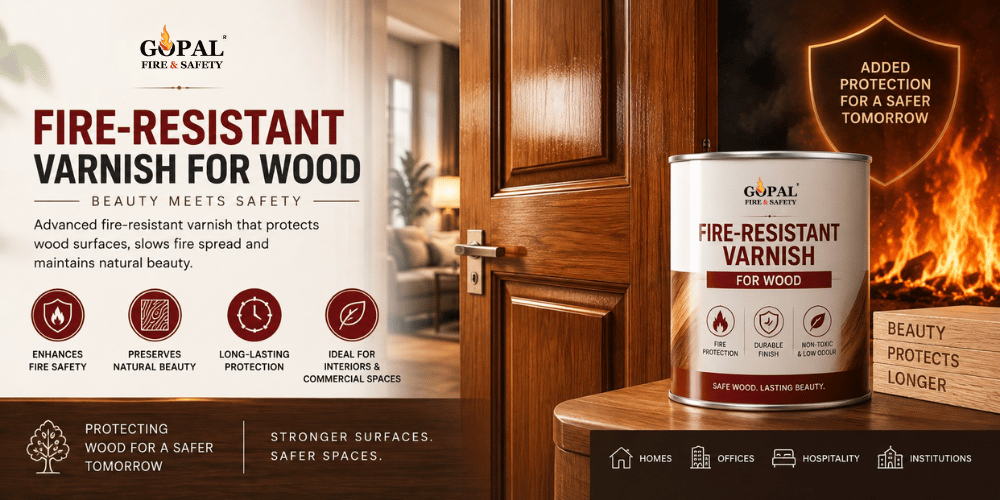
Fire-Resistant Varnish for Wood: Complete Guide to Wood Fire Protection
When natural timber is used in commercial interiors, architectural projects, hotels, offices, restaurants, public buildings, and industrial spaces, fire performance becomes an important consideration. A fire-resistant varnish for wood can be part of a fire-protection strategy when the product is specifically formulated, tested, and applied for the intended timber substrate and environment. Gopalfiresafety provides fire safety products and solutions, and its website is Gopalfiresafety. Gopalfiresafety also shares fire safety information and product updates through Instagram.
What Is Fire-Resistant Varnish for Wood?
A fire-resistant varnish for wood is a specialized coating or finish designed to improve the fire performance of suitable timber surfaces under specified test conditions.
Unlike an ordinary decorative varnish, a fire-protection coating can be formulated to influence how a wooden surface reacts when exposed to heat or flame.
Depending on the technology, the coating may:
- Reduce flame spread
- Delay ignition
- Form a protective char
- Reduce heat transfer
- Protect the underlying wood
- Modify surface-burning characteristics
The exact mechanism depends on the formulation.
It is important to understand that “fire resistant,” “fire retardant,” “flame retardant,” and “fireproof” are not automatically interchangeable terms. The actual performance should always be established from the manufacturer’s technical documentation and relevant test evidence.
Why Wood Requires Fire Protection
Wood is widely used because it provides:
- Natural appearance
- Structural versatility
- Easy machining
- Design flexibility
- Warm aesthetics
- Good acoustic possibilities
- Renewable-material advantages when responsibly sourced
However, untreated wood is combustible.
When exposed to a sufficiently high heat source, timber can ignite and contribute fuel to a developing fire.
Its behavior depends on factors such as:
- Species
- Density
- Moisture
- Thickness
- Surface condition
- Geometry
- Ventilation
- Heat exposure
A suitable coating can help improve the fire performance of a wood surface, but it does not make every wooden element automatically fireproof.
How Fire-Resistant Wood Varnish Works
Different technologies can be used in fire-protective wood coatings.
Some formulations work by creating a protective film. Others contain ingredients that promote char formation when heated.
Intumescent technology is one important example.
When exposed to elevated temperatures, an intumescent coating can expand and create a carbonaceous char. This expanded layer can provide insulation between the heat source and the timber.
The resulting protective layer can help:
- Slow heat transfer
- Reduce direct flame contact
- Protect the underlying timber
- Delay surface degradation
- Reduce flame propagation under tested conditions
The result depends on the exact coating system and its tested application.
Fire-Resistant Varnish vs Ordinary Wood Varnish
An ordinary varnish is primarily designed for:
- Appearance
- Gloss
- Stain resistance
- Moisture resistance
- Surface protection
- Durability
A fire-protection varnish has additional performance requirements.
It may be designed and tested to improve the reaction-to-fire characteristics of the coated substrate.
Therefore, a conventional polyurethane, acrylic, lacquer, or decorative wood varnish should not automatically be described as fire resistant simply because it protects the wood surface.
Fire-Resistant Varnish vs Fire-Retardant Coating
The terminology used in product literature can vary.
A fire-retardant coating generally refers to a coating intended to reduce or delay certain fire-related characteristics.
A fire-resistant system can imply a broader performance claim, depending on the relevant standard.
For SEO and product descriptions, it is important to use terminology that accurately reflects the manufacturer’s test evidence.
Intumescent Varnish for Wood
Some fire-protective wood finishes use intumescent technology.
An intumescent layer can expand under high-temperature exposure.
The expanded char acts as a thermal barrier.
For architectural timber, this can be useful because the coating can potentially provide fire protection while maintaining a decorative appearance.
However, clear or transparent appearance does not itself establish fire performance.
The complete product system must be tested for the intended application.
Clear Fire-Resistant Varnish
Clear finishes can be attractive for projects where the natural appearance of timber must remain visible.
Potential applications include:
- Natural wood walls
- Timber ceilings
- Decorative panels
- Wooden partitions
- Architectural features
- Interior woodwork
The exact level of transparency can vary between products.
A clear finish may slightly alter:
- Colour
- Gloss
- Grain appearance
- Surface texture
A sample application should therefore be evaluated before large-scale installation.
Transparent Wood Fire Protection
Transparent coatings are particularly valuable in architectural applications.
Designers may want to retain:
- Natural grain
- Timber colour
- Texture
- Pattern
- Visual warmth
A suitable transparent fire-protection system can help balance aesthetic requirements with fire-performance objectives.
However, the product must be tested on the relevant timber substrate.
Fire-Resistant Varnish for Interior Wood
Interior timber is commonly found in:
- Hotels
- Restaurants
- Offices
- Schools
- Retail stores
- Museums
- Libraries
- Auditoriums
- Residential developments
- Public buildings
Large areas of exposed wood can influence the fire characteristics of an interior.
A suitable coating may be specified where the project requires improved reaction-to-fire performance.
The coating should form part of the overall fire strategy.
Fire Protection for Wooden Ceilings
Wooden ceilings can cover large surface areas.
If exposed to fire, a combustible ceiling can contribute to flame development.
A suitable fire-protective finish can be considered for timber ceilings where required.
Before application, confirm:
- Wood type
- Existing finish
- Required classification
- Coating thickness
- Application method
- Environmental conditions
Fire Protection for Wooden Walls
Wooden wall panels are popular in modern interior design.
They can be used in:
- Hotel lobbies
- Restaurants
- Offices
- Conference rooms
- Retail interiors
- Public buildings
Where exposed timber is part of the design, fire-performance requirements should be established during the specification stage.
Fire Protection for Timber Panels
Not all timber panels have the same composition.
They can include:
- Solid timber
- Plywood
- MDF
- OSB
- Veneered boards
- Engineered wood
These substrates can behave differently during fire exposure.
A coating tested on solid timber should not automatically be assumed to provide the same performance on MDF or plywood.
The product documentation should clearly identify approved substrates.
Fire-Resistant Varnish for Plywood
Plywood consists of multiple wood veneer layers bonded together.
Its surface and internal construction differ from solid timber.
Before applying a fire-protection varnish, confirm that the product has been tested or documented for the relevant plywood type.
Important considerations include:
- Thickness
- Density
- Surface finish
- Adhesion
- Existing coating
- Application thickness
Fire Protection for MDF
MDF is an engineered wood product with different characteristics from natural timber.
A coating suitable for solid timber does not automatically apply to MDF.
For MDF applications, the technical documentation should specifically address the substrate.
Fire Protection for Veneered Wood
Veneered wood combines a decorative timber layer with another substrate.
The coating interacts with the veneer surface, while the underlying material can also influence overall fire behavior.
The coating system should therefore be selected for the complete substrate rather than the decorative veneer alone.
Why Coating Thickness Matters
Coating thickness is one of the most important variables in fire-protective coating application.
The manufacturer may specify:
- Wet film thickness
- Dry film thickness
- Number of coats
- Total coating thickness
- Recoat interval
Insufficient coating can result in performance below the tested level.
Excessive coating can also create problems such as:
- Cracking
- Poor drying
- Uneven finish
- Adhesion problems
- Extended curing
The specified thickness should therefore be measured rather than estimated.
Surface Preparation
Proper preparation is essential.
Before applying a fire-resistant varnish for wood, the surface should generally be:
- Clean
- Dry
- Free from dust
- Free from grease
- Free from oil
- Free from loose particles
- Suitable for the coating system
The exact preparation requirements depend on the product.
Existing Varnish
Existing varnish can create compatibility issues.
Before applying a new fire-protection system, determine:
- What the existing coating is
- Whether it is firmly bonded
- Whether it is compatible
- Whether sanding is required
- Whether complete removal is necessary
Applying a fire-protection coating over an unknown finish can make the final performance difficult to establish.
Wood Moisture Content
Moisture in timber can affect coating application.
Excess moisture can cause:
- Poor adhesion
- Slow drying
- Blistering
- Surface defects
- Inconsistent curing
The coating manufacturer may specify a maximum moisture level.
A moisture meter can be used where appropriate to check the substrate before application.
Timber Species
Different wood species have different physical characteristics.
These can include differences in:
- Density
- Porosity
- Resin content
- Absorption
- Grain
- Surface hardness
The tested species or substrate should be compared with the actual wood being treated.
Application Methods
Depending on the product, application can be performed using:
- Brush
- Roller
- Spray
The manufacturer’s technical data sheet should identify approved methods.
Using an unapproved application technique can produce a coating thickness or surface structure different from the tested system.
Brush Application
Brush application is suitable for many small or detailed surfaces.
It can provide good control around:
- Edges
- Corners
- Profiles
- Decorative details
However, inexperienced application can produce uneven film thickness.
Roller Application
Rollers can be useful for larger flat timber surfaces.
The correct roller type should be selected according to the coating manufacturer’s recommendations.
Application should be consistent across the surface.
Spray Application
Spray application can provide a uniform finish when properly controlled.
It can be particularly useful for:
- Manufacturing facilities
- Large projects
- Multiple timber panels
- Door production
- Architectural woodwork
Spray operators should be trained and should follow the product’s safety requirements.
Drying Time
Each coating system has specific drying requirements.
Drying can depend on:
- Temperature
- Humidity
- Ventilation
- Film thickness
- Application method
A coating should not be recoated or placed into service before the specified drying stage is reached.
Curing
Drying and curing are not necessarily the same.
A coating can feel dry while still requiring additional time to reach its final properties.
The manufacturer’s technical documentation should define the appropriate curing period.
Compatible Topcoats
Some systems require a compatible decorative topcoat.
The topcoat can provide:
- Colour
- Gloss
- Surface protection
- Improved durability
However, applying an incompatible product may affect the underlying fire-protection system.
Only approved or compatible products should be used.
Fire Classification
Fire classifications vary depending on the applicable standard.
A project may specify:
- Flame-spread performance
- Reaction-to-fire classification
- Smoke performance
- Heat release
- Fire resistance
These terms describe different characteristics.
The product should therefore be selected according to the actual project requirement.
Reaction to Fire
Reaction to fire concerns how a material behaves when exposed to fire.
Depending on the applicable standard, testing can consider characteristics such as:
- Ignitability
- Flame spread
- Heat release
- Smoke production
- Flaming droplets
A coating that improves reaction-to-fire performance should not automatically be described as providing a fire-resistance rating for a structural assembly.
Fire Resistance
Fire resistance generally relates to an element or assembly maintaining specified performance during a fire for a defined period.
For example, a fire door, wall, floor, or structural element may have a specified fire-resistance period.
A wood varnish alone does not automatically provide such an assembly rating.
Why Test Reports Matter
When buying a fire-protection coating, ask for documentation showing:
- Product name
- Manufacturer
- Test standard
- Substrate
- Application method
- Coating thickness
- Number of coats
- Test result
- Classification
- Limitations
This allows the product to be compared with the actual project requirement.
Standards for Wood Fire Protection
Different standards can apply depending on the country and application.
Examples can include:
- ASTM standards
- UL standards
- EN standards
- ISO standards
- National building standards
The relevant standard should be determined by the project’s location and specification.
For example, EN 16755 addresses durability classification for fire-retardant-treated wood products in interior and exterior end-use conditions, including certain products treated by superficial processes such as film-forming and intumescent coatings.
ASTM E84
ASTM E84 is widely used to evaluate surface-burning characteristics.
It can provide information concerning:
- Flame spread
- Smoke developed
Where a coating is marketed with ASTM E84 performance, the exact tested system should be checked.
UL 723
UL 723 is associated with surface-burning characteristics of building materials.
A UL-related claim should identify the exact product and test scope.
It should not be assumed that a product is UL listed or certified simply because UL 723 is mentioned in general marketing content.
European Reaction-to-Fire Classification
European projects may use reaction-to-fire classifications under the relevant EN framework.
The classification can depend on:
- Substrate
- Product
- Application thickness
- Installation
- End-use condition
The exact classification should be confirmed from the product’s documentation.
Fire-Retardant Coating for Commercial Buildings
Commercial buildings can contain significant quantities of decorative timber.
Potential applications include:
- Reception counters
- Wall panels
- Ceilings
- Partitions
- Decorative columns
- Furniture
- Feature walls
A suitable coating can help address fire-performance requirements for exposed wood when properly specified.
Hotels
Hotels commonly use timber for decorative purposes.
Examples include:
- Lobby walls
- Reception areas
- Corridors
- Restaurants
- Guest-room features
- Ceiling panels
Fire safety is particularly important in accommodation buildings.
Any wood coating should be selected according to the applicable building requirements and project fire strategy.
Restaurants
Restaurants can combine combustible decorative materials with cooking equipment and heat-producing appliances.
Wood may be used for:
- Wall cladding
- Ceiling features
- Furniture
- Partitions
- Decorative panels
The coating should be suitable for the expected temperature, cleaning, and environmental conditions.
Offices
Wood finishes are common in modern offices.
They can be used for:
- Acoustic panels
- Feature walls
- Meeting rooms
- Reception areas
- Ceilings
- Partitions
A suitable fire-protective coating can be incorporated into the interior specification where required.
Public Buildings
Schools, libraries, museums, auditoriums, and community buildings may have significant timber elements.
Because these buildings can have high occupancy, the fire performance of interior finishes can be an important design consideration.
Architectural Timber
Architects often want to preserve the natural appearance of timber.
A transparent fire-protection coating can be useful where the grain needs to remain visible.
However, the final appearance should be evaluated through sample panels before full-scale application.
Natural Timber Appearance
A well-selected coating can potentially preserve:
- Grain
- Colour
- Texture
- Natural variation
The final appearance can still vary depending on timber species and coating formulation.
Maintenance
Fire-protection coatings require appropriate maintenance.
Inspect surfaces for:
- Cracks
- Peeling
- Blistering
- Abrasion
- Impact damage
- Discoloration
- Water damage
The manufacturer should provide maintenance recommendations.
Repairing Damaged Coatings
A damaged coating should not simply be covered with ordinary varnish.
The repair system should be compatible with the original coating and should follow the manufacturer’s instructions.
For important fire-protection applications, repairs should be documented.
Exterior Wood
Exterior timber experiences additional stresses.
These include:
- Rain
- UV radiation
- Humidity
- Temperature changes
- Biological exposure
- Abrasion
A coating suitable only for interior conditions should not be used outside without confirmation.
Interior Wood
Interior environments are generally more controlled, but surfaces can still experience:
- Cleaning
- Impact
- Humidity
- Abrasion
- Frequent handling
The coating should match the expected service environment.
Choosing the Right Product
Before purchasing a fire-resistant varnish for wood, consider:
- Timber species
- Substrate
- Existing finish
- Required fire classification
- Interior or exterior location
- Application method
- Required thickness
- Drying conditions
- Durability
- Maintenance
- Appearance
- Supporting test evidence
Why Gopalfiresafety?
Gopalfiresafety provides fire safety products and solutions for commercial and industrial requirements. Customers researching wood fire-protection products can visit Gopalfiresafety to explore the company’s fire-safety offerings.
For any fire-resistant varnish for wood, the exact product documentation should be reviewed before specifying the coating. The actual wood species, substrate, environment, required fire performance, coating thickness, and applicable standards should all be considered.
Gopalfiresafety also shares fire safety information and product updates through Instagram.
Commercial Applications of Fire-Resistant Varnish for Wood
Wood is widely used in commercial interiors because it creates a warm, natural and premium appearance. It can be found in wall panels, ceilings, doors, partitions, furniture, decorative structures, stair components, reception counters and architectural features. However, because timber is combustible, fire performance needs to be considered whenever wood is used in a building.
A properly specified fire-resistant varnish for wood can be part of a broader fire-protection strategy for suitable timber surfaces. The purpose is not to make wood permanently fireproof. Instead, the coating can be designed to improve the surface’s reaction to fire under defined test conditions, depending on the formulation, substrate, dry film thickness and application system.
For businesses looking for wood fire protection products, Gopalfiresafety provides fire-safety solutions and information through its website, https://gopalfiresafety.com/. The company also shares product and fire-safety information through Instagram.
Hotels and Hospitality Buildings
Hotels frequently use timber for decorative wall panels, wooden ceilings, reception areas, doors, furniture and architectural details.
A fire-resistant varnish for wood can be considered where maintaining the appearance of natural timber is important while improving the fire performance of an appropriate wood surface.
However, the coating specification should be based on the intended application. A product suitable for an interior timber panel should not automatically be assumed to be suitable for a hotel door, staircase or structural timber component.
The exact substrate and coating system should always be checked against the available test evidence.
Restaurants and Cafés
Restaurants often combine wood with decorative lighting, fabrics and other interior materials. Wooden wall panels, ceilings, counters and partitions can create an attractive atmosphere, but these materials must be considered as part of the overall fire-safety design.
A suitable fire-retardant wood coating may help reduce the contribution of certain timber surfaces to fire development when properly specified and applied.
For commercial kitchens, additional considerations are necessary because heat, grease, humidity and cleaning chemicals can affect coating performance. A wood coating intended for a decorative dining area should not automatically be used in a high-heat kitchen environment.
Offices and Corporate Interiors
Modern offices increasingly use wood for acoustic panels, partitions, ceilings, feature walls, furniture and meeting-room interiors.
A fire-resistant varnish for wood can be useful when architects or designers want to retain the appearance of timber while incorporating additional fire-performance considerations into the specification.
The coating should be selected according to:
- Wood species
- Timber thickness
- Surface condition
- Indoor environmental conditions
- Required fire classification
- Application method
- Required coating thickness
- Maintenance requirements
- Available test documentation
Retail Stores and Showrooms
Retail interiors often use decorative timber to create premium displays and branded environments.
Wooden shelving, wall panels, counters and display structures can benefit from an appropriate fire-retardant coating system where required by the project specification.
The important point is that coating performance is dependent on the complete application system. Changing the timber substrate, coating thickness or finishing layer may affect the result.
Fire Protection for Wooden Ceilings
Wooden ceilings can create a strong architectural appearance, particularly in restaurants, hotels, offices and residential projects.
Because ceilings can cover a large surface area, their reaction to fire can be an important consideration.
A fire-resistant varnish for wood may be specified for suitable timber ceiling systems when supported by appropriate test information.
Before application, the project team should determine:
- What type of timber is being used?
- What is the timber thickness?
- Is the wood solid, veneered or engineered?
- Is the coating transparent or pigmented?
- What fire-performance requirement applies?
- What coating thickness is required?
- How will the coating be applied?
- Does the tested system match the actual installation?
These questions help prevent a common mistake: selecting a coating simply because it is described as “fire resistant” without checking whether its tested application matches the project.
Fire Protection for Wooden Walls and Panels
Timber wall panels are another common application.
Panels may be made from solid timber, plywood, MDF, veneer-faced boards or other engineered wood products. These substrates can behave differently during fire exposure.
Therefore, a fire-resistant varnish for wood should be evaluated for the actual substrate rather than treated as a universal solution for every type of wood.
For example, a coating tested on solid timber should not automatically be assumed to provide identical performance on MDF or plywood.
Decorative Timber Panels
Architectural wood panels frequently require a transparent finish because designers want the natural grain to remain visible.
In such applications, a clear fire-retardant wood coating can offer a balance between appearance and fire-performance objectives.
The finish may be particularly useful in:
- Hotel lobbies
- Reception areas
- Restaurants
- Office interiors
- Conference rooms
- Retail stores
- Residential common areas
- Educational interiors
- Public buildings
The final specification should still be based on the product’s technical documentation and test evidence.
Fire-Resistant Varnish for Wooden Doors
Wooden doors require special attention because a door can be part of a fire-resisting assembly.
Applying a fire-resistant varnish for wood to an ordinary timber door does not automatically turn that door into a certified fire door.
A fire-rated door normally involves multiple components working together, including the door leaf, frame, hardware, seals and installation details.
For this reason, fire-door performance must be assessed using the complete door assembly and the relevant supporting evidence.
Can Varnish Make a Wooden Door Fire Rated?
Not automatically.
A coating can improve the fire performance of a suitable timber surface under defined test conditions, but it should not be used to claim that a complete door assembly has a particular fire-resistance rating unless the complete assembly has been appropriately tested or assessed.
This distinction is extremely important for architects, contractors, manufacturers and building owners.
Fire-Resistant Varnish for Furniture
Furniture is another area where fire-retardant finishes may be considered.
Wooden tables, cabinets, counters, shelves and decorative furniture can be finished with different coating systems. When fire performance is important, the selected coating should be appropriate for the particular wood product and expected use.
For furniture, other factors also matter:
- Abrasion resistance
- Cleaning resistance
- Chemical resistance
- Appearance
- Gloss level
- Scratch resistance
- Drying time
- Indoor air requirements
- Maintenance
Fire performance should therefore be considered together with the normal performance requirements of the furniture finish.
Clear Fire-Resistant Varnish for Natural Wood
One of the major advantages of transparent wood coatings is that they can preserve the natural appearance of timber.
Many designers prefer visible wood grain instead of covering the surface with an opaque paint.
A clear fire-resistant varnish for wood can therefore be attractive for architectural applications where aesthetics are important.
However, “clear” does not mean that every transparent coating has the same fire performance.
The formulation, dry film thickness, number of coats and substrate all matter.
Maintaining the Natural Appearance
A good transparent coating system can allow the grain, texture and natural character of timber to remain visible.
This makes transparent fire-retardant finishes useful for projects where designers want:
- Natural wood appearance
- Modern interiors
- Premium finishes
- Visible timber grain
- Architectural woodwork
- Decorative ceilings
- Feature walls
- Timber furniture
The final appearance should be checked using a sample panel before large-scale application.
Intumescent Varnish for Wood
Some fire-protective coating systems use intumescent technology.
When exposed to sufficient heat, an intumescent material can undergo physical and chemical changes that produce an expanded protective char layer. This layer can help insulate the underlying material and reduce the rate at which heat reaches the substrate.
An intumescent fire-resistant varnish for wood therefore works differently from a conventional decorative varnish.
The effectiveness of the system depends on its formulation and specified application conditions.
How Intumescent Wood Coatings Work
A simplified process is:
Heat exposure → coating reaction → expansion/char formation → protective barrier → reduced heat transfer
The exact mechanism depends on the chemistry of the product.
The coating does not eliminate the fire. Instead, it can modify the behavior of the coated surface during fire exposure.
This is why test data is essential when selecting an intumescent coating.
Fire Testing and Classification
Fire-performance claims should always be connected to appropriate test evidence.
Different standards evaluate different characteristics.
Depending on the market and application, a project may consider reaction-to-fire testing, flame spread, smoke production, ignitability or other fire-performance characteristics.
ASTM E84 and UL 723
ASTM E84 is commonly associated with the surface burning characteristics of building materials.
UL 723 is closely related to this type of test methodology.
However, passing a surface-burning test does not mean that a material has a particular fire-resistance rating as part of a complete wall, floor, ceiling or door assembly.
This distinction should be clearly communicated in product specifications.
European Fire Classification
European projects may use reaction-to-fire classifications under the relevant EN framework.
The classification can depend on the product and its tested configuration.
A fire-resistant varnish for wood should therefore be selected using documentation applicable to the actual substrate and application rather than relying only on a generic product description.
NFPA 703
NFPA 703 addresses fire-retardant-treated wood and fire-retardant coatings for building materials.
For projects using standards-based specifications, the applicable edition, testing requirements and project conditions should be verified before selecting a coating system.
Coating Thickness Is Critical
One of the most important technical factors in a fire-retardant coating system is application thickness.
Too little coating may fail to provide the intended performance.
Too much coating may affect appearance, drying, adhesion or other properties.
The required quantity should therefore come from the manufacturer’s technical specification and the tested system.
Wet Film Thickness
Wet film thickness refers to the thickness of the coating immediately after application.
Dry Film Thickness
Dry film thickness refers to the coating thickness after solvents or water have evaporated and the coating has cured.
For fire-protection applications, the required dry film thickness can be particularly important.
Application teams should use appropriate measurement methods rather than estimating coating quantity by eye.
Surface Preparation Before Applying Wood Coating
Even a high-quality fire-resistant varnish for wood cannot perform as intended if the surface is poorly prepared.
Surface preparation may include:
- Removing dust
- Removing grease
- Removing loose material
- Sanding where required
- Ensuring adequate dryness
- Removing incompatible old finishes
- Repairing surface defects
- Ensuring good adhesion
The exact preparation procedure should follow the product’s technical instructions.
Why Clean Timber Matters
Dust and contamination can prevent proper adhesion.
Moisture can also affect drying and curing.
Existing varnish or paint can create compatibility problems if the new coating system has not been designed to work over it.
For these reasons, preparation should be treated as part of the fire-protection system rather than as an optional cosmetic step.
Moisture Content of Wood
Timber contains moisture, and its moisture content can affect coating application.
If timber is excessively wet, the coating may not dry or adhere correctly.
Wood can also expand and contract as environmental moisture changes.
Before applying a fire-retardant coating, the timber should meet the moisture and environmental requirements specified for that particular product.
Application Methods
Different wood coating systems may be applied using:
- Brush
- Roller
- Spray equipment
- Other manufacturer-approved methods
The best method depends on the product, project size and required finish.
Brush Application
Brush application can work well for small areas and detailed timber components.
It allows the applicator to work carefully around corners and edges.
Roller Application
Rollers can provide efficient coverage for larger flat surfaces.
The correct roller type should be selected according to the coating formulation.
Spray Application
Spray application can provide a more uniform finish over large architectural surfaces when carried out by trained personnel.
Spray application also requires proper control of:
- Nozzle settings
- Pressure
- Distance
- Overlap
- Material viscosity
- Environmental conditions
The manufacturer’s application instructions should always take priority.
Quality Control During Application
A professional wood fire-protection project should include quality control.
Important checks may include:
- Product identification
- Batch number
- Surface preparation
- Timber moisture
- Ambient temperature
- Relative humidity
- Number of coats
- Coverage rate
- Wet film thickness
- Dry film thickness
- Drying time
- Final appearance
Documentation of these checks can be useful for commercial projects.
Common Mistakes When Using Fire-Resistant Wood Coatings
Mistake 1: Assuming Every Wood Type Is the Same
Different timber products can behave differently.
A coating’s performance on one substrate does not automatically apply to another.
Mistake 2: Applying Too Little Material
Insufficient coating thickness can compromise the intended system.
Coverage should therefore be calculated rather than guessed.
Mistake 3: Ignoring Surface Preparation
Poor preparation can lead to adhesion problems and inconsistent performance.
Mistake 4: Using an Unapproved Topcoat
Adding another varnish, paint or finish can change the coating system.
Always verify compatibility before applying another layer.
Mistake 5: Confusing Fire Retardancy With Fire Resistance
This is one of the most important distinctions.
A fire-retardant coating may improve the reaction-to-fire characteristics of a surface.
It does not automatically give a wall, floor, door or structural assembly a specific fire-resistance period.
Mistake 6: Ignoring Maintenance
A coating can become damaged through abrasion, renovation, drilling, sanding or chemical exposure.
Damaged areas may require assessment and repair.
Maintenance of Fire-Protective Wood Coatings
After application, the coating should be periodically inspected.
Look for:
- Peeling
- Cracking
- Scratches
- Abrasion
- Impact damage
- Water damage
- Discoloration
- Areas affected by renovation
- New holes or penetrations
If the timber is damaged, the repair procedure should follow the coating manufacturer’s instructions.
Renovation and Recoating
Buildings are frequently renovated.
Walls may be repainted, furniture may be refinished and electrical or data systems may be installed.
During renovation, contractors should avoid accidentally removing or covering the fire-protective coating with incompatible materials.
Any recoating system should be checked for compatibility with the original coating.
Exterior Wooden Applications
Exterior timber presents additional challenges because it may be exposed to:
- Rain
- UV radiation
- Temperature changes
- Humidity
- Biological growth
- Dirt
- Mechanical wear
A fire-resistant varnish for wood intended for indoor use should not automatically be assumed to be suitable for exterior exposure.
Outdoor applications require products and systems specifically designed and tested for those conditions.
Interior Wooden Applications
Interior applications are generally more controlled than exterior applications, but environmental conditions still matter.
A coating may be suitable for:
- Wooden wall panels
- Ceilings
- Doors
- Decorative timber
- Furniture
- Partitions
- Architectural features
The exact product specification should determine where it can be used.
How to Select the Right Fire-Resistant Wood Varnish
When choosing a wood fire-protection coating, consider the following checklist.
1. Identify the Timber
Determine whether the substrate is:
- Solid timber
- Hardwood
- Softwood
- Plywood
- MDF
- Veneer
- Engineered wood
2. Define the Application
Is the coating intended for:
- Walls
- Ceilings
- Doors
- Furniture
- Decorative panels
- Structural timber
- Interior architecture
- Exterior timber?
3. Define the Fire Requirement
Determine what fire-performance requirement applies to the project.
4. Check Test Evidence
Request technical documentation that corresponds to the actual product and application.
5. Confirm Application Thickness
Check the specified wet and dry film thickness.
6. Confirm Compatibility
Make sure primers, sealers and topcoats are compatible.
7. Check Appearance
For transparent coatings, test a sample area first.
8. Consider Maintenance
Understand how the coating should be cleaned, repaired and recoated.
Why Choose Gopalfiresafety?
Gopalfiresafety focuses on fire-safety solutions and provides information for customers looking to understand different fire-protection products and applications.
For projects involving timber fire protection, the right approach is to understand the substrate, required performance and application conditions before selecting a coating.
The fire-resistant varnish for wood specification should always be based on the exact product documentation and applicable test evidence.
Businesses can explore fire-safety information and solutions through Gopalfiresafety.
Frequently Asked Questions
What is fire-resistant varnish for wood?
A fire-resistant varnish for wood is a specialized coating intended to improve the fire performance of suitable timber surfaces under specified conditions. Depending on its formulation, it may help reduce flame spread, delay ignition or create a protective char when exposed to heat.
Can fire-resistant varnish make wood completely fireproof?
No. Wood remains a combustible material. A fire-retardant coating can modify its behavior under fire exposure, but it should not be described as making timber completely fireproof.
Can clear wood varnish provide fire-retardant performance?
Yes, certain specially formulated transparent coating systems can provide fire-retardant performance. However, the performance must be supported by relevant testing for the actual substrate and application.
Can I use fire-resistant varnish on plywood?
Potentially, but the coating must be suitable for plywood and supported by appropriate test information. Performance on solid timber cannot automatically be transferred to plywood.
Can I use the coating on MDF?
Some coating systems may be suitable for MDF, but the product specification must be checked. MDF and solid timber have different physical and fire characteristics.
How thick should a fire-retardant wood coating be?
There is no single universal thickness. The required thickness depends on the specific product, substrate and tested system. The manufacturer’s technical data should be followed.
Can I apply normal varnish over a fire-retardant coating?
Only if the fire-retardant coating manufacturer confirms compatibility. An additional finish can alter the behavior of the complete coating system.
Is fire-resistant varnish suitable for fire doors?
A coating may be used as part of an approved or tested door system where the specification permits it. However, simply coating an ordinary wooden door does not automatically give it a fire-resistance rating.
How can I verify a fire-resistant wood coating?
Ask for product-specific technical documentation and test evidence covering the relevant substrate, coating thickness, application method and intended end use.
Timber offers excellent visual and architectural benefits, but its combustible nature means that fire performance should be considered carefully.
A properly specified fire-resistant varnish for wood can form one part of a broader timber fire-protection strategy. The best results depend on selecting the correct coating, preparing the surface properly, applying the required thickness and maintaining the finished system.
Most importantly, fire-retardant coating performance should not be confused with the fire-resistance rating of a complete building assembly.
For architects, contractors, interior designers, manufacturers and building owners, the correct approach is to match the coating to the exact wood substrate and application and verify the supporting technical evidence.
For more information about fire-safety solutions and wood fire-protection products, visit https://gopalfiresafety.com/ and follow Gopalfiresafety on Instagram for additional fire-safety updates.