Complete Guide to Industrial Cable Fire Protection
When industrial facilities need dependable passive fire protection for electrical infrastructure, selecting the right FM Approved industrial cable coating is an essential step in developing an effective fire safety strategy. Gopalfiresafety provides fire protection products and solutions for industrial and commercial applications, and you can explore the company directly through Gopalfiresafety as well as on Instagram for technical updates.
For projects involving power plants, manufacturing plants, oil and gas installations, commercial complexes, and data centers, cable protection must be evaluated against performance standards, certification scope, environmental exposure, and installation requirements.
What Is an FM Approved Industrial Cable Coating?
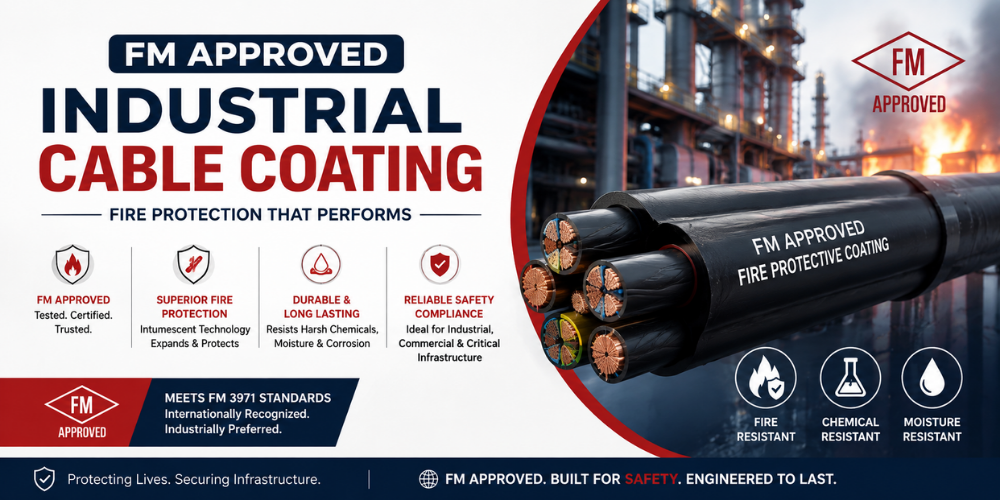
An FM Approved industrial cable coating refers to a certified passive fire protection product tested and evaluated under stringent property-loss-prevention standards established by FM Approvals.
The term must be used with precision. A coating should never be marketed or assumed as FM Approved simply because it possesses fire-retardant properties. Project engineers and procurement teams should verify:
- Exact product formulation and manufacturer
- Official FM certificate identification and listing
- Tested scope, fire exposure ratings, and limitations
- Required dry film thickness (DFT) and application methods
Depending on the formulation, an FM Approved industrial cable coating is engineered to address key fire risks:
- Limiting flame propagation along grouped cable arrangements
- Providing thermal insulation against direct heat exposure
- Protecting cable jacket integrity during localized fire incidents
- Reducing smoke and toxic byproduct emission
Why Industrial Cable Fire Protection Matters
Electrical cables serve as the nervous system of modern industrial sites—transmitting power, instrumentation signals, control commands, and emergency communications. A standard facility may house kilometers of cabling routed through cable trays, utility tunnels, switchgear rooms, and vertical shafts.
Because cable runs interconnect disparate operational areas, a fire originating in one zone can travel rapidly along cable bundles. Applying a certified FM Approved industrial cable coating limits flame spread and protects adjacent process areas from secondary ignition.
FM Approved Industrial Cable Coating Applications
Different industries face distinct operational hazards, requiring tailored passive fire protection approaches.
+---------------------+---------------------------------------------------------+
| Industry / Sector   | Critical Protection Focus                               |
+---------------------+---------------------------------------------------------+
| Power Generation    | Turbine controls, switchgear, emergency generators      |
| Oil & Gas           | Hydrocarbon processing units, emergency shutdown (ESD)  |
| Data Centers        | Server power feeds, UPS cabling, network trunk lines    |
| Manufacturing       | Automation lines, PLC systems, motor control centers    |
| Commercial Bldgs    | Smoke management, life-safety power, riser shafts       |
+---------------------+---------------------------------------------------------+
Power Plants & Heavy Industry
Power generation facilities depend on continuous circuit operation. Specifying an FM Approved industrial cable coating safeguards high-voltage runs, generator connections, and emergency systems from catastrophic heat damage.
Oil, Gas, and Petrochemicals
Refineries and chemical plants present severe fire hazards from hydrocarbons and volatile vapors. Where coatings are deployed, they must resist chemical vapors, moisture, and extreme ambient conditions while maintaining certified fire resistance.
Data Centers and Commercial Facilities
Data centers and commercial buildings require high service continuity. Cable coatings installed in plenum spaces and vertical risers help prevent fire spread between floors while minimizing structural disruption.
Cable Tray Fire Protection: Horizontal & Vertical
Cable trays carry tightly packed bundles of power and signal lines. Applying an FM Approved industrial cable coating over open or ladder trays prevents dense cable groupings from becoming fuel beds.
- Vertical Cable Trays: Vertical runs create a natural chimney effect, accelerating upward flame spread. Coatings used on vertical runs must be evaluated for vertical burn resistance.
- Horizontal Cable Trays: Horizontal runs require uniform top-and-bottom coating coverage to prevent longitudinal fire travel across rooms or fire compartments.
Intumescent Technology and Coating Thickness
Most modern cable protection systems utilize intumescent technology. Under normal temperatures, the coating forms a flexible, durable outer skin. When exposed to severe fire or radiant heat, the material undergoes a chemical reaction, swelling into an expanded insulating char layer.
A high-performance intumescent FM Approved industrial cable coating reacts to heat by expanding multi-fold, slowing thermal transfer to the cable jacket.
Managing Dry Film Thickness (DFT)
Achieving the exact specified thickness is critical:
- Under-application: Fails to build the required char volume during a fire, leading to premature cable breakdown.
- Over-application: Can cause mud-cracking, sagging, prolonged curing cycles, and poor adhesion.
Installers must measure Wet Film Thickness (WFT) during spraying or brushing and verify final Dry Film Thickness (DFT) with calibrated gauges.
Cable Jacket Compatibility & Surface Preparation
Cables are manufactured with diverse outer jacket polymers, including PVC, XLPE, PE, and LSZH (Low Smoke Zero Halogen).
Confirming compatibility before applying an FM Approved industrial cable coating prevents delamination, jacket degradation, or poor bonding over the service life of the installation.
Essential Surface Preparation Steps:
- Decontamination: Remove all industrial dust, oil, grease, and chemical residue.
- Moisture Removal: Ensure cables are completely dry before application.
- Physical Inspection: Verify jackets have no existing mechanical splits or dielectric faults.
Selecting an FM Approved Industrial Cable Coating
When evaluating an FM Approved industrial cable coating, procurement teams should inspect the complete technical submittal package to verify:
- Official FM approval certificate and listing number
- Tested cable configurations (tray types, loading density, orientation)
- Minimum required DFT for the targeted fire rating
- Environmental ratings (UV resistance, indoor/outdoor suitability, chemical resistance)
- Application guidelines, shelf life, and storage parameters
Quality Control, Inspection, and Maintenance
Passive fire protection requires ongoing verification throughout its lifecycle:
- Application QC: Maintain batch traceability logs, ambient temperature/humidity records, and DFT verification sheets.
- Routine Inspection: Routine inspection of an installed FM Approved industrial cable coating helps identify mechanical abrasion, chemical attack, flaking, or cracking caused by plant modifications.
- Repair Protocol: Any coating damaged during cable additions or retrofits must be repaired using the original manufacturer’s approved repair procedure.
Working with Gopalfiresafety
For facilities seeking a high-grade FM Approved industrial cable coating, Gopalfiresafety provides certified fire safety products and engineered solutions tailored to industrial and commercial requirements. Explore Gopalfiresafety’s product portfolio and follow their Instagram channel for updates on passive fire protection best practices and technical specifications.