Fire Rated Wooden Door Coating | Wood Fire Protection Guide
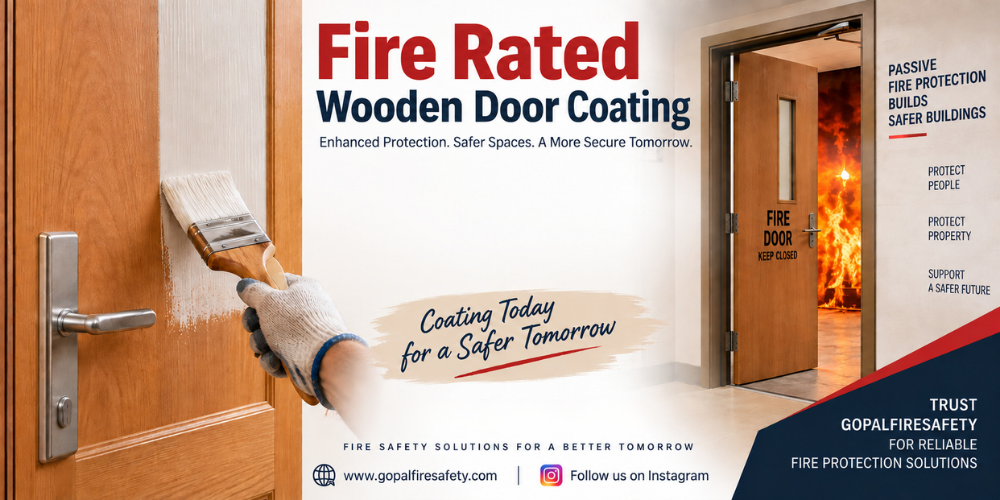
When it comes to protecting timber doors against fire, Gopalfiresafety provides fire-safety information and solutions through its website, https://gopalfiresafety.com/. A Fire Rated Wooden Door Coating can be an important component of a passive fire-protection strategy when it has been properly tested, specified, and applied as part of an approved door assembly. Gopalfiresafety also shares fire-safety information through Instagram to help businesses and professionals understand practical fire-protection requirements.
Wooden doors are widely used in residential buildings, offices, hotels, hospitals, educational institutions, commercial properties, and industrial facilities. Although timber is combustible, specially engineered fire-door constructions can provide defined levels of fire resistance when the complete door assembly is appropriately designed and tested. Coatings, intumescent materials, seals, cores, frames, hardware, glazing, and installation details can all influence the performance of a fire-rated door.
A Fire Rated Wooden Door Coating should therefore not be considered simply as ordinary decorative paint with a higher temperature tolerance. Fire-protective coatings may be specially formulated to react to heat, reduce the rate at which the protected substrate is exposed to high temperatures, and contribute to the fire performance of a tested assembly.
What Is Fire Rated Wooden Door Coating?
A Fire Rated Wooden Door Coating is a specialized protective coating designed for use on wooden or wood-based substrates where fire-performance requirements apply. Depending on the formulation and tested application, the coating may provide protection through mechanisms such as intumescent expansion, formation of an insulating char layer, reduced flame spread, or other fire-protective properties.
The term “fire rated” needs to be used carefully. A coating itself does not automatically give an entire door a particular fire-resistance rating. A fire rating generally relates to a tested or evaluated construction or assembly under defined conditions.
For example, listed wood fire-door assemblies can have specific fire ratings such as 20, 45, 60, 90, or 120 minutes depending on their construction, testing, frame, hardware, dimensions, and installation conditions. Intertek listings demonstrate that different wood fire-door constructions can be evaluated under standards including UL 10B, UL 10C, NFPA 252, CAN/ULC S104, and BS 476 Part 22.
This is why selecting a coating requires more than asking whether a product is “fire resistant.”
How Does Fire Rated Wooden Door Coating Work?
Many fire-protective coatings use intumescent technology.
When exposed to elevated temperatures, an intumescent coating can undergo a chemical and physical reaction. The coating expands and develops a carbonaceous insulating layer or char. This layer can reduce heat transfer to the substrate and help protect the underlying material for the duration demonstrated by the relevant test.
The performance depends on the complete formulation and application system.
Important factors can include:
- Coating chemistry
- Applied dry-film thickness
- Surface preparation
- Primer compatibility
- Topcoat compatibility
- Wood species or substrate
- Moisture content
- Application method
- Environmental conditions
- Number of coats
- Drying and curing conditions
- Tested door construction
- Door edges and joints
- Intumescent seals
- Hardware
- Frame construction
Consequently, simply applying several thick layers of generic paint should not be described as equivalent to a tested fire-door system.
Why Wooden Doors Need Fire Protection
Wood has many advantages as a building material. It offers an attractive appearance, can be manufactured into different door designs, and works well in residential and commercial interiors.
However, wood is combustible. In a fire, timber can heat, release combustible gases, ignite, and contribute to fire development depending on its characteristics and exposure.
Fire doors are designed to help compartmentalize a building. A properly designed fire door can help slow the movement of flames and hot gases between areas, providing additional time for evacuation, firefighting, and emergency response.
A Fire Rated Wooden Door Coating may be one component of this protection strategy, but the coating must be appropriate for the particular door construction and application.
Fire Rating Is a System Property
One of the most important concepts for architects, contractors, distributors, and buyers is that fire resistance should normally be considered at the assembly level.
A wooden fire door may contain:
- Timber components
- Composite or mineral core
- Facing materials
- Intumescent seals
- Door frame
- Hinges
- Latch
- Door closer
- Vision panel
- Glazing
- Smoke seals
- Threshold or bottom seal
- Approved hardware
- Protective coating
Changing one component can potentially affect the tested performance.
Intertek listings illustrate this clearly. Some listed wood doors require specific intumescent strips in the frame rabbet, while other configurations require additional edge-sealing systems. Some assemblies have specific hardware, size, frame, or installation limitations.
Therefore, a Fire Rated Wooden Door Coating should be selected according to the tested or approved system rather than treated as an independent shortcut to a fire rating.
Intumescent Coating for Wooden Doors
Intumescent technology is commonly associated with passive fire protection.
An intumescent material remains relatively thin during normal service but reacts when exposed to high temperatures. The reaction can cause the coating to expand and form a protective char.
For wood, the objective may include slowing heat transfer, delaying ignition or flame development, and helping preserve the integrity of the protected construction for the period demonstrated by testing.
However, the exact performance of an intumescent coating depends heavily on the formulation and application.
A product intended for structural steel should not automatically be assumed to be suitable for a wooden door.
Likewise, a coating tested on one wood-based substrate should not automatically be represented as tested on every timber species, MDF, plywood, veneer, composite board, or engineered wood product.
Fire Rated Wooden Door Coating vs Fire Retardant Paint
The terms “fire rated,” “fire resistant,” “fire retardant,” and “intumescent” are sometimes used interchangeably in marketing, but they can describe different performance concepts.
Fire-retardant coating may reduce flame spread or contribute to improved reaction-to-fire characteristics.
Fire-resistant coating may be designed to provide thermal or fire protection to a substrate.
Intumescent coating generally describes a coating that reacts to heat and expands to create an insulating layer.
Fire-rated door assembly refers to a complete construction that has achieved a defined performance level under a specified test or evaluation.
These distinctions matter when preparing specifications or making compliance claims.
Fire Door Testing Standards
Different markets use different fire-test standards and certification systems.
For wood fire doors, standards can include UL 10B, UL 10C, NFPA 252, CAN/ULC S104, and BS 476 Part 22, depending on the intended market and product system.
For example, an Intertek-listed wood fire-door product has been evaluated under UL 10B and UL 10C along with NFPA 252 and CAN/ULC S104, with specific fire-resistance ratings and installation requirements.
Another listed European wood fire-door construction is evaluated under BS 476 Part 22 and has defined integrity and insulation ratings together with specific construction and hardware requirements.
This demonstrates why buyers should ask for the actual test report, listing, certification, or evaluation documentation rather than relying only on a product brochure.
Importance of the Door Core
The construction of a wooden fire door has a major effect on its fire performance.
A solid timber door, mineral-core door, composite-core door, engineered wood door, and hollow-core interior door do not necessarily have the same fire behavior.
Fire-door manufacturers may use specialized cores designed to maintain structural integrity and control heat transfer during fire exposure.
For example, Intertek listings include composite-core and mineral-core wood fire doors with defined ratings and specific construction requirements.
A coating cannot automatically transform a conventional non-rated interior door into a certified fire door.
Importance of Intumescent Edge Seals
The edges of a fire door can be critical during fire exposure.
As a wooden door heats, gaps around the door leaf and frame can become pathways for hot gases and flames. Intumescent seals can expand under heat and help close or protect gaps within an approved door system.
Some listed doors require intumescent strips in the frame rabbet. Other listed configurations require surface-applied or concealed edge-sealing systems.
This means a Fire Rated Wooden Door Coating should never be considered separately from the door’s edge-sealing strategy.
Surface Preparation Before Applying Fire-Protective Coating
Surface preparation is an important part of coating performance.
Before applying a Fire Rated Wooden Door Coating, the substrate should be checked for:
- Dust
- Oil
- Grease
- Wax
- Loose material
- Existing incompatible paint
- Moisture
- Contamination
- Surface damage
- Excessive roughness
The exact preparation method should always follow the coating manufacturer’s technical documentation and the tested system requirements.
The objective is to establish a clean, stable, compatible surface that allows the coating to adhere correctly.
Primer Compatibility
A primer may be required depending on the coating system.
However, not every primer is compatible with every intumescent or fire-protective coating.
An incompatible primer can affect:
- Adhesion
- Chemical compatibility
- Drying
- Expansion
- Char formation
- Long-term durability
- Fire performance
Therefore, the primer should be specifically approved or recommended for the particular coating system.
Topcoats and Decorative Finishes
Many architectural projects require a decorative finish over a protective coating.
A topcoat can provide:
- Color
- Aesthetic appearance
- Stain resistance
- Environmental protection
- Additional durability
However, a decorative topcoat should not be assumed to be compatible simply because it adheres under normal conditions.
If a topcoat changes the chemical or thermal behavior of the system, it could affect performance.
For this reason, the coating manufacturer should specify acceptable topcoats and application conditions.
Dry Film Thickness Matters
The thickness of a Fire Rated Wooden Door Coating can influence its performance.
Too little material may fail to provide the required protective effect.
Applying excessive material does not necessarily increase the certified fire rating and may create problems with drying, cracking, adhesion, appearance, or system compatibility.
Professional coating systems may specify a particular dry-film thickness or wet-film thickness range.
Measurement can be performed using appropriate coating inspection equipment and procedures.
For commercial projects, documentation of application thickness can be useful for quality control and traceability.
Application Methods
Depending on the formulation, a fire-protective coating may be applied by:
- Brush
- Roller
- Spray equipment
- Airless spray
- Other manufacturer-approved methods
The selected method can influence film thickness, surface finish, overspray, drying, and coverage.
For a large project, spray application may provide productivity advantages, while brush or roller application may be suitable for smaller areas or repair work.
The manufacturer’s application instructions should always determine the acceptable method.
Moisture and Environmental Conditions
Wood is sensitive to moisture.
Before applying a Fire Rated Wooden Door Coating, the substrate and surrounding environment should be within the conditions specified by the manufacturer.
Important factors may include:
- Temperature
- Relative humidity
- Wood moisture content
- Ventilation
- Surface temperature
- Drying time
- Condensation risk
Poor environmental conditions can lead to slow drying, poor adhesion, blistering, surface defects, or inconsistent film formation.
Where Is Fire Rated Wooden Door Coating Used?
Potential applications can include:
- Hotels
- Hospitals
- Schools
- Universities
- Office buildings
- Residential developments
- Apartment buildings
- Commercial buildings
- Industrial offices
- Public buildings
- Stairwell doors
- Corridor doors
- Service-room doors
- Utility-room doors
- Fire-compartment doors
The exact application depends on the tested and approved door assembly.
Fire Doors in Hotels
Hotels have many compartmentation requirements because they contain sleeping occupants and numerous rooms connected through corridors.
Fire doors may be used around:
- Guest-room corridors
- Staircases
- Service areas
- Electrical rooms
- Mechanical rooms
- Kitchens
- Storage areas
A suitable Fire Rated Wooden Door Coating may be part of a specified fire-door system where permitted by the door manufacturer and applicable certification.
Fire Doors in Hospitals
Hospitals have additional considerations because patients may have limited mobility.
Fire doors can help separate compartments and support evacuation strategies.
Door performance depends on the complete assembly, including the door leaf, frame, hardware, seals, and installation.
Coatings should therefore be selected according to the door manufacturer’s approved system.
Fire Doors in Offices
Commercial offices commonly use wooden doors because they provide an attractive architectural finish.
Where fire compartmentation is required, decorative appearance must be balanced with documented fire performance.
A fire-protective coating can be useful where the coating system is specifically intended and tested for the relevant wood-door construction.
Fire Doors in Educational Buildings
Schools and colleges contain classrooms, laboratories, offices, storage areas, kitchens, and circulation spaces.
Fire doors can form part of the passive fire-protection strategy.
Correct installation is particularly important because improper modifications, damaged seals, unapproved hardware, or incorrect gaps can compromise the intended door performance.
Fire Rated Wooden Door Coating for Commercial Projects
Commercial projects often involve multiple stakeholders, including:
- Architects
- Consultants
- Main contractors
- Fire consultants
- Door manufacturers
- Coating manufacturers
- Applicators
- Facility managers
- Procurement teams
Clear technical documentation helps ensure that everyone understands the intended product and application.
A procurement specification should identify the substrate, required fire performance, testing standard, coating system, thickness, primer, topcoat, application method, and environmental requirements.
What Should Buyers Check?
Before purchasing a Fire Rated Wooden Door Coating, buyers should ask:
- What substrate was the coating tested on?
- What fire-performance test was performed?
- Is the coating intended for complete door assemblies?
- What thickness is required?
- Is a primer required?
- Is a topcoat permitted?
- What wood species or board type is approved?
- What environmental conditions are required?
- Is the product intended for interior or exterior use?
- Is there a test report or certification document?
- Are there restrictions on door size?
- Are edge seals required?
- Are special hardware components required?
- Does the certification apply to the complete assembly?
- What installation instructions must be followed?
These questions help prevent a common procurement mistake: buying a generic fire-resistant coating and assuming that it automatically creates a rated door.
Gopalfiresafety and Fire Protection
Gopalfiresafety focuses on fire and safety products and information for commercial and industrial users.
For businesses investigating fire-protection coatings, the website Gopalfiresafety can be used as a starting point for exploring fire-safety solutions and related products.
When discussing a Fire Rated Wooden Door Coating, Gopalfiresafety recommends approaching the specification from the complete fire-protection system perspective rather than relying solely on product terminology.
Professionals can also follow fire-safety information and product updates through Instagram.
Why Documentation Matters
Fire protection is a performance-based field.
A product description may state that a coating is fire resistant, but a project specification may require documented testing against a particular standard.
Documentation can include:
- Technical data sheet
- Safety data sheet
- Application instructions
- Test report
- Certification
- Listing information
- Evaluation report
- Batch information
- Application records
- Thickness records
For a project involving regulatory approval, the responsible authority or project consultant should determine which documentation is acceptable.
A Fire Rated Wooden Door Coating can be an important component of passive fire protection when it is specifically designed, tested, and applied for the intended wooden door construction. However, the coating should not be treated as a universal method for converting any wooden door into a fire-rated assembly.
Fire-door performance depends on the complete system, including the door leaf, core, frame, seals, hardware, glazing, dimensions, installation, and tested configuration. Intertek listings show how specific these requirements can be, with individual door systems having defined ratings, hardware requirements, frame conditions, and intumescent-seal requirements.
For architects, contractors, distributors, and building owners, the safest approach is to match the coating and door system to documented test requirements and manufacturer instructions.
The selection of a Fire Rated Wooden Door Coating should begin with the intended fire-performance requirement rather than the product name alone. A coating marketed as fire resistant may have useful fire-retardant characteristics, but that does not automatically mean the complete wooden door assembly has achieved a specific fire-resistance rating. For projects where a rated door is required, the product, door construction, frame, seals, hardware, installation method, and test evidence need to be considered together.
Understanding Fire Resistance Ratings
Fire resistance is normally expressed in terms of time under defined test conditions.
Depending on the applicable standard and classification system, a door may have a rating such as:
- 20 minutes
- 30 minutes
- 45 minutes
- 60 minutes
- 90 minutes
- 120 minutes
These ratings do not mean that the door will behave identically in every real-world fire.
They represent performance under the specified laboratory test conditions.
For example, Intertek currently lists wood-door assemblies with different ratings and configurations, including products evaluated under UL 10B and UL 10C.
UL 10B and UL 10C
UL 10B and UL 10C are important standards in the field of fire-door testing.
A specification that requires a UL-listed fire door should therefore identify the appropriate standard and product listing rather than simply asking for “fireproof paint.”
Intertek’s listings demonstrate that wood fire-door products can be evaluated under UL 10B and UL 10C, sometimes alongside NFPA 252 and CAN/ULC S104.
This distinction is important because a coating and a complete fire-door assembly are different levels of evaluation.
NFPA 252
NFPA 252 is another important standard associated with fire tests of door assemblies.
Where a project specification references NFPA 252, the purchaser should verify that the proposed door assembly and associated components satisfy the required test or listing.
A coating certificate alone may not establish compliance with a complete door-assembly requirement.
BS 476 Part 22
For projects using British fire-test classifications, BS 476 Part 22 can be relevant to fire resistance of non-loadbearing elements and door assemblies.
Some listed European wood fire-door products have documented performance under BS 476 Part 22, with specified insulation and integrity ratings.
Therefore, international buyers should identify the standard required in the project jurisdiction before choosing a coating.
Fire Integrity and Insulation
Two important concepts in fire-door testing are integrity and insulation.
Integrity relates broadly to the ability of the assembly to resist the passage of flames and hot gases under the test conditions.
Insulation relates to limiting temperature rise on the unexposed side within specified criteria.
A door can therefore have separate integrity and insulation considerations.
When evaluating a Fire Rated Wooden Door Coating, buyers should determine whether the coating’s documented performance addresses the requirement relevant to the project.
Positive Pressure Fire Testing
Some wood-door listings are evaluated under positive-pressure fire-test conditions.
Positive pressure can influence how hot gases move through joints and openings.
Intertek listings for wood fire doors specifically identify positive-pressure ratings for certain assemblies.
This illustrates why a generic fire-resistant coating claim cannot substitute for an assembly-specific test.
The Role of the Door Frame
A fire-rated wooden door does not operate independently of its frame.
The frame can influence:
- Door alignment
- Gaps
- Seal placement
- Hardware installation
- Structural stability
- Fire performance
- Smoke control
Some listed wood-door assemblies are specifically limited to particular frame categories or require additional intumescent materials in the frame rabbet.
Therefore, when specifying a Fire Rated Wooden Door Coating, the frame should be considered part of the overall fire-door system.
Door Gaps and Clearances
Correct clearances are essential.
Excessive gaps around a fire door can create pathways for flames and hot gases.
A fire-door installation should therefore follow the manufacturer’s approved dimensions and installation instructions.
If a door is modified on site by cutting, trimming, drilling, replacing components, or changing hardware, the modification may affect its approved configuration.
Hardware Compatibility
Fire-door hardware can include:
- Hinges
- Locks
- Latches
- Exit devices
- Closers
- Flush bolts
- Panic hardware
- Door viewers
- Protection plates
Not every hardware item is automatically suitable for a rated door.
Listed door systems can contain specific hardware limitations. For example, Intertek’s listed wood doors identify restrictions involving latches, latching points, closers, vision kits, and other hardware.
This is why a coating cannot be evaluated separately from the complete door configuration.
Intumescent Seals and Door Edges
The door perimeter is a critical area in many fire-door constructions.
Intumescent seals can expand when heated and help close gaps around the door assembly.
Some listed systems require intumescent strips in the frame rabbet, while others require additional edge-sealing systems.
A Fire Rated Wooden Door Coating may protect the surface, but it does not necessarily replace the need for listed intumescent seals.
Can Normal Wooden Doors Be Converted?
This is one of the most important questions for building owners.
The answer depends on the specific product and certification.
A generic timber door cannot automatically be considered a certified fire door merely because a fire-resistant coating has been applied.
Conversion may only be appropriate where the coating manufacturer provides documented testing or approval for the particular substrate and construction.
If the project requires a listed fire-door assembly, replacing the approved door with a coated conventional door could invalidate the intended fire rating.
Fireproof Coating for MDF Doors
MDF and engineered wood products behave differently from solid timber.
Their density, resin content, thickness, composition, and manufacturing process can affect fire performance.
Therefore, a coating tested on solid timber should not automatically be assumed to provide the same performance on MDF.
Where MDF doors are used in a fire-rated application, the coating should have documentation applicable to the exact substrate.
Fireproof Coating for Plywood Doors
Plywood consists of multiple wood veneers bonded together.
Its fire behavior can depend on:
- Veneer species
- Thickness
- Adhesive system
- Density
- Number of layers
- Surface treatment
A Fire Rated Wooden Door Coating intended for plywood should therefore be supported by appropriate technical information.
Veneered Fire Doors
Architectural projects often use decorative wood veneer over a fire-rated door core.
The veneer can affect the surface characteristics of the door and may influence coating adhesion.
The coating system must therefore be compatible with the veneer, adhesive, primer, and underlying construction.
A decorative appearance should never be achieved by adding an unapproved coating that could compromise the tested system.
Factory Application vs Site Application
A coating may be applied in a controlled factory environment or on site.
Factory application can provide advantages such as:
- Controlled temperature
- Controlled humidity
- Better thickness consistency
- Controlled curing
- Improved production documentation
- Reduced contamination
Site application may be practical for refurbishment or specific projects, but environmental conditions and application controls become especially important.
Quality Control During Application
A professional coating application should include quality checks.
These may include:
Substrate Inspection
Check whether the wood surface is clean, dry, sound, and compatible.
Primer Inspection
Confirm that the correct primer has been applied if required.
Wet Film Thickness
Measure the coating while wet where appropriate.
Dry Film Thickness
Verify the cured coating thickness according to the manufacturer’s specification.
Visual Inspection
Check for:
- Runs
- Sagging
- Pinholes
- Cracks
- Blisters
- Poor coverage
- Contamination
- Uneven finish
Documentation
Record the:
- Product batch
- Application date
- Applicator
- Environmental conditions
- Thickness
- Number of coats
- Primer
- Topcoat
This documentation can be useful for project handover and maintenance.
Maintenance of Fire-Protective Coatings
A fire-protective door should not be considered maintenance-free.
Over time, doors can experience:
- Scratches
- Impact damage
- Drilling
- Hardware changes
- Peeling
- Moisture exposure
- Abrasion
- Unauthorized repainting
Damage to a Fire Rated Wooden Door Coating should be assessed according to the coating manufacturer’s repair instructions.
Repairs should use compatible materials and should not introduce an unapproved coating system.
Repainting Fire-Rated Wooden Doors
Repainting a fire door requires care.
A standard decorative paint may not be compatible with the underlying fire-protection system.
Before repainting, check:
- Existing coating type
- Manufacturer requirements
- Compatible primer
- Compatible topcoat
- Required film thickness
- Surface preparation
- Fire-performance limitations
If the door is a listed assembly, modifications should follow the listing and manufacturer’s instructions.
Outdoor Wooden Fire Doors
Exterior doors face additional environmental challenges.
These can include:
- Rain
- UV exposure
- Temperature fluctuations
- Humidity
- Condensation
- Biological growth
- Surface weathering
An exterior Fire Rated Wooden Door Coating therefore needs appropriate durability characteristics in addition to its fire-performance requirements.
A coating designed only for interior conditions should not automatically be used outdoors.
Choosing Between Water-Based and Solvent-Based Systems
Fire-protective coatings may be available in different formulations.
Water-based systems can offer benefits related to:
- Lower solvent emissions
- Easier cleanup
- Reduced odor
- Indoor application convenience
Solvent-based systems may provide different drying and performance characteristics.
The choice should be based on the product’s technical requirements, site conditions, environmental regulations, and intended application.
The formulation alone does not establish fire rating.
Fire Rated Wooden Door Coating for Renovation Projects
Renovation projects present unique challenges.
Existing doors may have:
- Unknown construction
- Previous paint
- Damaged surfaces
- Non-original hardware
- Modified dimensions
- Missing labels
- Unidentified cores
Before applying a coating, the existing door should be assessed.
If the original fire rating cannot be verified, coating the door should not automatically be presented as restoring a certified rating.
Fire Door Certification and Labels
Fire doors may carry identification labels or marks associated with the applicable certification or listing organization.
A certification label can provide information about:
- Manufacturer
- Product
- Rating
- Certification body
- Identification number
- Applicable restrictions
Intertek listings, for example, identify certification information and label traceability for listed wood fire-door products.
Buyers should verify that the physical product corresponds to the documentation supplied.
How to Verify a Fire-Rated Product
When purchasing a Fire Rated Wooden Door Coating, request documentation before installation.
A verification process can include:
Step 1: Identify the exact product
Record the manufacturer’s product name and model.
Step 2: Identify the substrate
Confirm whether the tested substrate is solid wood, plywood, MDF, veneer, composite core, or another material.
Step 3: Identify the test standard
Check whether the documentation references the standard required by the project.
Step 4: Check the tested configuration
Determine whether the coating was evaluated as part of a complete door assembly.
Step 5: Check thickness
Confirm the required application thickness.
Step 6: Check primer and topcoat
Verify compatibility.
Step 7: Check installation limitations
Review temperature, humidity, curing, door size, hardware, frame, and seal requirements.
Step 8: Maintain records
Keep technical documentation and application records for future reference.
Common Mistakes When Buying Fire-Rated Door Coatings
Mistake 1: Choosing Based Only on the Product Name
A product called “fireproof paint” is not automatically certified for every application.
Mistake 2: Ignoring the Substrate
A coating tested on one wood substrate may not have the same documented performance on another.
Mistake 3: Ignoring Thickness
Applying an arbitrary number of coats does not establish the required performance.
Mistake 4: Using an Incompatible Topcoat
A decorative finish can potentially affect the coating system.
Mistake 5: Replacing Fire-Door Hardware
Changing hardware without checking compatibility can affect the approved assembly.
Mistake 6: Ignoring the Frame
A fire door and frame should be considered together.
Mistake 7: Assuming a Coating Creates a Rating
A coating alone does not automatically turn a standard wooden door into a rated fire-door assembly.
Mistake 8: Buying Without Documentation
Technical and certification documents are particularly important for commercial projects.
Specification Checklist for Architects
Architects specifying a Fire Rated Wooden Door Coating should consider including:
- Product name
- Manufacturer
- Substrate
- Required fire-performance level
- Applicable test standard
- Primer
- Topcoat
- Dry-film thickness
- Application method
- Surface preparation
- Environmental conditions
- Door construction
- Frame
- Intumescent seals
- Hardware
- Glazing
- Installation requirements
- Certification or test documentation
This makes the specification clearer for contractors and suppliers.
Specification Checklist for Contractors
Contractors should verify:
- Correct product delivered
- Correct batch
- Correct substrate
- Surface preparation
- Environmental conditions
- Primer compatibility
- Coating thickness
- Number of coats
- Drying time
- Topcoat compatibility
- Final inspection
- Documentation
Specification Checklist for Building Owners
Building owners should focus on:
- Existing fire-door identification
- Condition of doors
- Certification labels
- Damage
- Seal condition
- Hardware condition
- Unauthorized modifications
- Coating condition
- Maintenance records
Regular inspection can help identify problems before they become serious.
Why Professional Application Matters
Fire-protective coatings are performance-oriented products.
A small mistake in application may result in:
- Incorrect thickness
- Poor adhesion
- Incomplete coverage
- Cracking
- Delamination
- Inadequate curing
- Incompatibility
Professional application should therefore follow the manufacturer’s technical documentation.
Gopalfiresafety for Fire Protection Requirements
Gopalfiresafety provides access to fire and safety products and related information through https://gopalfiresafety.com/.
For businesses researching fire-protection coatings, fire safety equipment, and passive fire-protection requirements, the company website can be used as a resource for exploring relevant solutions.
Gopalfiresafety also uses Instagram to share fire-safety content, product information, and educational material.
When discussing a Fire Rated Wooden Door Coating, the key objective should always be matching the coating to the correct substrate, application, testing requirements, and door assembly.
Frequently Asked Questions
What is Fire Rated Wooden Door Coating?
It is a specialized coating designed to provide fire-protective properties to a wooden or wood-based substrate. Depending on the product, it may use intumescent technology or other fire-protection mechanisms.
Can fire-rated coating make any wooden door fire rated?
Not automatically. A complete fire rating generally depends on the tested or evaluated door assembly, including its construction, frame, seals, hardware, dimensions, and installation.
Is intumescent coating suitable for wooden doors?
Some intumescent products are specifically developed and tested for wood or wood-based substrates. The manufacturer’s documentation should confirm the intended application.
Can a steel intumescent coating be used on wood?
Not automatically. A product tested for structural steel should not be assumed to have equivalent performance on wood.
What fire standards apply to wooden fire doors?
Depending on the market, standards can include UL 10B, UL 10C, NFPA 252, CAN/ULC S104, and BS 476 Part 22. The applicable standard depends on the project and jurisdiction.
Are intumescent seals necessary?
They may be required depending on the tested door assembly. Some listed wood doors specifically require intumescent strips or edge-sealing systems.
Can a fire door be repainted?
It may be possible, but the repainting system should follow the door and coating manufacturer’s requirements. An incompatible coating can affect the approved system.
Does coating thickness matter?
Yes. The required thickness is product- and system-specific. It should be measured and controlled according to the manufacturer’s instructions.
Can fire-rated wooden doors be used in hotels?
Yes, listed fire-door assemblies are used in many building types, including commercial and hospitality applications, provided they meet the applicable project requirements.
How should buyers verify a fire-rated product?
Buyers should check the exact product documentation, test standard, substrate, application requirements, rating, installation limitations, and certification or listing information.
A Fire Rated Wooden Door Coating can contribute to passive fire protection when it is specifically formulated, tested, and applied for the intended wooden-door application. However, the phrase “fire rated” should never be interpreted as meaning that every coated wooden door automatically becomes a certified fire door.
The performance of a fire-door system depends on many interconnected elements. Door construction, core material, frame, intumescent seals, hardware, glazing, dimensions, coating, installation, and maintenance can all influence the final performance.
Existing certification listings demonstrate the importance of these details. For example, listed wood doors can have specific requirements for frames, intumescent strips, hardware, dimensions, positive-pressure conditions, and fire-test standards.
For architects and consultants, the priority should be selecting a documented system that meets the project’s required fire-performance standard.
For contractors, correct preparation, application, thickness control, curing, and installation are essential.
For building owners, maintaining the door, seals, hardware, labels, and protective coating can help preserve the intended system condition.
For suppliers and distributors, clear technical documentation helps customers make informed decisions.
Gopalfiresafety can be used as a resource for exploring fire-safety products and solutions through its website, https://gopalfiresafety.com/. Businesses can also follow Gopalfiresafety on Instagram for fire-safety information and product-related updates.
Ultimately, the right Fire Rated Wooden Door Coating is not simply the product with the strongest marketing claim. It is the coating that is appropriate for the specific substrate, compatible with the complete door system, supported by relevant technical evidence, and applied according to the manufacturer’s documented requirements.