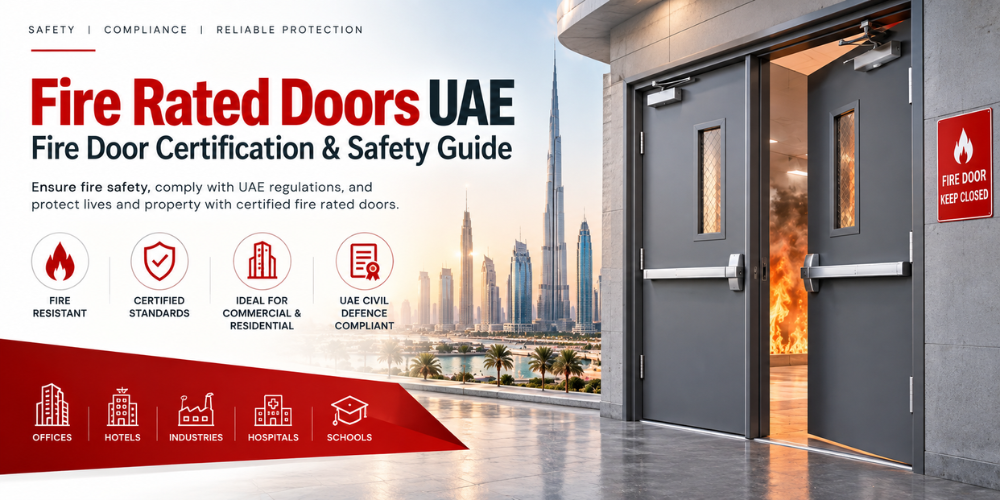
Why Are Fire Rated Doors Important in the UAE?
Introduction
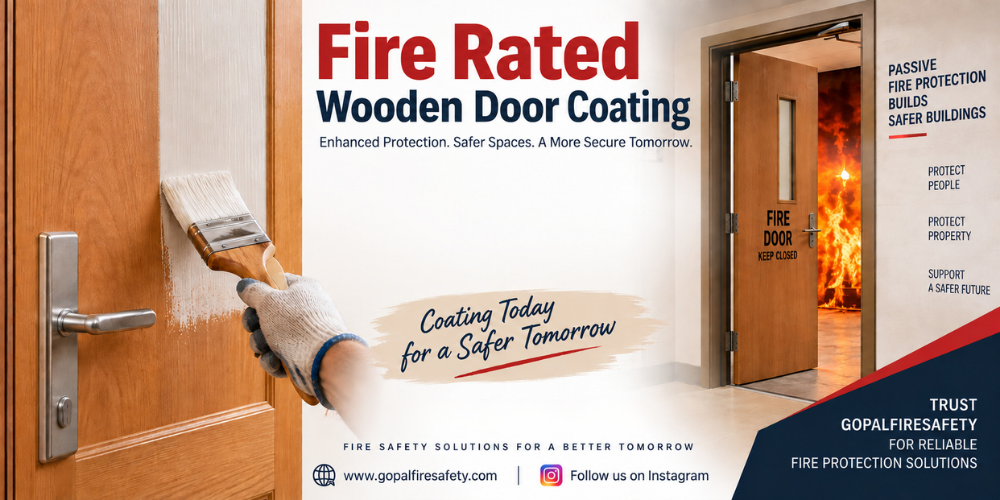
Fire Rated Doors UAE are an important part of passive fire protection in commercial buildings, residential towers, hotels, hospitals, offices, industrial facilities and other properties. Gopalfiresafety provides fire-safety products and information through https://gopalfiresafety.com/, helping businesses, contractors, consultants and project professionals understand fire-protection requirements. Gopalfiresafety also shares fire-safety information, product updates and educational content through Instagram. In the UAE, fire door requirements can involve product testing, certification, installation, identification, maintenance and approval by the relevant authority.
Fire doors are not simply ordinary doors manufactured with fire-resistant materials. A properly tested fire door is an assembly designed to perform under defined fire-exposure conditions. Depending on the tested system, the assembly can include the door leaf, frame, hinges, closer, latch or lock, intumescent seals, glazing, hardware and other components.
The UAE has specific fire and life-safety requirements, and Dubai Civil Defence has published requirements concerning fire-resistant doors and product certification. Dubai Civil Defence has stated that fire-resistant doors for Dubai building projects are subject to evaluation through the Emirates Safety Laboratory and certification by an approved certification body, with a Certificate of Conformity used for product registration.
This makes accurate product selection particularly important for anyone sourcing Fire Rated Doors UAE for a construction or renovation project.
What Are Fire Rated Doors?
Fire-rated doors are specially tested door assemblies designed to provide a defined level of fire performance for a specified period under a recognized test procedure.
The purpose of a fire door is generally to help maintain compartmentation and protect openings in fire-resisting walls and other protected areas.
A fire door may help:
- Limit the spread of fire
- Limit the passage of hot gases
- Protect escape routes
- Protect stairways
- Separate fire compartments
- Protect service rooms
- Protect plant rooms
- Protect shafts
- Protect corridors
- Protect certain high-risk areas
The actual performance depends on the tested door assembly and the applicable classification.
A fire door should therefore not be considered independently from its frame and associated components.
Why Fire Rated Doors Are Important in the UAE
The UAE has extensive commercial, residential and industrial development, including high-rise buildings, hotels, shopping centres, hospitals, warehouses and mixed-use developments.
Fire compartmentation is an important part of building fire safety.
A fire-resistant wall may be designed to restrict fire spread, but openings through that wall can create weak points if they are not appropriately protected.
Doors installed in those openings may therefore need defined fire performance.
Dubai Civil Defence’s published information specifically identifies fire-resistant doors among products subject to updated safety requirements and certification processes.
For projects involving Fire Rated Doors UAE, the project team should identify the required rating and certification route before ordering doors.
Fire Door Ratings Explained
Fire doors are often described using ratings such as:
- 30 minutes
- 45 minutes
- 60 minutes
- 90 minutes
- 120 minutes
- 180 minutes
The actual rating required depends on the location, occupancy, wall construction, building design and applicable code requirements.
A “60-minute” door should not simply be interpreted as a generic door that can withstand fire for exactly 60 minutes in every situation.
The rating is connected to a defined test method and classification.
For example, European door testing can use EN 1634-1, while other project specifications may reference standards such as UL 10B, UL 10C, NFPA 252 or BS 476 Part 22. UAE-accredited testing capabilities include these standards for fire-resistance-rated door assemblies.
Fire Door Integrity and Insulation
Fire door classifications can involve different performance characteristics.
Two commonly discussed characteristics are:
Integrity (E): The ability of the tested assembly to resist fire penetration under the applicable test conditions.
Insulation (I): The ability to limit heat transmission through the door assembly according to the relevant classification.
Another characteristic that may be relevant is radiation performance.
The exact classification depends on the test standard.
For example, official UAE product records can contain fire door assemblies tested to EN 1634-1 with separate values for integrity, radiation and insulation.
This illustrates why buyers should examine the complete classification instead of looking only at the number of minutes.
Common Types of Fire Doors
Fire doors can be manufactured in different configurations.
Steel Fire Doors
Steel doors are widely used in:
- Industrial facilities
- Plant rooms
- Warehouses
- Electrical rooms
- Service corridors
- Commercial buildings
They can provide robust construction and can be manufactured in different fire-rated configurations.
Wooden Fire Doors
Wooden fire doors can be used in:
- Hotels
- Offices
- Apartments
- Residential buildings
- Interior commercial areas
Their construction can include specially engineered cores, timber components, intumescent materials and tested finishes.
Glazed Fire Doors
Fire-rated glazing can allow visibility while maintaining specified fire performance.
These doors can be useful in:
- Corridors
- Offices
- Commercial spaces
- Lobbies
- Stair areas
The glass must be part of the tested door system.
Double Fire Doors
Double-leaf doors can be used where larger openings are required.
Their fire performance depends on the complete tested assembly, including the meeting stile, seals, hardware and frame.
Single Fire Doors
Single-leaf fire doors are commonly used for:
- Offices
- Service rooms
- Staircases
- Corridors
- Plant rooms
- Residential entrances
Again, the required rating must be determined from the project requirements.
Fire Door Assembly
One of the most important concepts when purchasing Fire Rated Doors UAE is understanding the term “door assembly.”
A fire door assembly can include:
- Door leaf
- Frame
- Hinges
- Door closer
- Lock or latch
- Intumescent seals
- Smoke seals
- Vision panel
- Fire-rated glass
- Threshold
- Fixings
- Other tested hardware
The certification or test evidence may apply to the assembly rather than just the door leaf.
Changing a component can affect the tested configuration.
For example, replacing certified fire-rated glass with ordinary glass could invalidate the intended fire performance.
Similarly, installing an unapproved door closer or changing the frame construction may create a non-compliant configuration.
Intumescent Seals
Intumescent seals are an important component of many fire door assemblies.
When exposed to high temperatures, an intumescent material can expand and form a protective char.
This expansion can help close gaps around the door leaf and restrict the passage of hot gases and flames.
Fire doors may use intumescent materials around:
- Door edges
- Frame rebates
- Hardware areas
- Glazing systems
- Other specified locations
The exact seal arrangement must follow the tested door design.
Smoke Seals
Fire protection and smoke control are related but are not identical.
Smoke seals can help restrict smoke movement through the door assembly.
Smoke is a major hazard during building fires, particularly along evacuation routes.
Where a project requires smoke control, the door assembly should be tested and specified accordingly.
Some UAE requirements and project checklists specifically identify smokeproof and self-closing requirements for particular door locations.
Self-Closing Fire Doors
A fire door may need to close automatically after being opened.
A self-closing mechanism can include:
- Hydraulic door closer
- Concealed closer
- Electromechanical closer
- Other approved closing devices
The closer should be compatible with the door assembly.
A fire door that is permanently propped open cannot perform its intended compartmentation function when a fire occurs.
For this reason, self-closing requirements can be important in protected routes and fire compartments.
Fire Doors for Staircases
Staircases are critical escape routes.
Fire doors used at stair enclosures can help maintain separation between the staircase and other building areas.
The exact rating and smoke-control requirements depend on the building design and applicable regulations.
Dubai Civil Defence documentation includes examples of staircase door requirements involving fire rating, smokeproof construction and self-closing features.
For this reason, staircase doors should be specified as complete tested assemblies rather than ordinary doors with a fire-resistant label.
Fire Doors for Corridors
Corridors can serve as evacuation routes.
Where fire-rated separation is required, the doors serving these corridors need to meet the applicable fire and smoke requirements.
Depending on the project, doors can be required to include:
- Fire resistance
- Smoke control
- Self-closing
- Appropriate hardware
- Approved glazing
- Correct labeling
The project drawings and fire strategy should establish the exact requirement.
Fire Doors for Elevator Lobbies
Elevator lobbies can require fire-rated separation depending on building design and applicable requirements.
The door assembly can include:
- Fire-rated leaf
- Fire-rated frame
- Door closer
- Intumescent seals
- Approved hardware
- Fire-rated glazing where required
The UAE fire-code documentation contains specific requirements for certain elevator-lobby door applications.
Fire Doors for Service Rooms
Electrical rooms, mechanical rooms, boiler rooms, plant rooms and other service spaces can present elevated fire risks.
Fire-rated doors may be used to maintain separation between these spaces and occupied areas.
The required rating should be established by the project’s fire strategy and applicable regulations.
Fire Doors for Industrial Buildings
Industrial buildings can contain:
- Machinery
- Electrical equipment
- Flammable materials
- Manufacturing processes
- Storage areas
- Service equipment
Fire compartmentation can therefore be an important design consideration.
Depending on the application, fire-rated doors may be required for:
- Plant rooms
- Electrical rooms
- Production areas
- Fire compartments
- Storage areas
- Protected escape routes
Fire Doors for Warehouses
Warehouses can have large storage loads and different fire hazards depending on the stored products.
Fire doors can be used between:
- Storage areas
- Offices
- Service areas
- Fire compartments
- Plant rooms
- Escape routes
The door rating should be coordinated with the wall rating and overall fire strategy.
Fire Doors for Hotels
Hotels often use fire doors throughout:
- Guest-room corridors
- Staircases
- Service areas
- Kitchens
- Plant rooms
- Electrical rooms
- Storage rooms
Hotels also require attention to aesthetics.
Wooden or decorative fire doors may therefore be selected where the tested system allows an architectural finish.
The finished door must continue to comply with the applicable tested configuration.
Fire Doors for Hospitals
Hospitals require careful fire compartmentation because occupants may have different levels of mobility.
Fire doors may be used in:
- Patient areas
- Corridors
- Staircases
- Service areas
- Electrical rooms
- Plant rooms
- Storage rooms
The specification should account for fire rating, smoke performance, accessibility and hardware requirements.
Fire Doors for Residential Towers
High-rise residential buildings commonly use fire doors at:
- Apartment entrances
- Staircases
- Corridors
- Service rooms
- Electrical rooms
- Refuse areas
The rating can vary according to location.
Apartment entrance doors, for example, may have different requirements from stairwell doors.
The applicable building design must determine the required classification.
Fire Door Frames
The frame is an essential part of the fire door assembly.
A fire-rated door leaf installed in an ordinary frame does not automatically create a fire-rated opening.
Frames can be manufactured from:
- Steel
- Timber
- Special composite materials
- Aluminum systems for specific tested assemblies
The frame must be compatible with the tested door system.
Fire Door Hardware
Hardware can include:
- Hinges
- Locks
- Latches
- Panic hardware
- Exit devices
- Door closers
- Coordinator devices
- Pull handles
- Push plates
Hardware must be compatible with the fire-rated assembly.
The use of ordinary hardware without confirming compatibility can affect certification and performance.
Fire-Rated Door Glass
Fire-rated glazing is different from ordinary safety glass.
Depending on the tested system, fire-rated glass can provide specified performance for:
- Integrity
- Radiation
- Insulation
The glass must be installed according to the certified door assembly.
A larger vision panel may require a different tested configuration.
Door Identification Labels
Identification labels are useful for establishing the door’s certified characteristics.
A label can contain information such as:
- Manufacturer
- Product identification
- Rating
- Test standard
- Certification information
- Manufacturing information
The exact marking requirements depend on the applicable certification.
Buyers should avoid accepting undocumented doors simply because the door visually resembles a certified product.
Fire doors are an essential component of passive fire protection.
For projects involving Fire Rated Doors UAE, product selection should consider the complete door assembly, applicable fire rating, testing standard, certification, hardware, glazing, frame, installation and local authority requirements.
Dubai Civil Defence has specifically identified fire-resistant doors among products subject to certification requirements, and the Emirates Safety Laboratory plays a role in the conformity process for applicable products in Dubai.
The second part covers certification, UAE approval, installation, testing, maintenance, procurement and common mistakes.
UAE Certification Requirements for Fire Doors
For anyone sourcing Fire Rated Doors UAE, certification is one of the most important considerations.
Dubai Civil Defence announced updated safety requirements under which fire-resistant doors for Dubai building projects are evaluated through the Emirates Safety Laboratory and authorized by an official certifying body in the UAE. A Certificate of Conformity can then be submitted for Dubai Civil Defence product registration.
This means that a manufacturer supplying fire doors for a Dubai project may need more than an overseas test report.
The project’s approval route should be confirmed before procurement.
This is particularly important for imported fire doors.
Emirates Safety Laboratory
The Emirates Safety Laboratory, or ESL, has a role in evaluating relevant fire-safety products.
Dubai Civil Defence states that, from January 1, 2024, ESL undertakes certification conformity checks and issues Certificates of Conformity as a requirement for applicable product approval requests, including fire-resistant doors.
Therefore, suppliers should understand the current approval requirements for the emirate and project involved.
Requirements can change, so project teams should confirm the latest applicable procedures with the relevant authority or certification body.
International Fire Door Standards
Different fire door standards can be used depending on the project and certification route.
Examples include:
- EN 1634-1
- EN 16034
- BS 476 Part 22
- UL 10B
- UL 10C
- NFPA 252
- UL 1784
UAE-accredited laboratory capabilities include several of these standards for fire-resistance-rated door assemblies.
The standard should not be selected simply because it is familiar.
The project consultant should determine which test standard and classification are required.
EN 1634-1
EN 1634-1 is a European test standard used for determining fire-resistance characteristics of doors, shutters and openable windows.
Products tested under EN 1634-1 can receive classifications involving integrity and insulation depending on the test results.
Official UAE product records demonstrate that fire door assemblies can be registered with EN 1634-1 test information and specific integrity, radiation and insulation values.
UL 10C
UL 10C is a fire test standard associated with positive-pressure fire tests of door assemblies.
Where a project specifically requires a UL-tested door, the complete certification should be verified.
A door being manufactured in accordance with a similar construction does not automatically make it UL certified.
NFPA 252
NFPA 252 provides fire-test requirements for door assemblies.
It can be relevant to projects using North American fire-protection standards.
Again, the applicable test standard should be specified by the project’s fire consultant or authority.
BS 476 Part 22
BS 476 Part 22 is another fire-resistance test route that may appear in specifications for doors and other building elements.
A supplier should clearly identify the test standard used and provide the relevant report.
Fire Door Certification Is Assembly-Based
One of the most important rules when purchasing Fire Rated Doors UAE is that certification generally relates to a defined door assembly.
For example:
Door leaf + frame + seals + hardware + glazing + installation
may represent the tested configuration.
If the supplier changes a component, the original test evidence may no longer apply.
This is why certified doors should be installed according to the manufacturer’s approved details.
Installation Requirements
Installation can be just as important as manufacturing.
A correctly tested door can perform differently if it is:
- Installed in an incorrect frame
- Improperly fixed
- Installed with excessive gaps
- Fitted with incompatible hardware
- Modified on site
- Installed without required seals
- Damaged during installation
- Held permanently open
Installation instructions should therefore form part of the project documentation.
Door Gaps
The gap between the door leaf and frame can affect fire performance.
The permitted gap depends on the tested door assembly.
Installers should not simply use an arbitrary gap based on standard carpentry practice.
The manufacturer’s approved installation details should be followed.
Fire Door Hardware Installation
Hardware should be installed without compromising the door’s certified construction.
Examples include:
- Hinges
- Locks
- Closers
- Panic bars
- Exit devices
- Door coordinators
Cutting large openings into a fire door for unauthorized hardware can affect its performance.
Where hardware changes are necessary, the manufacturer or certification holder should confirm whether the modification is permitted.
Fire Door Modifications
Fire doors should not be treated like ordinary doors.
Unauthorized modifications can include:
- Cutting the bottom
- Drilling large holes
- Replacing glazing
- Removing seals
- Replacing the frame
- Adding decorative panels
- Changing hardware
- Installing ventilation grilles
- Cutting for access-control equipment
Any modification should be checked against the certified configuration.
Access Control and Fire Doors
Modern buildings often use:
- Card readers
- Electronic locks
- Magnetic locks
- Access-control systems
- Smart building systems
These systems must be coordinated with fire and life-safety requirements.
A door on an escape route may need to allow appropriate egress during emergencies.
The access-control arrangement should therefore be designed with the fire strategy and applicable requirements.
Fire Door Inspection
Inspection should consider:
- Door label
- Door leaf
- Frame
- Hinges
- Closer
- Latch
- Seals
- Glazing
- Gaps
- Damage
- Hardware
- Closing operation
A fire door that does not close properly should be investigated.
A damaged or modified fire door should not simply be assumed to retain its original certification.
Fire Door Maintenance
Maintenance helps preserve the intended operation of fire doors.
Regular checks can identify:
- Damaged seals
- Loose hinges
- Broken closers
- Misalignment
- Damaged frames
- Missing labels
- Door damage
- Incorrect hardware
- Doors being propped open
Maintenance should follow the manufacturer’s recommendations and project requirements.
Fire Door Testing and Documentation
A supplier should be able to provide appropriate documentation for the product being offered.
Depending on the certification route, this can include:
- Fire test report
- Classification report
- Certificate
- Product certification
- Certificate of Conformity
- Installation instructions
- Maintenance instructions
- Product datasheet
- Approved drawings
Dubai Civil Defence information also refers to certification and documentation requirements for fire-safety products and fire-rated doors.
Choosing Fire Rated Doors for Dubai
Dubai projects should consider the current Dubai Civil Defence approval process.
Before ordering, the project team should confirm:
- Required fire rating
- Required smoke performance
- Door location
- Test standard
- Certification route
- Product registration requirements
- Installation requirements
- Hardware requirements
- Glazing requirements
- Label requirements
The supplier should provide documents suitable for consultant and authority review.
Choosing Fire Rated Doors for Abu Dhabi
Abu Dhabi projects can have their own approval and registration requirements.
The product should be evaluated according to the project specifications and the relevant local authority requirements.
The same principle applies across the UAE: an international test certificate should not automatically be assumed to satisfy every local approval requirement.
Choosing Fire Rated Doors for Sharjah
Sharjah projects should similarly follow the applicable authority requirements.
The supplier should identify:
- Product certification
- Fire rating
- Test standard
- Manufacturing details
- Installation requirements
- Authority approval where applicable
Choosing Fire Rated Doors for Other Emirates
For projects in Ajman, Ras Al Khaimah, Fujairah and Umm Al Quwain, the applicable local authority requirements should be confirmed.
The project consultant and authority can determine the required certification route.
Fire-Rated Door Suppliers
When evaluating a fire-door supplier, buyers should look beyond the appearance and price of the door.
Consider:
- Certification documentation
- Testing
- Manufacturing capability
- Product traceability
- Installation support
- Technical support
- Maintenance
- Replacement components
- Authority approval
- Project experience
A supplier should be able to explain exactly what certification applies to the offered door.
Questions to Ask a UAE Fire Door Supplier
Before purchasing, ask:
- What is the fire rating?
- Which test standard applies?
- Is the complete assembly tested?
- Is the frame included?
- Are the hinges certified?
- Are the seals included?
- Is the closer approved?
- Is the glazing certified?
- What is the maximum door size?
- What installation details apply?
- Is the product registered or approved for the relevant UAE project?
- Is a Certificate of Conformity available where required?
- Can the certificate be independently verified?
- What maintenance is required?
- What modifications are permitted?
These questions can significantly improve procurement accuracy.
Common Mistakes When Buying Fire Doors
Mistake 1: Buying Based Only on Price
The cheapest door may not meet the required certification or performance requirements.
Mistake 2: Checking Only the Door Leaf
The frame and hardware can be part of the tested assembly.
Mistake 3: Ignoring the Test Standard
A “60-minute door” without a clear test basis is incomplete technical information.
Mistake 4: Assuming Every Certificate Is Equivalent
Different certification routes can have different requirements.
Mistake 5: Changing Hardware
Unauthorized hardware can affect the tested configuration.
Mistake 6: Modifying the Door on Site
Cutting, drilling or trimming can affect fire performance.
Mistake 7: Ignoring Door Closers
A fire door may need to self-close as part of its intended function.
Mistake 8: Using Ordinary Glass
Fire-rated glazing must be appropriate for the tested assembly.
Mistake 9: Ignoring Installation
A certified door installed incorrectly may not perform as intended.
Mistake 10: Failing to Maintain Doors
Damaged seals, closers, hinges or frames can compromise door operation.
Fire Rated Doors UAE for Commercial Projects
Commercial developments frequently require different fire door ratings throughout the building.
For example:
- Staircase doors
- Corridor doors
- Electrical-room doors
- Plant-room doors
- Storage-room doors
- Service doors
- Elevator-lobby doors
Each location may have a different requirement.
The architectural door schedule should therefore be coordinated with the fire strategy.
Fire Rated Doors UAE for High-Rise Buildings
High-rise buildings require careful compartmentation and protected escape routes.
Fire doors can help separate:
- Staircases
- Corridors
- Fire compartments
- Service shafts
- Plant rooms
- Electrical rooms
The required rating and smoke-control characteristics should be determined from the approved building design.
Fire Rated Doors UAE for Industrial Facilities
Industrial facilities can involve machinery, storage, production processes and specialized hazards.
Fire doors may be installed between different fire compartments and around higher-risk areas.
The door specification should be coordinated with:
- Fire alarm systems
- Sprinklers
- Fire compartments
- Emergency exits
- Access control
- Smoke management
- Fire-fighting access
Fire Rated Doors UAE for Hotels
Hotels may require fire doors in both guest-facing and service areas.
The doors can be designed to combine fire performance with architectural appearance.
Wooden veneers, decorative finishes and glazed panels can be possible when included in the tested configuration.
Fire Rated Doors UAE for Hospitals
Hospitals can require careful coordination between fire protection and accessibility.
Door hardware may need to accommodate:
- Wheelchairs
- Beds
- Emergency movement
- Access control
- Evacuation procedures
The fire-door system should therefore be coordinated with the overall hospital design.
Fire Rated Doors UAE for Residential Buildings
Residential fire doors can be used for:
- Apartment entrance doors
- Staircases
- Corridors
- Service rooms
- Electrical rooms
- Refuse areas
The rating depends on the specific location and applicable requirements.
Fire Door Installation Checklist
Before installation:
- Verify the product
- Verify the certification
- Check the door rating
- Check frame compatibility
- Check hardware
- Check seals
- Inspect for damage
During installation:
- Follow approved drawings
- Use specified fixings
- Maintain required gaps
- Install seals correctly
- Install approved hardware
- Ensure the door closes properly
After installation:
- Test closing
- Check latching
- Inspect seals
- Check labels
- Record installation
- Complete handover documentation
Fire Door Maintenance Checklist
Regular maintenance can include:
Door leaf: Check damage and warping.
Frame: Check alignment and fixing.
Hinges: Check condition and tightness.
Closer: Confirm that the door closes correctly.
Latch: Check operation.
Seals: Check for damage or missing sections.
Glass: Check for cracks or unauthorized replacement.
Hardware: Verify correct components.
Label: Ensure identification remains visible.
Opening: Ensure the door is not permanently wedged open.
Gopalfiresafety and Fire Door Solutions
Gopalfiresafety provides fire-safety information and products for businesses, contractors, industrial users and professionals.
For projects involving Fire Rated Doors UAE, customers should identify the building type, door location, required fire rating and certification requirements before selecting a product.
Visit Gopalfiresafety for fire-safety products and solutions, and follow the company on Instagram for fire-safety information and updates.
The company can also help users understand the importance of choosing fire-protection products according to their intended application and technical requirements.
Frequently Asked Questions
What are Fire Rated Doors UAE?
Fire Rated Doors UAE are door assemblies designed and tested to provide defined fire performance for a specified period according to a recognized test standard and applicable UAE project requirements.
What fire ratings are available for fire doors?
Common ratings can include 30, 45, 60, 90, 120 and 180 minutes, depending on the product and test configuration. The required rating must be established from the project’s approved design.
Are fire doors required in Dubai?
Fire-resistant doors are subject to Dubai Civil Defence requirements for applicable projects, including product evaluation and certification processes.
What standard is used for fire doors in the UAE?
Depending on the project and certification route, standards can include EN 1634-1, UL 10B, UL 10C, NFPA 252 and BS 476 Part 22. UAE-accredited testing capabilities include these standards.
Is a fire-rated door only the door leaf?
No. The tested fire-door assembly can include the leaf, frame, seals, hardware, glazing and other components.
Can I change the hardware on a fire-rated door?
Hardware should not be changed without confirming compatibility with the tested door assembly and certification requirements.
Can fire doors have glass?
Yes, certain tested fire door assemblies can include fire-rated glazing. The glass and glazing system must be part of the appropriate tested configuration.
Do fire doors need door closers?
Some applications require self-closing doors. The exact requirement depends on the location and applicable code or approved design.
Can a fire door be left open?
A fire door that is required to provide compartmentation should generally not be permanently propped open. Where hold-open systems are used, they need to comply with the applicable fire-safety design.
How do I choose a fire door supplier in UAE?
Check the supplier’s certification, test documentation, product identification, installation requirements, authority approval and technical support rather than relying only on price or appearance.
Final Conclusion
Fire Rated Doors UAE are a key part of passive fire protection and building compartmentation. Their performance depends on much more than the door leaf itself. The frame, seals, hinges, closer, latch, glazing, hardware, installation and tested configuration can all be important.
For UAE projects, particularly those requiring Dubai Civil Defence approval, certification and conformity requirements should be established before procurement. Dubai Civil Defence has identified fire-resistant doors among products subject to its certification and registration procedures, while the Emirates Safety Laboratory has a defined role in the conformity process for applicable fire-safety products.
The appropriate test standard should also be identified. Depending on the project, fire door testing can involve standards including EN 1634-1, UL 10B, UL 10C, NFPA 252 and BS 476 Part 22.
For architects, consultants, contractors, developers and building owners, the best technical approach is to specify the required fire rating, test standard, assembly configuration, certification and installation requirements before ordering.
Gopalfiresafety supports fire-safety awareness and provides fire-safety products and information through https://gopalfiresafety.com/. The company also shares fire-safety information through Instagram.
When selecting Fire Rated Doors UAE, always verify the exact product, certification, tested assembly and applicable UAE authority requirements. A correctly specified, certified and properly installed fire-door assembly can form an important part of a building’s overall passive fire-protection strategy.