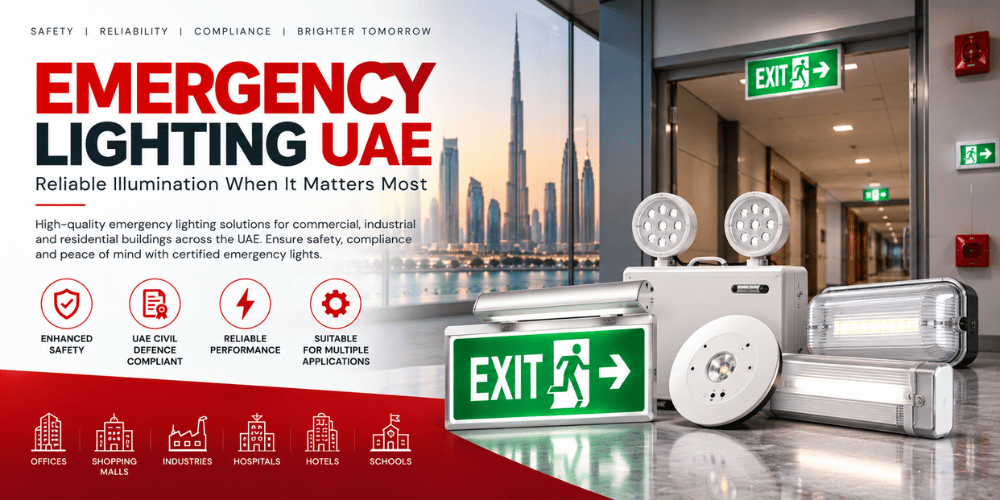
Emergency Lighting UAE: The Complete Guide to Types, Standards and Compliance
A sudden power cut, a fire or a wave of smoke can turn a familiar corridor into a dangerous maze within seconds. That is why emergency lighting UAE requirements exist, and why every building owner, facility manager, consultant and fit-out contractor in the Emirates needs to understand them. In this two-part guide, Gopalfiresafety (https://gopalfiresafety.com/) explains everything you need to know about emergency lighting UAE projects, from the basic definition to standards, system types, design rules, testing routines and common mistakes. Part 1 covers the fundamentals, regulations, types and components. Part 2 covers design, installation, testing, maintenance, costs and frequently asked questions. You can also follow Gopalfiresafety on Instagram for short fire safety tips, product highlights and project updates.
What Is Emergency Lighting UAE? A Quick Answer
Emergency lighting UAE systems are battery-backed or generator-backed luminaires and illuminated signs that switch on automatically when the normal power supply fails. Their purpose is to light escape routes, exit doors, stairs, fire-fighting equipment and high-risk areas so that people can leave a building safely and quickly. In the UAE, emergency lighting is required under the UAE Fire and Life Safety Code of Practice, which is enforced by local Civil Defence authorities. It must be supplied, installed, tested and maintained by approved companies.
In short, if your building has people in it, and especially if it has people who do not know its layout, you almost certainly need a compliant system.
Understanding Emergency Lighting
Emergency lighting is the part of a building’s life safety package that keeps people able to see when everything else has failed. Ordinary lighting depends on mains electricity. When a fire damages a cable, a transformer trips or the grid drops out, ordinary lighting goes dark instantly. Emergency luminaires detect the loss of supply and turn on within seconds, using an internal battery, a central battery system or a standby generator.
It helps to separate emergency lighting into three functions:
- Escape route lighting guides people along corridors, stairs and exit routes to a place of safety.
- Open area (anti-panic) lighting reduces panic in large spaces such as halls, showrooms and open-plan offices by helping people see obstacles and find the way to an escape route.
- High-risk task area lighting allows people to shut down dangerous processes safely, for example in plant rooms, laboratories and industrial floors.
A well-planned emergency lighting UAE installation covers all three functions where they apply, and it also lights fire alarm call points, fire extinguishers, first aid points and changes of direction along the route.
Emergency lighting is not the same as simply leaving some lights on a generator circuit. It is a designed system with defined light levels, defined running times, defined testing and defined documentation. Authorities and insurers expect to see evidence of all of these.
Why Emergency Lighting UAE Compliance Matters
The UAE has some of the tallest towers, largest malls, busiest hotels and most densely occupied labour accommodation in the world. That creates unusual life safety demands.
Vertical evacuation takes time. In a tall tower, occupants may have to descend dozens of floors. Stairwells are enclosed, often windowless spaces. If the lights go out in a stair core filled with smoke, people can become disoriented quickly. Reliable emergency lighting UAE systems give evacuees the confidence to keep moving.
Crowds are large and unfamiliar with the building. Shopping malls, airports, hospitals, hotels, exhibition centres and entertainment venues welcome thousands of visitors who have never seen the exit routes before. Illuminated exit signs and route lighting are their main guide.
Smoke is the main killer. In most fires, smoke reduces visibility long before flames reach an occupant. Low-level and high-quality emergency lighting, combined with photoluminescent or illuminated signage, helps people find exits even in reduced visibility.
Power interruptions still happen. Summer peak loads, maintenance shutdowns, faults in building switchgear and utility works can all cause blackouts. A building must be safe even when the power cut has nothing to do with a fire.
Legal, insurance and reputational risk is high. Failing a Civil Defence inspection can delay a completion certificate or occupancy approval. After an incident, an inoperative system can create serious liability. For these reasons, emergency lighting UAE projects are treated as a core compliance item rather than an optional extra.
Business continuity depends on it. Even outside a fire, a safe orderly evacuation during a blackout protects staff, customers and brand reputation.
Regulatory Framework for Emergency Lighting in the UAE
Emergency lighting UAE rules are set at the federal level and applied locally. The key document is the UAE Fire and Life Safety Code of Practice, issued under the authority of the Ministry of Interior and the General Command of Civil Defence. It applies across the Emirates and is used by local authorities such as Dubai Civil Defence, Abu Dhabi Civil Defence, Sharjah Civil Defence and others when reviewing designs and inspecting buildings.
The Code draws on internationally recognised standards. Depending on the building type and the authority reviewing it, the following are commonly referenced:
- NFPA 101 (Life Safety Code): requirements for means of egress lighting and emergency lighting duration in many occupancies.
- NFPA 70 and NFPA 110/111: for emergency power supply systems and stored electrical energy systems.
- EN 1838: lighting applications for emergency lighting, including light levels and uniformity.
- EN 50172 / BS 5266-8: emergency escape lighting systems, including testing and record keeping.
- BS 5266-1: code of practice for emergency lighting of premises.
- IEC 60598-2-22: particular requirements for luminaires for emergency lighting.
- Local authority circulars and product approval lists: many Civil Defence departments require that fire and life safety products, including emergency luminaires and exit signs, appear on an approved list or carry approved third-party certification.
Requirements can differ slightly between Emirates, and codes are updated from time to time. For that reason, always check the latest edition of the code and confirm design expectations with the relevant Civil Defence authority or your fire safety consultant before finalising any emergency lighting UAE design.
What Approvals Are Usually Involved?
- Design approval: fire and life safety drawings, including emergency lighting layouts and calculations, are reviewed by the authority or an approved consultant.
- Product approval: luminaires, batteries and exit signs may need to be from an approved manufacturer or hold recognised certifications.
- Installation inspection: the authority or an approved third party inspects the installed system, checks operation and issues a completion or compliance certificate.
- Ongoing maintenance: owners are generally expected to keep the system in working order, with periodic testing and maintenance records available for inspection.
Types of Emergency Lighting Systems
Choosing the right type is one of the biggest design decisions in any emergency lighting UAE project. The choice affects cost, maintenance effort and how the building looks and operates.
By Operating Mode
Non-maintained emergency lighting is off when the normal supply is healthy and turns on only when the supply fails. It is the most common type in offices, corridors, car parks and stairwells because it is economical and simple.
Maintained emergency lighting is on all the time, both in normal and emergency conditions. It is typically used in places where the lights must be lit whenever the building is occupied, such as cinemas, theatres, restaurants, halls and exit signs in public areas.
Sustained emergency lighting contains two light sources or two modes in one luminaire. It behaves like a normal light during ordinary operation and continues to provide light on battery power when the supply fails. It is popular in decorative and architectural installations where fittings must look integrated.
Combined and switched variants allow some luminaires to be switched off when the premises are unoccupied, while still working as emergency lights when the mains fails.
By Power Source
Self-contained (single-point) luminaires have their own battery, charger and control gear inside the fitting or its enclosure. They are simple to install, easy to add to an existing building and mean that a fault affects only one light. They are widely used in offices, retail units, clinics, schools and small to medium buildings.
Central battery systems power many luminaires from a single battery bank and charger, often located in a dedicated room. They suit large, complex buildings such as hospitals, malls, airports, towers and industrial facilities. The batteries are easier to maintain in one place and typically last longer thanks to the controlled environment, though they require careful design of cabling and protection.
Generator-backed systems use a standby generator to power selected lighting circuits. These systems must ensure the required changeover time, fuel supply, testing and resilience. Many buildings combine a generator with self-contained luminaires or a central battery system for the most critical routes to cover the generator start-up delay.
Hybrid designs combine the above approaches, using each where it works best.
Self-Contained vs Central Battery: Quick Comparison
Self-contained systems have a lower upfront cost and simpler installation, but they need more testing points and battery replacements spread across the building. Central battery systems cost more at the start and need dedicated space, but they simplify maintenance and often support central monitoring. A qualified consultant, such as the team at Gopalfiresafety, can advise which is more economical over the full life of the building.
Main Components of an Emergency Lighting System
A complete emergency lighting UAE installation is more than a few lights with batteries. Its main components include the following.
Emergency luminaires. These include escape route luminaires, open area luminaires, spotlights for special hazards, recessed downlights, bulkheads, weatherproof units for external exits and explosion-proof units for hazardous areas. Modern units almost always use LED technology, which offers low energy use, long life and compact size.
Exit and directional signs. Signs mark exits and show the direction of travel. They may be internally illuminated, edge-lit or photoluminescent depending on the design. In the UAE, running-man pictograms are widely used, and bilingual text in English and Arabic is often specified for clarity.
Batteries. The battery is the heart of any emergency luminaire. Common chemistries include nickel-cadmium, nickel-metal hydride and lithium iron phosphate. UAE ambient temperatures, especially in plant rooms, roof spaces and unconditioned areas, shorten battery life, so temperature-rated batteries and good placement matter a great deal.
Charger and control gear. These keep the battery charged, detect mains failure, switch the lamp on and protect the battery from deep discharge.
Central control and monitoring. Addressable systems allow automatic testing, fault reporting and log records. They reduce manual inspection effort and help maintain compliance in large buildings.
Wiring and protection. Circuits for central systems often require fire-resistant cabling, correct protective devices and proper segregation from normal supplies so that a single fault does not disable the whole route.
Test facilities. These include test keys, push-buttons or automatic test functions that allow the system to be tested without cutting off the building’s power.
Where Emergency Lighting Is Required in UAE Buildings
Exact requirements depend on the occupancy type, building height and size, and on the authority reviewing the project. In general, emergency lighting UAE regulations expect coverage in the following locations:
- Exit routes such as corridors, lobbies, ramps and landings
- Fire escape staircases and stair lobbies
- Exit doors, including external areas immediately outside exits leading to a safe place
- Changes of level and direction along an escape route
- Intersections of corridors
- Near each fire alarm call point, fire fighting equipment, fire extinguisher and first aid post
- Lift lobbies and refuge areas
- Large open-plan spaces such as halls, showrooms, retail floors and car parks
- Plant rooms, generator rooms, switch rooms, control rooms and pump rooms
- Toilets above a certain size, and accessible toilets
- Kitchens and back-of-house areas in restaurants and hotels
- Basements, parking levels and service corridors
- Sleeping accommodation, including hotel corridors and labour camps
Building Types Where It Is Critical
High-rise residential and commercial towers rely on emergency lighting in stairwells, lobbies and refuge floors. Long evacuation paths make reliability and duration extremely important.
Shopping malls and retail centres must guide large crowds through complex layouts, often with different levels and internal streets.
Hotels and serviced apartments house guests unfamiliar with the layout, frequently asleep when an emergency occurs, so clear and continuous route lighting is essential.
Hospitals and clinics need lighting that protects vulnerable patients and allows critical procedures to continue. These buildings often need more advanced standby systems as well.
Schools, nurseries and universities need reliable lighting for large groups of children and young people.
Warehouses, factories and industrial sites have high-risk areas where a sudden loss of light could cause injuries, as well as long, complex exit routes.
Labour accommodation is densely occupied and often at night, making emergency lighting a key part of life safety.
Airports, metro stations and transport hubs need high-integrity systems because of the sheer number of people and the complexity of the routes.
Car parks and basements depend on emergency lighting because they are windowless and are filled by smoke quickly.
Light Levels, Duration and Response Time
Three numbers define how well an emergency lighting UAE system performs: how bright it is, how long it lasts and how quickly it starts.
Illuminance (Light Level)
Commonly used design values based on EN 1838 include:
- At least 1 lux along the centreline of an escape route, measured at floor level, for routes up to 2 metres wide
- At least 0.5 lux across open areas (anti-panic lighting), excluding a border around the edge
- At least 5 lux at fire alarm call points and fire fighting equipment
- At least 15 lux or 10 percent of normal lighting in high-risk task areas, whichever is higher
Uniformity also matters. The ratio between the maximum and minimum light level along an escape route should not exceed 40:1, so that people do not encounter dark patches that make them hesitate. NFPA 101 uses different numerical criteria, expressed in foot-candles, and the authority may specify which approach applies to your project. Always confirm the design basis at the start.
Duration
Emergency lighting must run long enough to allow full evacuation and, where applicable, for people to remain in a place of relative safety. A common minimum in the UAE is 90 minutes, aligning with NFPA 101 practice, while some occupancies and designs may call for longer durations, for example three hours for certain high-risk or continuously occupied premises. Batteries should be sized with an allowance for ageing and temperature so that the required duration is still met near the end of the battery life.
Response Time
When normal power fails, emergency lighting should reach its required light level quickly. A widely used benchmark is within five seconds, with full illuminance achieved within 60 seconds, although generator-based systems may be designed to specific transfer times. The faster the response, the lower the risk of panic and collisions.
Emergency Lighting vs Exit Signs vs Generators vs UPS
Many owners mix these up, so here is the difference in plain terms.
Emergency lighting lights the space, so people can see the route and obstacles.
Exit signs show where the exit is and which direction to go. They are part of the emergency lighting UAE package but serve a different purpose. Lighting shows the path, while the sign gives the instruction.
Generators provide longer-term standby power to keep selected loads running, such as lifts, fire pumps and some lighting. A generator normally takes several seconds to start, so it cannot fully replace battery-backed emergency luminaires.
UPS systems protect sensitive equipment such as servers and control systems. They are not designed to power escape lighting to code, and using a UPS in place of a proper emergency lighting system is a common mistake.
A properly planned building uses each system for what it does best and coordinates them so that there are no gaps during a failure.
Common Misunderstandings About Emergency Lighting UAE Requirements
- “Exit signs are enough.” Signs alone do not light the route, the stairs or the obstacles around them.
- “The generator covers everything.” Start-up delay and possible generator failure mean a battery-backed layer is still needed.
- “We tested it once at handover.” Periodic testing is needed for the life of the building.
- “Any LED with a battery is fine.” Only luminaires that meet the relevant standards and approvals should be used.
- “It is only a design issue.” Poor maintenance can make even an excellent design fail.
Step-by-Step Design Process for Emergency Lighting UAE Projects
A good design starts long before the first luminaire is chosen. The steps below reflect how experienced consultants approach emergency lighting UAE projects, from the first drawing review to the final approval package.
Step 1: Confirm the design basis. Identify which code applies. In most cases this is the UAE Fire and Life Safety Code of Practice, together with referenced standards such as NFPA 101 or EN 1838. Confirm the expectations of the local Civil Defence authority early, and record the required light levels, duration and response time in a written design brief.
Step 2: Classify the building and occupancy. A hotel, a hospital, a warehouse and a school all have different risks and different required durations. Occupancy type, building height, number of occupants and the presence of sleeping or vulnerable people all influence the design.
Step 3: Trace every escape route. Using the fire strategy drawings, follow the route from every point in the building to a final exit and then to a safe place outside. Include corridors, stairs, ramps, lobbies, refuge areas, lift lobbies and exit discharge paths.
Step 4: Mark the points that need emphasis. These include exit doors, changes of direction, changes of level, corridor intersections, fire alarm call points, fire extinguishers, hose reels, first aid points and fire control panels. Each of these needs a nearby luminaire.
Step 5: Identify open areas and high-risk areas. Large halls, showrooms, open-plan offices and car parks need open area lighting. Plant rooms, laboratories and industrial floors need high-risk task lighting.
Step 6: Select the system type. Choose between self-contained luminaires, a central battery system, generator-backed circuits or a hybrid. This depends on building size, maintenance capability, budget and the authority’s preferences.
Step 7: Run the photometric calculations. Use the luminaire manufacturer’s photometric files in lighting software such as DIALux or Relux to prove that the required lux levels and uniformity are achieved on the escape routes and open areas.
Step 8: Size batteries and cables. Calculate battery capacity, inverter capacity for central systems and cable sizes with voltage drop in mind.
Step 9: Prepare the approval package. This normally includes layout drawings, a luminaire schedule, calculation reports, datasheets and certificates, and a description of the operating philosophy.
Layout Rules of Thumb
Every emergency lighting UAE layout should follow a few practical principles, and the final positions must always be verified by calculation rather than guesswork.
- Place a luminaire near every exit door and every emergency exit sign. A common guideline is within about 2 metres of the door.
- Light each flight of stairs directly, so that every step receives light, and place a luminaire at each change of level.
- Add a luminaire at every change of direction and at every junction of corridors.
- Position luminaires near fire alarm call points, fire fighting equipment and first aid points.
- Follow the manufacturer’s spacing tables for the mounting height, then confirm the result with a photometric calculation.
- Account for obstructions such as partitions, ductwork, racking, banners and deep beams, which can create dark patches.
- Avoid glare, particularly in stairwells and low-ceiling corridors, because glare can reduce visibility and cause disorientation.
- Light the outside area immediately beyond the final exit so that people do not step from a lit corridor into total darkness.
Sloppy layout is one of the top reasons systems fail Civil Defence inspections. A few extra luminaires at the design stage cost far less than rework after failed testing.
Sizing the Battery Correctly
Battery sizing is where many projects go wrong. The basic idea is simple: the battery must supply the full load for the full required duration, at the end of its service life and in the worst-case temperature.
A simplified example shows the logic. If a luminaire draws 5 watts and must run for 3 hours, it needs 15 watt-hours of usable energy. Batteries lose capacity as they age, so designers often assume only about 80 percent of the rated capacity is available at end of life. Dividing 15 by 0.8 gives about 19 watt-hours of nominal capacity, before any additional allowance for temperature or discharge limits.
For central battery systems, the calculation also includes the inverter efficiency, cable losses, the number of luminaires on each circuit and the fact that all connected luminaires must operate at the same time. For emergency lighting UAE projects, always ask the supplier for a battery sizing statement that includes the ageing factor and the design temperature, because these are the assumptions that decide whether the system passes its duration test years after handover.
Choosing Luminaires for the UAE Climate
Products that perform well in a mild European office may struggle in the Gulf. Emergency lighting UAE installations face heat, dust, humidity and, in coastal areas, salt-laden air. Specify accordingly.
Heat. Batteries are the weak point. Sustained high temperature shortens battery life sharply, and roof voids, plant rooms, unconditioned car parks and sun-exposed areas can be far hotter than the air-conditioned spaces. Choose luminaires rated for the ambient temperature, locate central batteries in ventilated or air-conditioned rooms, and avoid mounting self-contained units in hot spots where a different location is possible.
Dust and sand. For semi-exposed areas such as parking levels, loading bays and open corridors, an ingress protection rating of at least IP54 is a sensible starting point. External exits generally need IP65 or higher, and wash-down areas such as commercial kitchens may need IP66.
Humidity and corrosion. Coastal projects benefit from UV-stable polycarbonate, marine-grade stainless steel fixings and corrosion-resistant finishes.
Impact resistance. In car parks, labour accommodation, industrial sites and schools, luminaires suffer knocks and vandalism. Impact ratings such as IK08 to IK10 and vandal-resistant housings pay for themselves.
Battery chemistry. Nickel-cadmium and nickel-metal hydride are widely used and well understood. Lithium iron phosphate offers longer life and better tolerance of heat in many designs. Compare warranties, certified temperature ranges and replacement cost rather than choosing on price alone.
Hazardous areas. Fuel stores, some industrial plants and battery rooms may need explosion-protected luminaires with ATEX or IECEx certification.
Certification. Insist on luminaires that comply with IEC 60598-2-22 and that are acceptable to the relevant authority, with test reports available on request.
Exit Signs in Emergency Lighting UAE Schemes
Exit signs are part of the same life safety chain, and they need the same design attention. Use standard running-man pictograms with arrows pointing in the direction of travel. Many UAE buildings add bilingual English and Arabic text, which is helpful for the diverse population using public buildings.
Mount signs above doors or along the route where they can be seen from a distance, not hidden behind hanging banners, ducts or decorations. Choose the viewing distance the sign is rated for, because larger signs are readable from further away. In areas where smoke is a serious risk, such as long corridors and car parks, consider adding low-level way guidance, which stays visible below the smoke layer.
Installation Best Practices
A well-designed system can still be undermined by poor installation. A correct emergency lighting UAE installation follows these principles.
Connect self-contained luminaires to the right circuit. They need a permanent, unswitched live supply taken from the local lighting circuit serving the same area. This way, when that lighting circuit fails, the luminaire detects the loss and switches on. Connecting to a distant or unrelated circuit defeats the purpose.
Use the correct cable for central systems. Circuits feeding central battery luminaires normally need fire-resistant cable, correct support fixings and separation from other circuits so that a single fault does not disable the whole route.
Fix luminaires securely and at the designed positions. A luminaire moved a few metres to suit a ceiling layout can leave a dark gap on the route.
Coordinate with other trades. Ceiling contractors, mechanical and electrical services, interior designers and signage suppliers all affect the final positions. Early coordination prevents last-minute clashes.
Protect against damage during fit-out. Cover luminaires during painting and cleaning, and remove the covers afterwards. Painted-over indicators and lenses are a frequent finding at inspection.
Make test and status indicators visible. The green charge indicator or status light should be visible from the floor so that maintenance staff can check it quickly.
Label everything. Label circuits, distribution boards and central battery equipment, and keep drawings that match the installed layout.
Commissioning and Handover Requirements
Before an emergency lighting UAE system is handed over, it should be commissioned and documented properly. Commissioning normally includes the following.
- A check that all luminaires are installed as per the approved drawings
- Verification of correct wiring and supply arrangements
- Simulation of a mains failure to confirm that each luminaire switches on
- Measurement of light levels along routes with a calibrated lux meter
- A full-duration test to prove that the battery lasts the required time
- Checks of exit signs, indicators, central panel functions and fault reporting
- A witnessed test with the authority or its appointed representative where required
The handover pack should include as-built drawings, photometric calculations, product datasheets, certificates of conformity, battery information, test results, operation and maintenance manuals, warranty details and a blank log book for future tests. Missing paperwork is a common reason for delayed completion certificates, so plan for it early.
Testing Schedule for Emergency Lighting UAE Systems
Testing is not optional. A system that has never been tested is a system nobody can rely on. The schedule below reflects commonly used good practice based on standards such as EN 50172 and BS 5266-8. Always confirm the frequency required by your local authority, because it may differ.
- Daily or regular visual check: a responsible person confirms that indicators show normal charging status and that there are no obvious faults.
- Monthly functional test: a short simulated failure, long enough to confirm that each luminaire switches on and that lamps and changeover work. Record the result.
- Annual full-duration test: the system is run for its full rated duration, such as 90 minutes or 3 hours, to prove that the batteries still meet their requirement. Results must be recorded.
- After any modification: whenever the layout, circuits or occupancy change, test the affected area again.
Plan the annual test carefully. After a full-duration test, batteries need time to recharge, often up to 24 hours, so the building must not be left unprotected. Many facilities test in sections, or schedule tests when the building has low occupancy, so that some protection always remains available.
Maintenance Routines That Keep the System Alive
Regular maintenance keeps emergency lighting UAE systems reliable for the long term. A practical routine includes:
- Cleaning lenses, diffusers and signs so that light output is not reduced by dust
- Replacing failed lamps, LED modules or drivers promptly
- Replacing batteries at the end of their useful life, which is often every few years in hot conditions, depending on chemistry
- Checking that fixings are tight and that housings are not cracked or water-damaged
- Checking that signs are not obstructed by new partitions, stock, banners or decoration
- Updating drawings and layouts after tenant fit-outs or building changes
- Recording every test, defect and repair in the log book, with date, name and action taken
An annual maintenance contract is often the simplest way to ensure that these tasks are done on time, by trained technicians, with proper records ready for any inspection.
Common Faults and How to Fix Them
These are the most frequent faults found in emergency lighting UAE buildings, along with their usual causes.
- Luminaire does not switch on during test: dead or disconnected battery, failed charger, faulty lamp or driver, or incorrect wiring of the supply.
- Short duration: ageing batteries, heat damage, undersized battery capacity or a load that is higher than designed.
- Charge indicator off: loss of supply, blown fuse, tripped protective device or charger failure.
- Flickering or dim output: driver fault, poor connection or damaged LED module.
- Central system fault alarm: cable damage, earth fault, failed luminaire or a battery problem.
- Sign hard to see: dirt, obstruction, wrong location or low light output.
Good record keeping helps here. If the same luminaire fails repeatedly, the log will show a pattern and point to a location or product problem, rather than a random defect.
Smart Monitoring and Automatic Testing
Automatic test systems are becoming standard in larger emergency lighting UAE projects. Luminaires fitted with self-test functions perform periodic checks on their own and report results to a central controller. Communication can be through wired addressable networks, DALI or wireless links.
The benefits are considerable. Manual testing of thousands of luminaires in a mall or tower takes many hours and disrupts operations, while automatic systems perform routine tests overnight and generate reports instantly. They flag failing batteries early, reduce maintenance labour, and create an accurate audit trail for inspectors and insurers. Integration with the building management system lets facility teams see faults alongside other alarms.
Automatic systems cost more at the start, but for large or complex buildings the saving in time and the improvement in reliability usually justify the investment.
What Affects the Cost of Emergency Lighting UAE Projects
There is no single price for emergency lighting UAE installations, because costs depend on several factors.
- The size and layout of the building, and the number of luminaires and signs required
- The type of system chosen, whether self-contained, central battery or hybrid
- The quality, certification and warranty of the luminaires
- Battery chemistry and expected life
- Cabling requirements, especially fire-resistant cable for central systems
- Mounting heights and access needs, such as scaffolding or lifts in atria and warehouses
- Whether monitoring and automatic testing are included
- Authority approval and inspection requirements
- The scope of maintenance after handover
The lowest purchase price is not always the lowest total cost. Cheap luminaires with weak batteries may need replacement within a couple of years, may fail duration tests and may lead to repeated inspection failures. Compare the lifecycle cost, including maintenance and battery replacement, before deciding.
New Build vs Retrofit Projects
New buildings allow emergency lighting to be coordinated with ceilings, cable routes and architecture from the start. Retrofits are more complex because the building is often occupied, ceilings are finished and spare cable capacity may not exist.
When retrofitting emergency lighting UAE systems in occupied buildings, phase the works to minimise disruption, use night or weekend shifts where needed, and consider self-contained or wireless-enabled luminaires that avoid extensive new cabling. Survey the existing installation first, because many older buildings have missing, obstructed or non-working emergency lights that need to be corrected before any upgrade begins.
How to Choose a Reliable Emergency Lighting Contractor
The contractor you pick affects both compliance and long-term reliability. Look for these qualities when selecting a partner for emergency lighting UAE work.
- Experience with UAE codes, Civil Defence procedures and approval processes
- Access to approved and certified products, with genuine test reports
- In-house design capability, including photometric calculations
- Trained and competent installation and testing teams
- A clear handover process with full documentation
- Support after installation, including maintenance contracts and quick response to faults
- References from comparable projects and a track record of passing inspections
Ask to see sample calculation reports, previous approval certificates and maintenance records. A confident contractor will share them.
Mistakes to Avoid
Across many projects, the same errors appear again and again.
- Relying on a generator alone and skipping battery-backed luminaires
- Sizing batteries without an ageing or temperature allowance
- Using non-certified or unapproved products to save money
- Failing to light the area outside exits
- Ignoring changes to the building layout after handover
- Skipping monthly and annual tests, or not recording them
- Placing luminaires where they are hidden by ducts, beams or décor
- Treating maintenance as a one-time job rather than an ongoing duty
Avoiding these mistakes protects lives, avoids fines and prevents costly rework.
Frequently Asked Questions About Emergency Lighting UAE
How long must emergency lighting UAE systems last during a power failure?
A common minimum is 90 minutes, and some occupancies and designs require up to 3 hours. Confirm the required duration with the Civil Defence authority and your consultant for your specific building.
Do all buildings in the UAE need emergency lighting?
Most commercial, public, industrial, residential tower and accommodation buildings need it. Requirements for small private villas may differ, so check the code and local authority rules for your building type.
Can rechargeable torches or portable lamps replace fixed emergency lighting?
No. Fixed, automatic, approved luminaires are required because they switch on without human action and provide consistent coverage along the whole escape route.
How often should emergency lighting UAE systems be tested?
Good practice is a short functional test every month and a full-duration test every year, with records kept for each. Follow any stricter requirement set by your local authority.
Can one fitting act as both a light and an exit sign?
Yes, combined luminaires exist, provided they are certified and meet the light level and visibility requirements for both functions.
Who is responsible for maintaining the system?
The building owner, occupier or appointed facility manager is normally responsible, and many choose to outsource this to a qualified fire safety company under a maintenance contract.
What happens if the system fails an inspection?
The authority may refuse a completion or renewal certificate until defects are corrected and the system is retested. In serious cases, penalties or restrictions on occupancy may apply.
Are LED emergency luminaires better?
In most cases, yes. LEDs draw less power, allow smaller batteries to meet the duration, last longer and are compact. Quality still varies, so check the certification and warranty.
Final Thoughts
Reliable emergency lighting UAE systems rely on more than good products. They depend on sound design, correct installation, honest testing and steady maintenance from the first day of occupancy to the last. Whether you manage a tower, a mall, a hospital, a warehouse or a hotel, the goal is the same: when the power fails, every person should be able to see the way out.
Gopalfiresafety supports building owners, consultants and contractors with fire and life safety solutions, from site surveys and design support to supply, installation and ongoing service. To discuss your project or request a quotation, visit https://gopalfiresafety.com/ and speak with the team. You can also follow Gopalfiresafety on Instagram for quick safety tips, product updates and real installation highlights. Together, we can make sure your emergency lighting UAE system is ready before the day it is needed.