Fire Retardant Wood Coating: Complete Guide to Protecting Wood from Fire
When businesses, architects, contractors, and property owners are looking for wood fire-protection solutions, Gopalfiresafety provides fire-safety products and information through https://gopalfiresafety.com/. A Fire Retardant Wood Coating can help improve the fire performance characteristics of suitable wooden surfaces when the correct product is selected and applied according to its technical requirements. Gopalfiresafety also shares fire-safety information, product updates, and educational content through Instagram, helping customers understand the importance of practical fire protection for buildings, interiors, furniture, and wooden structures.
Wood is one of the most widely used natural materials in construction and interior design. It is used for doors, furniture, wall panels, ceilings, partitions, decorative structures, stair components, cabinetry, flooring, and architectural finishes. Its appearance, workability, strength-to-weight ratio, and natural character make it popular across residential, commercial, hospitality, institutional, and industrial environments.
However, wood is combustible. When exposed to sufficient heat, wood can undergo thermal decomposition, release combustible gases, and eventually ignite. The behavior depends on factors such as wood species, density, moisture content, dimensions, surface condition, ventilation, heat exposure, and the presence of other materials.
This is where fire-protective treatments can become important.
A properly selected coating can be used as part of a broader fire-safety strategy. Depending on its formulation and tested performance, a coating may help reduce flame spread, delay ignition, reduce the rate of heat exposure, or provide other fire-protective benefits.
It is important to understand that the term “fire retardant” does not automatically mean that a particular piece of wood becomes non-combustible or that an entire building component receives a specific fire-resistance rating. The actual performance depends on the product, substrate, application thickness, test method, environmental conditions, and intended use.
What Is Fire Retardant Wood Coating?
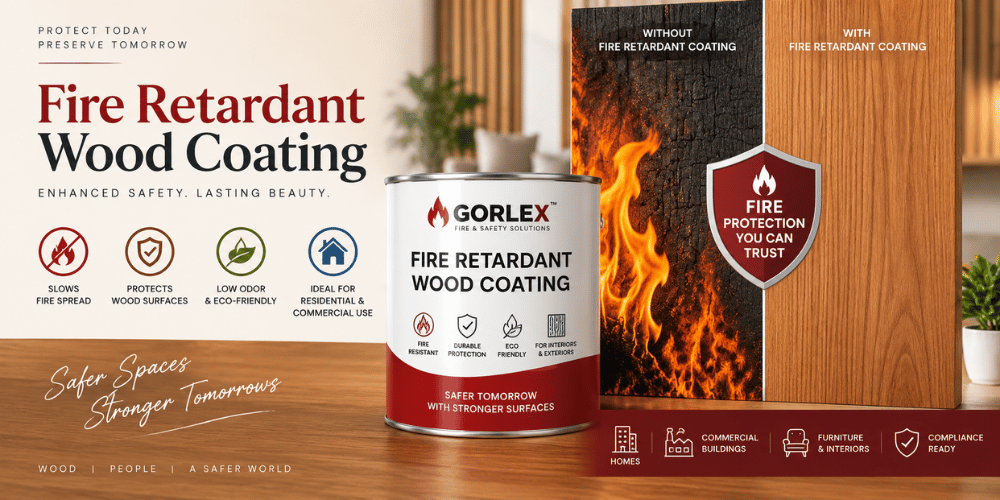
Fire Retardant Wood Coating is a specialized coating or treatment designed to improve the fire behavior of wood and wood-based substrates.
Depending on the formulation, these products may work through different mechanisms.
Some formulations can:
- Reduce flame spread
- Delay ignition
- Reduce heat release
- Form a protective char
- Expand under heat
- Insulate the underlying wood
- Reduce the rate of surface burning
- Help protect the treated surface during fire exposure
Not every product uses the same technology.
Some coatings are intumescent. When exposed to high temperatures, an intumescent coating can expand and form a carbonaceous insulating layer. Other fire-retardant coatings work through chemical mechanisms that influence combustion and flame propagation.
For this reason, product selection should always be based on the manufacturer’s technical documentation and the specific performance requirement.
Why Does Wood Need Fire Protection?
Wood has excellent architectural and functional properties, but it remains a combustible material.
In a fire, untreated wood can eventually ignite when sufficient heat reaches the surface. Once ignition occurs, combustion can continue as long as heat, oxygen, and combustible material are available.
Fire-protective treatment can help change the behavior of the surface.
The objective is generally not to make wood permanently immune to fire. Instead, the objective may be to improve its reaction to fire or provide a defined level of protection demonstrated through appropriate testing.
This distinction is important for architects and building professionals.
A decorative wooden wall panel in an interior space may have one requirement, while a wooden fire door, structural timber component, ceiling system, or escape-route wall lining may have a completely different requirement.
How Does Fire Retardant Wood Coating Work?
The way a coating works depends on its formulation.
A common technology is intumescence.
An intumescent coating can remain relatively thin during normal conditions. When exposed to high temperatures, chemical reactions can cause the coating to swell and create a protective char.
The char can act as an insulating barrier between the heat source and the underlying wood.
This can help slow the rate at which heat reaches the substrate.
The effectiveness of the coating can depend on:
- Coating chemistry
- Dry-film thickness
- Number of coats
- Surface preparation
- Wood species
- Wood density
- Moisture content
- Primer compatibility
- Topcoat compatibility
- Application method
- Curing conditions
- Fire exposure
- Tested configuration
Therefore, simply applying a thick layer of ordinary paint does not provide the same result as a professionally formulated fire-protective coating.
Fire Retardant vs Fire Resistant
The terms fire retardant and fire resistant are often used in marketing, but they can represent different technical concepts.
A fire-retardant treatment may be intended to reduce the rate of flame spread or improve a material’s reaction to fire.
Fire resistance generally refers to the ability of an assembly or construction to maintain specified performance during a defined fire test for a specified period.
For example, a complete fire-rated door assembly may need to maintain integrity and other required performance characteristics during a standardized test.
A coating on a wooden surface does not automatically give the entire construction a fire-resistance rating.
This distinction is especially important when specifying products for regulated construction projects.
Fire Retardant Wood Coating for Interior Wood
Interior wood surfaces are commonly found in:
- Hotels
- Restaurants
- Offices
- Schools
- Universities
- Hospitals
- Shopping centers
- Residential buildings
- Exhibition spaces
- Auditoriums
- Public buildings
- Corporate interiors
Wood may be used as wall cladding, ceiling panels, decorative screens, furniture, doors, reception counters, and feature walls.
Where fire performance is part of the building specification, the surface treatment may need to meet a defined reaction-to-fire classification or other requirement.
The coating selected should therefore match the substrate and the intended application.
Wooden Wall Panels
Wooden wall panels can create an attractive architectural appearance.
However, large areas of exposed combustible material may require careful consideration of fire behavior.
A suitable Fire Retardant Wood Coating can be considered where the product is designed for the particular panel material and where the required fire-performance evidence is available.
Before application, the contractor should identify:
- Wood type
- Panel thickness
- Surface finish
- Existing coating
- Required appearance
- Required fire performance
- Application environment
- Maintenance requirements
Wooden Ceilings
Wooden ceilings are increasingly used in hospitality, commercial, and architectural projects.
Ceiling applications can involve different fire-performance requirements from wall applications.
The coating must be suitable for overhead application, and the manufacturer should specify the correct application method.
The coating system should also be compatible with the existing surface treatment.
Wooden Doors
Wooden doors are another important application.
A fire-protective coating may be used on certain wooden door constructions where the coating is specifically approved or tested for the application.
However, a standard wooden door should not automatically be described as a fire-rated door simply because a fire-retardant coating has been applied.
Fire-door performance can depend on:
- Door leaf
- Core
- Frame
- Intumescent seals
- Hardware
- Glazing
- Gaps
- Dimensions
- Installation
- Coating system
Where a door is required to have a certified fire rating, the complete door assembly should be verified.
Fire Retardant Wood Coating for Furniture
Furniture can be manufactured from solid wood, plywood, MDF, particleboard, veneer, or composite materials.
Different substrates can react differently to heat.
A coating intended for solid timber should not automatically be assumed to have the same performance on MDF or laminated plywood.
For furniture applications, the manufacturer should provide information regarding:
- Compatible substrates
- Application thickness
- Drying time
- Finish
- Cleaning resistance
- Durability
- Fire-performance testing
Furniture located in hotels, restaurants, theaters, offices, and public buildings may require particular attention to fire performance depending on local regulations and project specifications.
Wooden Partitions
Wooden partitions can be used to divide offices, commercial spaces, hotels, and residential interiors.
If the partition forms part of a fire compartment, the complete partition system must be considered.
A coating may contribute to surface fire performance, but it should not be assumed to provide the complete fire resistance of a wall assembly unless the entire system has been tested or evaluated accordingly.
Wood Species and Fire Performance
Different species of wood can behave differently when exposed to heat.
Density, moisture, resin content, structure, thickness, and surface characteristics can influence combustion.
Hardwoods and softwoods are not interchangeable from a fire-testing perspective.
Similarly, engineered wood products can have different characteristics because they may contain adhesives, binders, veneers, fibers, or other materials.
Therefore, a coating’s documented performance should identify the types of substrates for which it is intended.
Solid Wood
Solid timber is commonly used for:
- Doors
- Furniture
- Frames
- Architectural features
- Wall panels
- Decorative structures
Before coating, the surface should be inspected for contamination, previous finishes, moisture, cracks, and defects.
Plywood
Plywood consists of layers of wood veneer bonded together.
Its performance can depend on:
- Wood species
- Number of layers
- Thickness
- Adhesive system
- Surface veneer
- Manufacturing process
A coating should be verified for the intended plywood type.
MDF
Medium-density fiberboard is made from wood fibers combined with resin and compressed into panels.
MDF is widely used for furniture, cabinets, wall panels, doors, and interior construction.
Because MDF has a different composition from solid timber, coating compatibility and fire-test applicability should be verified separately.
Particleboard
Particleboard contains wood particles bonded with adhesives.
Its fire behavior can differ from both MDF and solid timber.
If fire performance is important, the product documentation should specify whether the coating is suitable for particleboard.
Veneered Wood
A decorative veneer can change the surface characteristics of a substrate.
A coating system must be compatible with:
- Veneer
- Adhesive
- Primer
- Existing finish
- Underlying substrate
An attractive finish should not be achieved at the expense of documented fire performance.
Importance of Surface Preparation
Surface preparation is one of the most important stages of any coating project.
Before applying a Fire Retardant Wood Coating, the surface should be checked according to the manufacturer’s requirements.
Potential contaminants include:
- Dust
- Oil
- Grease
- Wax
- Silicone
- Old polish
- Loose paint
- Dirt
- Moisture
- Wood dust
Contaminated surfaces can reduce adhesion.
Poor adhesion can lead to:
- Peeling
- Blistering
- Cracking
- Delamination
- Uneven coverage
The correct preparation method depends on the substrate and existing finish.
Sanding Wooden Surfaces
Sanding may be required to create a suitable surface profile.
However, excessive sanding can damage veneer or alter the dimensions of a component.
The correct abrasive and preparation method should therefore be selected according to the manufacturer’s instructions.
After sanding, dust should be removed before coating.
Moisture Content of Wood
Moisture can significantly influence coating performance.
Wood that contains excessive moisture may experience:
- Poor adhesion
- Slow drying
- Blistering
- Uneven curing
- Surface defects
The coating manufacturer should specify acceptable moisture and environmental conditions where relevant.
Primer Compatibility
Some fire-protective coatings require a primer.
The primer can provide:
- Adhesion
- Surface sealing
- Corrosion or substrate protection where applicable
- Improved appearance
- Compatibility with the coating system
However, using an unapproved primer can affect performance.
A conventional primer should not automatically be substituted for the manufacturer’s recommended system.
Topcoat Compatibility
A decorative topcoat may be required to provide a specific color or appearance.
However, the topcoat should be compatible with the underlying fire-protective system.
An incompatible topcoat could affect:
- Adhesion
- Drying
- Chemical stability
- Expansion
- Surface appearance
- Fire performance
The manufacturer’s documentation should identify compatible topcoat systems.
Coating Thickness
Thickness is one of the most important application factors.
A coating applied below the specified thickness may not provide the intended performance.
Applying substantially more material is not necessarily better either.
Excessive thickness can cause:
- Slow drying
- Cracking
- Sagging
- Poor adhesion
- Uneven finish
- Extended curing time
Professional projects should maintain appropriate application records and thickness measurements where required.
Wet Film Thickness
Wet-film thickness can be measured shortly after application using appropriate gauges.
This allows the applicator to determine whether the wet coating is within the manufacturer’s specified range.
The relationship between wet-film thickness and final dry-film thickness depends on the coating’s solids content.
Dry Film Thickness
Dry-film thickness measures the coating after curing.
For products where thickness is critical to performance, the manufacturer’s technical data should establish the required range and measurement method.
Consistent thickness is particularly important when the product’s fire-performance testing is based on a specified application thickness.
Application Methods
A Fire Retardant Wood Coating may be applied using methods such as:
- Brush
- Roller
- Spray
- Airless spray
- Other approved application equipment
The appropriate method depends on the coating formulation and project requirements.
Brush Application
Brush application may be useful for:
- Small areas
- Edges
- Repairs
- Detailed wooden components
Roller Application
Rollers can provide efficient coverage on larger flat surfaces.
However, the roller type and application technique can influence texture and film thickness.
Spray Application
Spray application can provide efficient coverage on large production surfaces.
It may also provide a consistent finish when operated by trained personnel.
Overspray, ventilation, masking, equipment setup, and environmental conditions must be controlled.
Drying and Curing
Drying is not always the same as complete curing.
A surface can feel dry while the coating underneath remains soft or chemically active.
The manufacturer should specify:
- Touch-dry time
- Recoat interval
- Handling time
- Full curing time
- Environmental conditions
Doors, furniture, panels, and architectural components should not be placed into service before the coating system has reached the required condition.
Indoor Environmental Conditions
Application conditions can affect coating performance.
Important parameters may include:
- Temperature
- Relative humidity
- Ventilation
- Surface temperature
- Condensation
- Moisture
For a professional installation, environmental conditions should be monitored and recorded where necessary.
Fire Retardant Wood Coating for Commercial Buildings
Commercial buildings can contain large quantities of wood-based decorative material.
Examples include:
- Reception desks
- Wall cladding
- Decorative ceilings
- Doors
- Furniture
- Retail fixtures
- Display structures
- Conference-room interiors
The use of fire-protective coatings should be coordinated with the overall building fire strategy.
Hotels and Hospitality Projects
Hotels often use wood to create premium interiors.
Wooden panels, doors, furniture, partitions, and decorative ceilings can contribute to the visual character of a property.
However, hospitality buildings also require careful attention to occupant safety.
Where fire performance is specified, materials should be selected according to the applicable building requirements.
Restaurants
Restaurants can contain wood furniture, decorative walls, counters, ceilings, and partitions.
Cooking areas also contain heat sources and combustible materials.
A suitable coating may be considered for compatible wood surfaces where required, but coatings should not be used as a substitute for appropriate kitchen fire-safety equipment, ventilation, fire suppression, or housekeeping.
Offices
Modern offices often use timber features to create warm and professional interiors.
Wood can appear in:
- Meeting rooms
- Reception areas
- Ceilings
- Feature walls
- Partitions
- Furniture
Fire performance should be considered when large areas of combustible decorative material are used.
Schools and Universities
Educational buildings contain classrooms, laboratories, libraries, offices, furniture, and circulation areas.
Wood products may be present throughout these spaces.
Fire-safety requirements should be considered when selecting wood finishes and protective coatings.
Hospitals
Hospitals have complex fire-safety requirements because occupants may include people with limited mobility.
Wooden doors, furniture, wall panels, and decorative elements should be selected according to the relevant requirements for healthcare environments.
A coating should be specified according to its documented performance and suitability.
The Importance of Testing
Testing is essential because fire performance cannot be determined reliably from appearance alone.
A coating may look thick and durable but still have different behavior under standardized fire exposure.
Testing can evaluate characteristics such as:
- Flame spread
- Ignition behavior
- Heat release
- Smoke production
- Fire resistance
- Surface burning
- Durability
The appropriate test depends on the intended application.
Reaction to Fire vs Fire Resistance
These concepts should not be confused.
Reaction-to-fire testing generally considers how a material contributes to fire development.
Fire-resistance testing generally considers the performance of a construction or assembly under defined fire exposure.
A coating designed to improve surface flame behavior is not automatically equivalent to a fire-resistance system.
This distinction should be reflected in technical specifications and marketing claims.
Choosing the Correct Product
When purchasing a Fire Retardant Wood Coating, buyers should review the technical documentation before making a decision.
Important questions include:
- What wood substrates are approved?
- What fire-performance test has been conducted?
- What thickness is required?
- Is a primer required?
- Is a topcoat permitted?
- Is the coating suitable for interior use?
- Is it suitable for exterior use?
- What application method is recommended?
- What environmental conditions are required?
- How long does it take to cure?
- How should the coating be maintained?
- What documentation is available?
Gopalfiresafety provides fire-safety products and information for businesses seeking fire-protection solutions. Through its website and Instagram presence, Gopalfiresafety helps customers explore practical approaches to fire safety.
The next part examines testing, certification, application quality control, maintenance, commercial procurement, common mistakes, and how businesses can evaluate a fire-retardant wood coating for specific projects.
Selecting the right Fire Retardant Wood Coating requires more than choosing a product that contains the words “fire retardant” on its label. Professional fire protection depends on documented performance, correct substrate compatibility, application thickness, environmental conditions, and the specific purpose of the treated wood.
A coating designed for decorative timber panels may have different requirements from one intended for a wooden door, furniture, architectural ceiling, or engineered wood component.
For this reason, procurement teams should begin with the required performance and then identify products capable of meeting that requirement.
What Should a Technical Specification Include?
A strong coating specification should identify the following:
- Product type
- Intended substrate
- Fire-performance requirement
- Applicable test method
- Required application thickness
- Primer requirements
- Topcoat requirements
- Surface preparation
- Application method
- Environmental conditions
- Drying and curing requirements
- Inspection requirements
- Documentation requirements
- Maintenance requirements
This information helps reduce confusion between suppliers and contractors.
Fire Retardant Wood Coating for Architects
Architects often need to balance appearance, material selection, performance, and regulatory requirements.
Wood provides a natural appearance that can support modern, traditional, luxury, and minimalist designs.
However, when wood is used extensively in public or commercial interiors, its fire behavior should be considered during material selection.
Architects should ask whether the proposed coating has documentation applicable to:
- The exact wood substrate
- The intended thickness
- The intended environment
- The required fire-performance classification
- The proposed decorative finish
Fire Retardant Wood Coating for Contractors
Contractors are responsible for turning a specification into a properly completed installation.
This requires careful control of:
- Surface preparation
- Product identification
- Mixing
- Application
- Thickness
- Recoat intervals
- Environmental conditions
- Curing
- Final inspection
The contractor should not substitute products without confirming compatibility and project approval.
Fire Retardant Wood Coating for Manufacturers
Furniture and door manufacturers can benefit from integrating fire-protective coatings into controlled production environments.
Factory application can provide better control over:
- Surface preparation
- Temperature
- Humidity
- Coating thickness
- Curing
- Quality inspection
Manufacturers can also maintain batch records and application documentation.
Factory vs On-Site Application
Factory Application
Factory application offers a controlled environment.
Advantages can include:
- Consistent application
- Controlled drying
- Better quality control
- Repeatable production
- Easier inspection
- Lower contamination risk
On-Site Application
On-site application can be useful when:
- Existing wood surfaces need treatment
- Large architectural installations cannot be removed
- Renovation projects are underway
- Repairs are required
However, environmental conditions may be less predictable.
Common Application Problems
Several problems can reduce the quality of a coating installation.
Uneven Thickness
Uneven application can create areas with different protective characteristics.
Poor Surface Preparation
Contamination can cause adhesion failure.
Incorrect Mixing
Two-component coatings must be mixed according to the manufacturer’s instructions.
Insufficient Drying
Applying another layer before the previous layer has adequately dried can create defects.
Excessive Thickness
Too much material can cause cracking, sagging, or slow curing.
Incorrect Topcoat
An incompatible decorative finish may affect the coating system.
Mixing and Preparation
Some fire-protective products are supplied as single-component coatings, while others may have multiple components.
Where mixing is required, the applicator should follow the specified:
- Mixing ratio
- Mixing duration
- Induction period
- Pot life
- Application window
Material that exceeds its usable pot life should not be applied.
Storage of Coating Materials
Correct storage is important before application.
Products should generally be stored according to manufacturer instructions regarding:
- Temperature
- Humidity
- Direct sunlight
- Container position
- Shelf life
- Freezing
- Heat exposure
Expired or improperly stored material may not perform as expected.
Quality Control Checklist
A professional project can use a quality-control checklist.
Before Application
Confirm:
- Correct product
- Correct batch
- Valid shelf life
- Correct substrate
- Surface cleanliness
- Surface moisture
- Environmental conditions
During Application
Check:
- Application method
- Wet-film thickness
- Coverage
- Recoat interval
- Surface appearance
After Application
Check:
- Dry-film thickness
- Adhesion where required
- Surface defects
- Curing
- Topcoat
- Documentation
Importance of Dry Film Thickness
Dry-film thickness is particularly important where fire performance is linked to a specified coating thickness.
The coating should be applied consistently across the entire treated surface.
Areas that are difficult to access, such as:
- Edges
- Corners
- Grooves
- Joints
- Profiles
- Recesses
may require additional attention.
Coating Wooden Door Edges
Door edges may be exposed to impact and mechanical wear.
The coating system should be suitable for the complete application and should not interfere with door operation, seals, hardware, or clearances.
Where the door is part of a certified fire-door assembly, the manufacturer’s approved configuration should be maintained.
Coating Around Hardware
Care should be taken around:
- Hinges
- Locks
- Handles
- Closers
- Latches
- Vision panels
- Door seals
Uncontrolled coating buildup around hardware can affect operation.
Hardware should not be coated unless specifically permitted by the product and system requirements.
Fire Retardant Wood Coating and Decorative Appearance
Fire protection does not necessarily mean sacrificing aesthetics.
Modern architectural coatings can be designed to provide different appearances, depending on the product.
Potential finishes can include:
- Clear
- Transparent
- Matte
- Satin
- Colored
- Wood-compatible decorative finishes
However, the appearance and decorative finish should always be compatible with the fire-protection system.
Clear Fire-Retardant Coatings
Clear coatings can be useful when the natural appearance of timber needs to remain visible.
They may be considered for:
- Premium furniture
- Decorative wall panels
- Timber ceilings
- Hospitality interiors
- Architectural woodwork
The product documentation should confirm whether the coating is actually suitable for the intended substrate and fire-performance requirement.
Colored Fire-Retardant Coatings
Colored coatings can provide both decoration and protection.
Colors can be selected according to:
- Corporate identity
- Interior design
- Architectural requirements
- Maintenance requirements
Again, color alone does not establish fire performance.
Maintenance Requirements
A Fire Retardant Wood Coating should be inspected periodically where required by the application.
Maintenance inspections can look for:
- Peeling
- Cracking
- Impact damage
- Abrasion
- Discoloration
- Moisture damage
- Unauthorized repainting
- Surface contamination
Damage should be repaired according to the manufacturer’s instructions.
Cleaning Coated Wood
Cleaning methods should be compatible with the coating.
Aggressive chemicals or abrasive cleaning can damage the protective layer.
Building maintenance teams should know which cleaning products are permitted.
This is particularly important in:
- Hospitals
- Hotels
- Restaurants
- Schools
- Public buildings
where surfaces may be cleaned frequently.
Recoating
Recoating may eventually become necessary due to:
- Wear
- Damage
- Renovation
- Decorative changes
- Maintenance
Before recoating, determine whether the new product is compatible with the existing system.
A new layer of conventional paint should not automatically be applied over a fire-protective coating.
Renovation Projects
Renovation projects can present significant challenges.
Existing wood may have:
- Multiple paint layers
- Polish
- Wax
- Varnish
- Adhesive
- Damage
- Moisture
- Unknown substrate composition
The existing finish may need to be identified before treatment.
If the original construction has a certified fire rating, modifications should follow the relevant manufacturer’s or certification requirements.
Historic Wooden Buildings
Historic timber structures require special consideration.
The objective may be to preserve:
- Original wood
- Historic appearance
- Architectural character
- Structural integrity
A coating should therefore be selected with consideration for appearance, reversibility where relevant, substrate compatibility, and project requirements.
Specialist conservation advice may be appropriate.
Industrial Wood Applications
Industrial facilities may contain wooden offices, partitions, storage structures, pallets, furniture, and architectural features.
Where combustible materials are present near heat-producing equipment, the overall fire risk should be assessed.
A coating is only one part of fire protection.
Facilities may also need:
- Fire detection
- Fire alarms
- Fire extinguishers
- Fire suppression
- Emergency exits
- Fire compartmentation
- Electrical safety
- Housekeeping procedures
Fire Retardant Coating Is Not a Substitute for Fire Safety
This is an important point.
A fire-retardant coating does not replace:
- Fire alarms
- Smoke detection
- Fire extinguishers
- Sprinkler systems
- Emergency lighting
- Evacuation procedures
- Fire-rated construction
- Electrical protection
It should be viewed as one element of a broader fire-safety strategy.
Fire Protection for Hotels
Hotels can use fire-protective wood treatments on suitable:
- Doors
- Wall panels
- Ceilings
- Furniture
- Decorative structures
However, each application should be assessed against the applicable building and fire-safety requirements.
Fire Protection for Retail Stores
Retail interiors may contain large amounts of combustible displays and wood-based fixtures.
Fire performance can be considered when designing:
- Shelving
- Display panels
- Counters
- Decorative walls
- Partitions
The selected coating should be appropriate for the exact substrate.
Fire Protection for Restaurants
Restaurants may contain decorative timber near kitchens and electrical equipment.
A coating can contribute to surface protection where appropriate, but it should not be treated as a replacement for kitchen fire-suppression systems or safe cooking practices.
Fire Protection for Offices
Office furniture and architectural wood can benefit from appropriate fire-performance planning.
Coating systems can be considered during:
- New construction
- Interior renovation
- Fit-out
- Furniture manufacturing
Fire Protection for Public Buildings
Public buildings may include:
- Libraries
- Museums
- Community centers
- Government offices
- Auditoriums
- Transportation facilities
Fire performance can be particularly important because these buildings may have significant occupant loads.
Selecting a Supplier
When choosing a supplier for Fire Retardant Wood Coating, businesses should look beyond price.
Important supplier-selection factors can include:
- Technical documentation
- Product consistency
- Application support
- Substrate compatibility
- Fire-test information
- Availability
- Packaging
- Shelf life
- Training
- After-sales support
A supplier that can provide clear technical information can make project specification easier.
Questions to Ask a Supplier
Before ordering, ask:
1. What substrates can the product be applied to?
2. What fire test supports the stated performance?
3. What application thickness is required?
4. Is the product suitable for interior applications?
5. Is it suitable for exterior applications?
6. Is a primer required?
7. Is a topcoat allowed?
8. How long does the product take to cure?
9. What surface preparation is required?
10. What documentation is supplied with the product?
These questions help prevent incorrect product selection.
Understanding Product Claims
Fire-protection marketing can contain terms such as:
- Fireproof
- Fire resistant
- Fire retardant
- Flame resistant
- Intumescent
- Fire protective
- Heat resistant
These terms should not be treated as identical.
The actual performance should be supported by relevant technical documentation.
For professional projects, the test method and scope of application are more informative than a generic marketing phrase.
Certification and Test Reports
Where a project requires certified performance, buyers should request appropriate documentation.
Depending on the application, documentation may include:
- Test report
- Certification
- Product listing
- Evaluation report
- Technical data sheet
- Application specification
The documentation should identify the product and relevant conditions.
A certificate for one substrate should not automatically be transferred to another substrate.
Why Certification Scope Matters
Suppose a coating has been tested on a particular type of timber panel.
That evidence does not automatically establish identical performance on:
- MDF
- Plywood
- Particleboard
- Veneer
- Solid hardwood
- Softwood
The substrate is part of the testing context.
Likewise, performance demonstrated at one thickness should not automatically be assumed at another thickness.
Fire Retardant Wood Coating for Export Projects
Export projects may require different standards depending on the destination country.
Before exporting a coating or specifying it for an international project, determine:
- Country requirements
- Applicable standards
- Test methods
- Documentation format
- Labeling requirements
- Language requirements
- Environmental regulations
- Import requirements
A product accepted in one market may require additional documentation in another.
Procurement Checklist
A procurement team can use the following checklist:
Product
- Exact product name
- Manufacturer
- Product code
- Batch number
Technical
- Substrate
- Fire performance
- Thickness
- Primer
- Topcoat
- Application method
Documentation
- Technical data sheet
- Safety data sheet
- Test report
- Certification where applicable
Project
- Interior/exterior
- Environment
- Quantity
- Application schedule
- Maintenance requirements
Common Mistakes
Mistake 1: Assuming “Fire Retardant” Means “Fireproof”
No coating should be treated as making wood completely immune to fire.
Mistake 2: Applying the Product Too Thin
Insufficient coating can fail to provide the documented performance.
Mistake 3: Applying Too Much Product
Excessive thickness can create application problems.
Mistake 4: Using the Wrong Primer
An incompatible primer can affect adhesion and system performance.
Mistake 5: Applying an Unapproved Topcoat
The decorative layer can affect the underlying system.
Mistake 6: Ignoring Wood Moisture
High moisture can interfere with application and curing.
Mistake 7: Treating Every Wood Product the Same
Solid timber, plywood, MDF, particleboard, and veneer are different substrates.
Mistake 8: Ignoring Maintenance
A damaged protective coating may need inspection and repair.
Mistake 9: Assuming a Coating Creates a Certified Fire Door
A certified door is a complete assembly, not simply a painted wooden slab.
Mistake 10: Selecting Only by Price
A lower purchase price may not represent the lowest overall project cost if documentation, application, durability, or technical support are inadequate.
Gopalfiresafety Fire-Safety Solutions
Gopalfiresafety focuses on fire and safety products and related fire-protection information.
Businesses interested in fire-protective coatings can visit Gopalfiresafety to explore fire-safety products and solutions.
The company also shares fire-safety content through Instagram.
When evaluating a Fire Retardant Wood Coating, Gopalfiresafety encourages businesses to consider the entire application rather than relying on a product name alone.
The right product should be compatible with the substrate, suitable for the environment, supported by appropriate technical information, and applied according to manufacturer instructions.
Frequently Asked Questions
What is Fire Retardant Wood Coating?
It is a specialized coating or treatment designed to improve the fire behavior of suitable wood and wood-based substrates.
Does fire-retardant coating make wood non-combustible?
No. Fire-retardant treatment does not necessarily make wood non-combustible. It is intended to improve specific fire-performance characteristics according to the product’s documented testing.
Can fire-retardant coating be applied to MDF?
Some products may be suitable for MDF, but suitability must be confirmed from the manufacturer’s technical documentation.
Can the same coating be used on plywood and solid wood?
Not automatically. The coating should have documented suitability for the specific substrates.
Does coating thickness matter?
Yes. Application thickness can be directly related to the intended fire-performance characteristics of the coating system.
Can a decorative topcoat be applied?
Only if the topcoat is compatible with the fire-protective coating system and permitted by the manufacturer.
Can a fire-retardant coating be applied over old paint?
The existing coating must be evaluated for compatibility and adhesion. Surface preparation requirements should be followed before application.
Is fire-retardant coating suitable for outdoor wood?
Some products may be designed for exterior use, while others are intended for interior environments. The product documentation should confirm suitability.
Can fire-retardant coating turn a normal wooden door into a fire-rated door?
Not automatically. Fire-door ratings generally depend on the complete tested or evaluated door assembly.
How do I choose the right coating?
Start with the required fire-performance level, substrate, environment, application thickness, test documentation, primer, topcoat, and installation requirements.
Fire Retardant Wood Coating and Building Safety
Fire protection should always be considered as a system.
A coating can provide useful surface protection, but building safety involves multiple layers.
These can include:
- Prevention
- Detection
- Alarm
- Compartmentation
- Suppression
- Evacuation
- Passive fire protection
- Active fire protection
- Emergency response
Wood coatings belong within this broader strategy.
Benefits of Properly Specified Wood Fire Protection
When correctly selected and applied, a fire-protective coating can offer potential benefits such as:
- Improved fire-performance characteristics
- Protection of wooden surfaces
- Reduced flame-spread potential for tested systems
- Preservation of decorative wood appearance
- Compatibility with architectural designs
- Support for passive fire-protection strategies
- Application to selected wood-based substrates
The actual benefit depends on the individual product and documented test results.
Long-Term Considerations
A coating should be considered throughout its service life.
Important questions include:
- How durable is the finish?
- How often should it be inspected?
- Can it be cleaned?
- Can it be repaired?
- Can it be recoated?
- Is a compatible topcoat available?
- What environmental conditions can it tolerate?
These questions are particularly important for commercial buildings where maintenance continues for many years.
Sustainability Considerations
Wood is a renewable construction material when sourced responsibly.
Fire-protective coatings can potentially help designers continue using timber and wood-based materials in applications where improved fire performance is required.
However, sustainability should also consider:
- Coating chemistry
- VOC emissions
- Packaging
- Service life
- Maintenance
- Waste
- Disposal
- Environmental regulations
The most appropriate product should balance project performance with environmental requirements.
Final Selection Guide
Before purchasing a Fire Retardant Wood Coating, follow this practical selection framework:
Identify the Substrate
Determine whether it is:
- Solid wood
- Softwood
- Hardwood
- Plywood
- MDF
- Particleboard
- Veneer
- Engineered timber
Define the Required Performance
Identify whether the project requires:
- Flame-spread control
- Reaction-to-fire classification
- Fire-retardant performance
- Fire resistance
- A listed door assembly
- Another specific requirement
Check Documentation
Request appropriate technical evidence.
Confirm Thickness
Use the manufacturer’s specified application range.
Confirm Compatibility
Check:
- Primer
- Existing finish
- Topcoat
- Adhesive
- Sealant
Plan Application
Determine:
- Brush
- Roller
- Spray
- Factory application
- Site application
Control the Environment
Monitor:
- Temperature
- Humidity
- Wood moisture
- Ventilation
- Drying
Document the Installation
Keep records of:
- Product
- Batch
- Applicator
- Date
- Thickness
- Environmental conditions
- Inspection
A Fire Retardant Wood Coating can be an effective component of a broader fire-protection strategy when the coating is correctly selected, tested, specified, and applied to a compatible wood substrate. It can be particularly useful for architectural timber, wooden wall panels, furniture, doors, ceilings, partitions, and other wood-based surfaces where improved fire behavior is required.
However, fire-retardant coating should not be confused with making wood completely fireproof. Nor should a coating’s performance on one substrate automatically be transferred to another.
Solid wood, plywood, MDF, particleboard, veneer, and engineered timber can have different properties. The coating system should therefore be supported by documentation relevant to the actual substrate and intended application.
Application quality is equally important. Surface preparation, moisture, primer compatibility, coating thickness, drying, curing, topcoat compatibility, and environmental conditions can all influence the final result.
For architects, the objective should be to integrate fire-performance requirements into the material specification from the beginning.
For contractors, the objective should be consistent and documented application.
For manufacturers, factory-controlled application can provide improved quality control.
For building owners, inspection and maintenance are important for long-term performance.
For procurement teams, the most important step is to verify the exact product, substrate, fire-performance evidence, application requirements, and documentation before purchase.
Gopalfiresafety provides fire-safety products and information for businesses, contractors, and professionals looking for practical fire-protection solutions. Visit https://gopalfiresafety.com/ to explore the company’s fire-safety offerings and follow Gopalfiresafety on Instagram for additional product information and fire-safety content.
Ultimately, choosing the right Fire Retardant Wood Coating is about matching the product to the actual application. The best specification is not simply the coating with the strongest marketing statement. It is the product whose documented performance, substrate compatibility, application requirements, durability, and maintenance requirements align with the project’s needs.
When fire safety is treated as a complete system rather than a single product, architects, contractors, manufacturers, and building owners can make more informed decisions about protecting wood surfaces and supporting safer buildings.