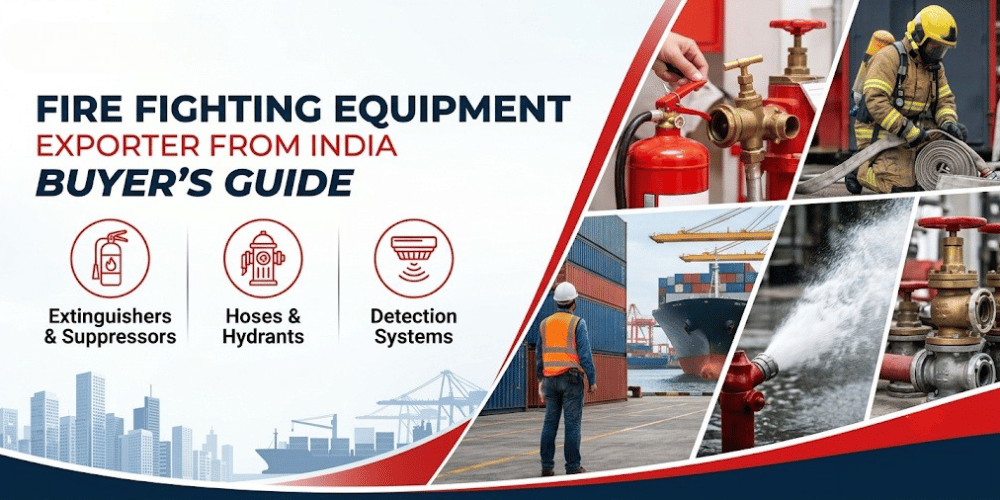
Choosing a dependable fire fighting equipment exporter from India can save an importer, contractor or distributor months of delay and a great deal of money. In this two-part guide, Gopalfiresafety (https://gopalfiresafety.com/) explains how the Indian fire safety export market works, what products are available, which standards matter and how to judge a supplier before you place an order. Part 1 covers the basics: why India is a strong sourcing base, the product range, certifications, target markets and supplier evaluation. Part 2 covers export documents, packaging, shipping, pricing, payment terms and frequently asked questions. You can also follow Gopalfiresafety on Instagram for fire safety tips, product highlights and updates from real projects.
What Does a Fire Fighting Equipment Exporter from India Do?
A fire fighting equipment exporter from India is a manufacturer or registered trading company that supplies fire extinguishers, hoses, valves, hydrants, pumps, alarms, suppression systems and protective gear to buyers in other countries. A good exporter handles more than the sale. It also arranges export packaging, test certificates, customs paperwork, shipping coordination and after-sales support.
There are three common business models:
- Manufacturer exporter: produces the equipment in its own factory and ships it directly.
- Merchant exporter: buys from several factories, consolidates the order and exports it under its own name or the buyer’s brand.
- Trading and sourcing partner: finds products, checks quality and manages the order for the buyer, often for mixed containers.
Each model can work. What matters is that the fire fighting equipment exporter from India you choose is transparent about which model it follows, because that affects pricing, quality control and who is responsible if something goes wrong.
Why Buyers Source Fire Safety Equipment from India
India has become a significant source of fire protection products for many reasons, and they explain why so many importers search for a fire fighting equipment exporter from India before looking elsewhere.
Competitive pricing. Lower labour and manufacturing costs allow Indian producers to offer attractive prices without cutting quality, provided the buyer specifies the standard clearly.
A broad product base. Indian industrial clusters produce most of what a fire protection project needs, from portable extinguishers to hydrant valves, pumps, hoses, signage and protective clothing. This makes it possible to source several categories from one country, often from one supplier.
Established manufacturing regions. Fire safety production is spread across industrial belts in Gujarat, Maharashtra, the Delhi NCR region, Tamil Nadu and other states. Gujarat in particular has deep expertise in valves, pumps, castings and metal fabrication.
Technical skill and engineering support. Many manufacturers employ trained engineers who can adapt products to a buyer’s specification, including custom colours, labels, valve threads and packaging.
Experience with international standards. Indian factories regularly produce to BIS, EN, UL-style and other specifications for export orders, so they are used to working from a buyer’s technical drawing or standard.
Strong port and logistics network. Major ports such as Nhava Sheva (JNPT), Mundra, Chennai, Kandla and Kolkata handle large export volumes, with regular sailings to the Middle East, Africa, Southeast Asia and beyond.
Flexible order sizes. Many exporters accept trial orders, mixed containers and OEM or private label projects, which suits distributors who want to test the market before committing.
None of this means every supplier is equal. A strong market also contains weak players, which is why the evaluation steps later in this guide matter so much when you shortlist a fire fighting equipment exporter from India.
Product Range Available from Indian Exporters
A capable fire fighting equipment exporter from India usually supplies products across several categories. Here is what you can expect.
Portable Fire Extinguishers
This is the most exported category. Common types include:
- ABC dry chemical powder extinguishers: general-purpose units for Class A, B and C fires, widely used in offices, shops, homes and vehicles.
- CO2 extinguishers: clean agents suited to electrical equipment, server rooms and laboratories.
- Water and water-additive extinguishers: for Class A fires such as paper, wood and textiles.
- Foam extinguishers (AFFF and similar): for flammable liquid and solid material fires.
- Clean agent extinguishers: for high-value electronics and sensitive equipment.
- Wet chemical extinguishers: for commercial kitchens and cooking oil fires.
- Stored pressure and cartridge-operated models in sizes from 1 kg to 50 kg or more.
Check the cylinder material, valve type, pressure test records, powder grade and label language when comparing quotes. Cheap extinguishers often differ in exactly these details.
Fire Hoses and Hose Fittings
Exporters supply delivery hoses, hose reels, fire hose couplings, nozzles and branch pipes. Typical hose types include rubber-lined, PVC-lined and polyurethane-lined hose, in diameters such as 38 mm, 63 mm and 70 mm. Instantaneous couplings, branchpipes and hose boxes are often sold together in packages.
Hydrants, Valves and Landing Equipment
This category includes landing valves, hydrant valves, gate valves, check valves, foot valves, fire brigade connections and fire hydrant stand posts. Many of these items are cast in gunmetal, brass, stainless steel or cast iron, so material grade, pressure rating and thread type should be specified in the purchase order.
Fire Pumps and Pumping Systems
Indian manufacturers produce electric, diesel and jockey pumps, and complete fire pump sets with controllers and panels. Larger pump skids are often built to order against a project specification, so lead time and testing arrangements should be agreed in advance.
Sprinkler and Suppression Equipment
Items include sprinkler heads, alarm valves, deluge valves, flow switches, pipe fittings, foam systems, water mist components and gas suppression cylinders. Approvals for these products are especially important because they form part of an engineered system.
Fire Detection and Alarm Systems
Conventional and addressable fire alarm panels, smoke detectors, heat detectors, manual call points, hooters, sounders and strobes are produced in India. Compatibility between panels and detectors is a frequent buyer concern, so always confirm whether devices are sold as a matched system.
Personal Protective Equipment
Firefighter suits, helmets, boots, gloves, breathing apparatus sets, fire blankets and safety harnesses are exported to many markets. For PPE, the testing standard and the certification document matter even more than the price.
Emergency Lighting, Exit Signs and Safety Signage
Emergency luminaires, exit signs, photoluminescent signs and fire safety posters are widely supplied, often with bilingual labelling for the destination market. If you also work in the Gulf region, our Gopalfiresafety guide to emergency lighting in the UAE explains how these items fit into a compliant building.
Specialised and Large Equipment
Some suppliers can also provide fire tenders, trailer fire pumps, portable monitors, foam trolleys and mobile firefighting units, usually to special order.
Standards and Certifications to Look For
The fastest way to separate serious suppliers from risky ones is to ask for standards compliance and test evidence. When a fire fighting equipment exporter from India claims compliance, ask for the actual document, not just a statement.
Indian standards (BIS): Many fire products in India are made to Bureau of Indian Standards specifications. Examples include IS 15683 for portable fire extinguishers, IS 636 for fire hose, IS 5290 for landing valves, and IS 2190 for the selection and installation of extinguishers. Products may carry the ISI mark where certification applies.
European standards: EN 3 for portable extinguishers is widely requested, and CE marking under applicable directives or regulations may be required for certain products and markets.
US-oriented approvals: UL and FM approvals are often requested for sprinklers, pumps, valves and systems, particularly on large projects and in some Gulf and Asian markets. Not every Indian factory holds these, so ask which product models are actually listed.
Quality management: ISO 9001 certification shows that a factory runs a documented quality system. ISO 14001 and ISO 45001 are positive additions.
Local market approvals: Many importing countries require their own approvals, such as Civil Defence approval in Gulf states, SABS in South Africa or equivalent bodies elsewhere. Check what your destination requires before you place an order, because an exporter cannot always obtain these after production.
Third-party test reports: Independent lab reports on pressure, discharge, corrosion and fire rating give more confidence than self-declared data.
Standards and editions change over time, so always confirm the current requirement with your local authority and ask the exporter for current certificates with valid dates.
Markets That Import Fire Safety Equipment from India
Demand for fire protection products is rising in construction, oil and gas, manufacturing, hospitality and infrastructure. Typical destinations for a fire fighting equipment exporter from India include:
- The Middle East, where large construction and industrial projects drive demand for extinguishers, hose, valves and alarm products.
- Africa, where growing infrastructure, mining and commercial building activity creates demand for affordable and durable equipment.
- Southeast Asia, where factories, ports and real estate developments need standard-compliant products at competitive prices.
- South Asia, where neighbouring markets buy a wide range of items through short supply routes.
- Latin America and the Caribbean, where distributors look for new sources of extinguishers and accessories.
- Europe and North America, where niche buyers and private label brands source components, cylinders and accessories from approved factories.
Each region has its own approval rules, labelling language and colour coding. A strong fire fighting equipment exporter from India will know these differences or will ask you for them upfront.
Who Buys from an Indian Exporter?
Understanding buyer types helps you describe your needs clearly:
- Distributors and wholesalers who stock extinguishers and accessories for resale.
- Fire protection contractors who need complete project supply, including pipes, valves and pumps.
- Engineering and construction companies that buy for specific building or plant projects.
- Government and municipal buyers who tender for large quantities of standard equipment.
- Industrial users such as factories, refineries, warehouses and ports.
- Brand owners who want private label or OEM manufacturing.
How to Evaluate a Fire Fighting Equipment Exporter from India
A shortlist is only useful if you know how to test it. Use this step-by-step approach when comparing suppliers.
1. Verify legal registration. A genuine exporter should have a valid Importer Exporter Code (IEC) issued by the Directorate General of Foreign Trade, a GST registration, a company registration certificate and a bank account in the company’s name. Ask for copies and check them against official records where possible.
2. Confirm manufacturing capability. Ask whether the company owns the factory, rents it or outsources production. Request photographs, a video walkthrough or a live factory call. A factory visit or third-party inspection is better still.
3. Review certificates carefully. Check the product model, standard number, issue date and validity on each certificate. Make sure the certificate covers the exact product you are buying, not a similar one.
4. Ask for test reports and batch records. Hydrostatic test records, powder quality reports, hose burst pressure results and valve pressure tests show that products are tested before dispatch.
5. Request samples. Order a small sample set, test it with your own engineer or a lab, and compare it to the specification. A confident fire fighting equipment exporter from India will not hesitate to provide samples, even if you pay for them.
6. Check export experience. Ask which countries the company has shipped to in the past year, and request references or past documentation (with confidential details removed).
7. Compare lead times honestly. A very short quoted lead time for a complex product may signal that the supplier is using stock of unknown quality or is promising something it cannot deliver.
8. Examine packaging. Export-grade cartons, pallets, foam and corner protection reduce damage in transit. Ask for photographs of packed goods.
9. Look at after-sales support. Clarify warranty terms, replacement procedure for defective items and who pays freight on claims.
10. Assess communication quality. Prompt, clear and precise answers are usually a good sign. Vague replies, missing technical data and pressure to pay quickly are warning signs.
Questions to Ask Before You Place an Order
Keep this checklist ready when you contact each fire fighting equipment exporter from India:
- Which standard does the product comply with, and can you supply the certificate?
- Is the factory owned or outsourced?
- What are the minimum order quantity and lead time?
- Can you provide sample units, and at what cost?
- What materials are used for the cylinder, valve, hose lining or casting?
- What is the warranty period and how are claims handled?
- Can you supply private label, custom colours or custom labelling?
- What export packing do you use, and how is it protected against moisture and impact?
- Which Incoterms do you offer, such as EXW, FOB, CFR or CIF?
- What payment terms do you accept?
- Can a third-party inspector visit before shipment?
Red Flags to Watch For
A few warning signs appear repeatedly when buyers run into problems with a fire fighting equipment exporter from India or from anywhere else.
- A price far below all other quotes. Low prices often mean thin cylinder walls, low-grade powder, inferior valves or missing testing.
- Certificates that cannot be verified, are expired, or cover a different model.
- Refusal to allow inspection or provide samples.
- No verifiable company address or a company that exists only as a website and a messaging account.
- Requests for full advance payment to a personal account or a bank in a different country from the company’s registration.
- Inconsistent technical answers, such as quoting a standard but being unable to explain the test requirements.
- No written quotation or proforma invoice with full specifications.
If you notice two or more of these signs, pause and investigate further before sending money.
Manufacturer vs Trader: Which Is Better?
Many buyers prefer to deal directly with a manufacturer, and there are good reasons for that: better control over specifications, more consistent quality and clearer responsibility. But a reliable trading exporter can also be valuable, especially when you need several product categories at once.
A multi-product trading partner can inspect goods at different factories, consolidate shipments into one container and handle the paperwork, which reduces your workload. The key is transparency. Ask the exporter to disclose the factory that makes each product, and ask whether you will receive that factory’s test reports and certificates. A responsible fire fighting equipment exporter from India will answer without hesitation.
OEM, Private Label and Customisation
Many Indian suppliers accept OEM and private label work. This lets distributors sell products under their own brand while the exporter handles manufacturing. Common customisation options include:
- Custom brand name, logo and label design
- Language-specific instructions and local regulatory markings
- Colour changes on cylinders, hose and cabinets
- Special valve threads or connection types
- Custom packaging, including retail boxes and master cartons
- Product bundles, such as a home safety kit or vehicle kit
Before approving customisation, confirm that changes do not affect certification. For instance, altering a label or cylinder colour may require approval in some markets. Ask your fire fighting equipment exporter from India to confirm in writing that the modified product will still comply with the stated standard.
Quality Control Practices to Expect
Reputable exporters follow a quality control process that includes inspection of incoming raw materials, in-process checks, final inspection and pre-shipment verification. For extinguishers, that typically includes cylinder pressure testing, leak testing, powder weight checks, gauge accuracy checks, and verification of labels and seals. For hoses, it includes burst and proof pressure testing and length checks. For valves, it includes hydrostatic testing, material verification and thread gauging.
Ask for a sample inspection report and agree on an acceptance quality level before production. Where the order is large, consider hiring an independent inspection agency to check the goods before they leave India. This is a normal practice and a good fire fighting equipment exporter from India will cooperate fully.
Common Mistakes Importers Make
- Choosing a supplier by price alone
- Not stating the required standard in the purchase order
- Accepting certificates without checking validity
- Skipping samples and pre-shipment inspection
- Ignoring local approval requirements in the destination country
- Forgetting to specify labelling language, colour and valve type
- Not agreeing in writing on warranty, replacement and claim procedures
- Paying the full amount in advance without protection
Avoiding these mistakes protects your investment and your reputation, particularly if you resell to end users who depend on the equipment working correctly in an emergency.
Why Product Quality Matters More Than Price
Fire safety equipment is the one purchase you hope you will never need to use, but it must work the first time. An extinguisher that does not discharge, a hose that bursts under pressure or a valve that leaks during a fire can have severe consequences, as well as legal and commercial ones for the importer. This is why experienced buyers treat a fire fighting equipment exporter from India as a long-term technical partner and not as a one-time seller.
A slightly higher price from a supplier with verified testing, consistent materials and responsive support usually delivers better value than a very low quote with unknown quality. Consider the total cost, including rejection risk, freight on replacements, delay costs and reputational damage.
Key Takeaways from Part 1
India offers a broad, competitively priced fire safety product base, supported by strong manufacturing clusters and good port access. To get the best result, define your product specification and the standard clearly, verify the supplier’s registration, factory capability and certificates, test samples before bulk orders, and watch for the red flags listed above. Whether you are a distributor, contractor or project buyer, the right fire fighting equipment exporter from India will answer your questions openly, show proof of quality and support you after delivery.
The Export Process, Step by Step
Once you have shortlisted a fire fighting equipment exporter from India and approved samples, the order normally follows this path.
- Inquiry and specification. You send product details, quantity, standard, labelling and destination.
- Quotation and proforma invoice. The exporter issues a written quotation, then a proforma invoice that lists specifications, price, Incoterm, lead time and payment terms.
- Order confirmation and payment. You confirm the order and pay the agreed advance or open a letter of credit.
- Production or stock allocation. The factory produces the goods, or reserves ready stock.
- Quality control and inspection. The exporter tests the goods, and a third-party inspector may verify them.
- Packing and marking. Goods are packed in export-grade packaging with correct shipping marks.
- Customs clearance in India. The exporter files the shipping bill and clears the cargo for export.
- Shipping. The cargo is loaded and sent by sea, air or road.
- Documents and payment balance. Original or digital documents are sent to you, and the balance is paid as agreed.
- Import clearance and delivery. You or your agent clear customs in your country and receive the goods.
Knowing these steps helps you see where delays can occur and which party is responsible at each stage. A professional fire fighting equipment exporter from India will explain them at the start.
Essential Export Documents
Paperwork is where many first-time importers run into trouble. A reliable fire fighting equipment exporter from India will prepare and share most of the documents below, and you should confirm early which ones your country requires.
Commercial invoice. This states the seller, buyer, product descriptions, quantities, unit prices, total value, currency and Incoterm. Customs in your country uses it to assess duty, so descriptions must be precise.
Packing list. This lists the number of cartons or pallets, contents of each, net and gross weights and dimensions. It helps customs and the forwarder check the cargo.
Bill of lading or airway bill. The bill of lading is the contract of carriage for sea freight and, in many cases, the document of title. An airway bill serves a similar purpose for air cargo.
Shipping bill. Indian customs requires this for exports, and it is the basis for export incentives and the realisation of foreign currency.
Certificate of origin. This confirms that the goods were made in India. Some countries grant reduced duty under trade agreements when a preferential certificate of origin is supplied, so ask whether your destination qualifies.
Test and quality certificates. These include the manufacturer’s test certificate, third-party lab reports, the standard compliance certificate and any approvals required by your authority.
Material safety data sheet (MSDS or SDS). For extinguishers, foam concentrates, clean agents and powders, a safety data sheet is often required by the carrier and by customs.
Inspection certificate. If a third-party agency inspected the goods, its report should accompany the shipment.
Insurance certificate. This is needed under CIF terms, and advisable under any term.
Destination-specific documents. Many importing countries need extra papers, such as a conformity certificate, product registration or an import permit. These requirements differ widely, and a fire fighting equipment exporter from India cannot always obtain them after production, so ask your customs broker or authority before you order.
Registrations a Genuine Exporter Should Hold
You can often judge a supplier by how well its own paperwork is organised. A serious fire fighting equipment exporter from India should hold:
- An Importer Exporter Code (IEC)
- GST registration, with the ability to export under a Letter of Undertaking or pay IGST and claim a refund
- Registration with the relevant export promotion council where applicable
- An authorised dealer bank account for receiving foreign currency
- A customs-registered process for filing shipping bills, usually through a licensed customs broker
Ask for copies and check them. Legitimate exporters are used to the request and will provide it promptly.
HS Codes for Fire Fighting Equipment
The Harmonised System (HS) code classifies goods for customs and decides the duty you pay. Codes are standardised to six digits worldwide, and countries add extra digits. The examples below are common starting points, but classification depends on the exact product and construction, so confirm with your customs broker before you finalise the order.
- Fire extinguishers, whether charged or not: 8424.10
- Fire hoses and hose fittings: often classified under textile hose (5909), plastic tubes (3917) or rubber tubes (4009), depending on construction, with couplings under 7307 or 8307
- Valves, hydrants and landing valves: 8481
- Fire pumps: 8413
- Fire alarm panels and signalling apparatus: 8531
- Firefighter protective clothing: 6210 or similar, depending on material
- Firefighter helmets and protective headgear: 6506
- Breathing apparatus: 9020
- Fire trucks and special vehicles: 8705
A wrong code can cause delay, fines or an unexpected duty bill. Ask your fire fighting equipment exporter from India to show the HS code on every quotation and invoice, and ask whether your customs authority uses the same code.
Packaging for Export
Good packaging reduces damage claims, protects labels and finishes and makes customs inspection easier. A responsible fire fighting equipment exporter from India should specify its packaging method before production.
Extinguishers. Individual cartons or master cartons with dividers, sealed pins, protected gauges and valves, and cartons strong enough for stacking. Large extinguishers may go on pallets, strapped and shrink-wrapped.
Hoses. Coiled and bound, then packed in cartons, bags or pallet wrap, with protection from oil, moisture and sunlight.
Valves and hydrants. Individually wrapped or boxed with end caps to protect threads and flanges, packed in cartons or wooden crates depending on weight.
Pumps and large equipment. Wooden crates or skids, with lifting points marked and moisture protection included.
Alarm panels and electronics. Foam or corrugated protection, anti-static material where needed and moisture-absorbing sachets.
Wood treatment. Wooden pallets and crates must normally comply with ISPM-15, meaning heat-treated and stamped, to avoid rejection at the destination port.
Marking and labelling. Cartons should show product name, model, quantity, net and gross weight, batch number, country of origin and shipping marks. Orders for some markets also need local language labels and handling symbols.
Ask for photographs of the packed goods before dispatch. This takes a few minutes and often prevents expensive disputes.
Dangerous Goods and Safety Rules
Some fire safety products are regulated for transport because they contain compressed gas, pressurised cylinders, chemicals or batteries.
- Pressurised extinguishers and gas cylinders may fall under dangerous goods rules depending on the agent, pressure and transport mode. Air freight is the most restricted.
- CO2 and clean agent cylinders are usually classified as compressed gases and need correct documentation, marking and carrier approval.
- Foam concentrates and chemicals may need a safety data sheet and, in some cases, a dangerous goods declaration.
- Emergency lights, exit signs and detectors with lithium or other batteries have battery transport rules that vary by chemistry and size.
Many exporters ship extinguishers empty or uncharged to certain markets and refill locally, while others ship them charged. The correct approach depends on the product, the carrier and the destination. Raise this early with your fire fighting equipment exporter from India and the freight forwarder, because last-minute surprises can lead to rejected cargo or extra charges.
Shipping Options and Transit Planning
Sea freight is the most common option for fire protection equipment because the goods are heavy and bulky.
- Full container load (FCL): a 20-foot or 40-foot container used by one buyer. It is cost-effective for larger orders and reduces handling.
- Less than container load (LCL): your cargo shares a container with other shippers. It suits smaller orders but involves more handling and longer waits for consolidation.
Air freight is faster and suits urgent, lightweight items such as detectors, panels and samples, but it costs much more per kilo and is more restricted for pressurised goods.
Road and rail can be an option for neighbouring countries such as Nepal and Bhutan, and through border arrangements with other South Asian markets.
Common Indian ports include Nhava Sheva (JNPT) in Mumbai, Mundra and Kandla in Gujarat, Chennai, Tuticorin, Kolkata and Visakhapatnam. The right port depends on where the factory is and which shipping lines serve your destination. Transit time varies by route, season and port congestion, so ask your forwarder for a current estimate and add a safety margin. When you plan stock levels, remember that production time, inspection, inland transport to the port, customs clearance and sailing schedules all add up. Experienced buyers ask their fire fighting equipment exporter from India for a full timeline, not just a production lead time.
Understanding Incoterms
Incoterms define who is responsible for costs and risk at each stage of the journey. The most common terms in fire safety exports are:
- EXW (Ex Works): you collect the goods at the factory and handle everything from there. It gives the lowest price but the most responsibility.
- FOB (Free on Board): the exporter delivers the goods onto the ship at the Indian port, and you take over from that point. This is very popular because you can choose your own shipping line.
- CFR (Cost and Freight): the exporter pays sea freight to your destination port, but you bear the risk during transit and pay insurance.
- CIF (Cost, Insurance and Freight): like CFR, with the exporter arranging minimum insurance.
- DAP (Delivered at Place): the exporter delivers to a named place in your country, while you handle import clearance and duty.
- DDP (Delivered Duty Paid): the exporter takes on nearly everything, including import duty. It is rare and depends on the exporter’s capability.
For first-time buyers, FOB or CIF is usually the easiest. Always write the Incoterm with the named port, for example “FOB Nhava Sheva,” so there is no confusion about where responsibility changes hands.
What Affects the Price of Fire Fighting Equipment from India
Anyone comparing quotes from a fire fighting equipment exporter from India needs to look beyond the unit price. The main cost factors are:
- Raw material grade: steel thickness, brass versus gunmetal, hose lining and powder purity all change cost.
- Standard and certification: products tested and certified to UL, FM, EN or BIS cost more than non-certified goods.
- Order quantity: higher volumes lower the unit price, and trial orders usually carry a premium.
- Customisation: private label, special colours, custom threads and language-specific labels add tooling, setup or minimum order costs.
- Packaging: export-grade cartons, crates and pallets cost more than basic packing.
- Testing and inspection: third-party inspection, lab reports and witnessed tests add to the price.
- Freight and insurance: these depend on volume, weight, route, season and fuel costs.
- Currency movement: the rupee and the quoted currency can move between quotation and payment, so check how long a quote is valid.
- Duties and taxes at destination: import duty, VAT or GST, port fees and clearance charges are usually paid by the buyer.
A useful method is to compare the landed cost, which is the total you pay to get the goods to your warehouse, rather than the factory price alone. A low unit price can become expensive after rejections, replacements and delays.
Payment Terms and Payment Safety
Payment terms balance risk between buyer and seller. The usual options are:
- Advance payment (TT): a percentage, often 30 percent, is paid with the order and the balance before shipment or against documents. This is common for fresh relationships.
- Letter of credit (LC): your bank guarantees payment once the exporter submits compliant documents. It is secure but involves bank charges and strict document checking.
- Documents against payment (D/P): the exporter’s bank releases documents once you pay.
- Documents against acceptance (D/A): documents are released against your promise to pay on a later date, which requires trust and carries more risk for the seller.
- Open account: payment after delivery, usually only for long-standing partners.
To protect yourself when working with any fire fighting equipment exporter from India:
- Pay only to a bank account in the company’s registered name and country.
- Confirm bank details by phone using a number you found independently, not one sent in the same email, because payment-redirection fraud is common.
- Avoid paying the full amount in advance on a first order.
- Consider an LC or a staged payment tied to inspection and shipping documents.
- Use a written contract or signed proforma invoice that states specifications, delivery time and remedies for defects.
Pre-Shipment Inspection
A third-party inspection is one of the best investments in an export order. An independent agency visits the factory, checks quantity, labelling, packaging and workmanship against the purchase order, samples products according to an agreed method and performs basic functional tests. For fire safety equipment, you can also ask the inspector to witness pressure tests, check cylinder markings, verify certificate numbers and confirm that product models match approved samples.
Agree on three things in advance: the standard for acceptance, what happens if the inspection fails, and who pays for re-inspection. A professional fire fighting equipment exporter from India will cooperate and often keep an inspection plan ready.
Customs Clearance at Your End
Before the shipment arrives, prepare for import clearance. Check:
- Whether you need an import licence, registration or product approval
- The exact duty and tax rate for the HS code
- Whether the shipment qualifies for a preferential rate through a trade agreement
- Whether customs requires pre-shipment inspection or a conformity certificate
- Which documents must be originals, and whether digital copies are accepted
- Port storage charges and free days, to avoid demurrage
A good customs broker can answer these questions and prevent delays. Share the draft documents from your fire fighting equipment exporter from India with the broker before shipment so errors can be corrected while the cargo is still in India.
After-Sales Support, Warranty and Claims
Support after delivery separates a supplier from a long-term partner. Before you place an order, agree on:
- Warranty period and what it covers, such as manufacturing defects, leaks and discharge failure
- Claim procedure, including time limits, the photographs and evidence you must supply and who pays freight on replacements
- Replacement or credit policy for defective items
- Spare parts and refilling guidance, such as valve kits, seals, gauges and powder
- Technical documentation, including manuals, installation guides and maintenance schedules
- Training or technical help for your sales and service team
Get all of this in writing. A trustworthy fire fighting equipment exporter from India will treat a defect report as a quality signal and respond promptly.
Building a Long-Term Relationship with an Exporter
The best results usually come from repeat business. Start with a trial order, review quality and communication, then expand the range and volume. Share forecasts so the exporter can plan production and keep stock for you. Give honest feedback on both problems and strengths. Many buyers also negotiate exclusive territory or private label agreements after a few successful shipments, which protects their investment in marketing and brand building.
Mistakes to Avoid in Export Orders
- Not stating the standard, model and materials in the purchase order
- Ignoring local approval rules until the goods are already shipped
- Using the wrong HS code or an incomplete product description
- Accepting weak packaging that leads to damage in transit
- Overlooking dangerous goods rules for cylinders and batteries
- Choosing an Incoterm without understanding what it covers
- Paying the full amount in advance to an unverified account
- Skipping inspection on large or high-value orders
- Failing to plan for port charges, duties and inland transport
- Not keeping signed copies of the quotation, specification and approved sample
Frequently Asked Questions About Fire Fighting Equipment Exporter from India
What is the minimum order quantity for a fire fighting equipment exporter from India?
It varies by product and supplier. Extinguishers and hose are often supplied in pallet or carton quantities, while pumps and engineered items may be made to order. Trial or mixed orders are possible with many exporters, but unit prices are usually higher.
Can I get samples before placing a bulk order?
Yes. Most exporters supply samples, though you may need to pay for the samples and courier costs. Testing a sample is strongly recommended.
Which certifications should I ask for?
Ask for the certificate that matches the product and your market, such as BIS, EN, UL, FM or CE, plus ISO 9001 for the factory. Always check that the model number and validity dates match your order.
How long does an export order take?
Time depends on whether the goods are in stock, the production schedule, inspection, port loading and sea transit. Ask your fire fighting equipment exporter from India for a written timeline covering each stage.
Can I buy under my own brand?
Many suppliers offer OEM and private label manufacturing. Confirm that branding changes do not affect certification and that your destination allows the label design.
Is it safe to pay in advance?
A partial advance is normal, but avoid paying everything upfront to a new supplier. Use verified bank details, written contracts and, for larger orders, a letter of credit or inspection before the balance is paid.
Who is responsible if the goods arrive damaged?
It depends on the Incoterm and the insurance. Under FOB, risk passes to you once the goods are on board, so insure the shipment. Document damage with photographs and notify the carrier and insurer immediately.
Do I need an agent in India?
Not necessarily, but a sourcing agent or inspection company can help with factory checks, consolidation and quality control, especially if you buy from several factories.
Can one exporter supply all my fire safety items?
Many can supply extinguishers, hoses, valves, alarms, signage and PPE together, often by sourcing from partner factories. Ask which items are made in-house and which are outsourced.
What should I do if a shipment fails local approval?
Contact the authority and your exporter immediately, ask for the test reports and certificates and agree on a corrective plan. Prevention is better, so confirm approvals before you place the order.
Final Thoughts
Importing fire protection products from India can be smooth and profitable when you prepare properly. Define the specification and standard, verify the supplier, check the documents, plan the packaging and shipping, and agree on payment and inspection terms before production starts. A dependable fire fighting equipment exporter from India will help you with each of these steps and stand behind the product after delivery.
Gopalfiresafety supports buyers with fire and life safety solutions, from product guidance to supply and service. To discuss your requirement or request a quotation, visit https://gopalfiresafety.com/ and speak with the team. You can also follow Gopalfiresafety on Instagram for quick safety tips, product updates and real project highlights. Choose carefully, test thoroughly and build a partnership that keeps your customers safe.