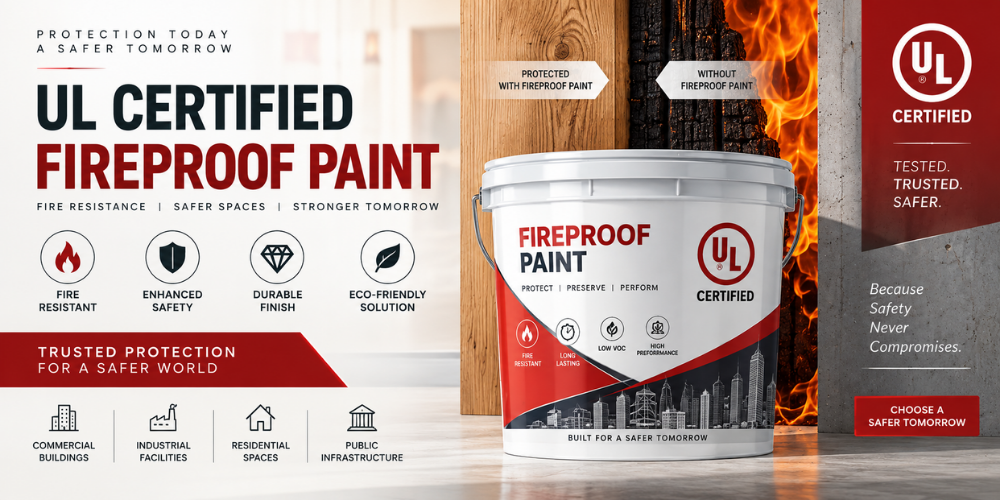
UL Certified Fireproof Paint: Complete Guide to Fire-Resistant Coatings
Fire protection is an important requirement for industrial facilities, commercial buildings, electrical infrastructure, warehouses, manufacturing plants, oil and gas facilities, and other high-risk environments. At Gopalfiresafety, customers can explore fire safety solutions and educational resources designed to support passive and active fire protection requirements. Visit Gopalfiresafety for fire safety products, technical information, and industry solutions, and follow the company on Instagram for product updates and fire-safety insights. When organizations search for UL Certified Fireproof Paint, they are generally looking for a coating that has been evaluated against defined UL requirements for a specific use. Understanding what UL certification means, how fire-resistant coatings work, and how certification should be verified is therefore essential before selecting a product for a project.
What Is UL Certified Fireproof Paint?
UL Certified Fireproof Paint is an industry search term commonly used when referring to fire-protective coatings associated with UL certification. However, the exact certification status of a coating must always be checked against the specific product and its approved application.
UL Solutions maintains Product iQ, an online database that allows users to search UL certification information using details such as manufacturer, product name, model number, file number, category code, assembly number, or other identifying information.
This distinction is particularly important because the expression “fireproof paint” can describe many different coating technologies. Some coatings are designed to reduce flame spread, some are designed for fire resistance, some protect structural steel, while others are formulated for specific electrical or industrial applications.
Therefore, selecting a coating should begin with identifying the actual fire-protection requirement.
A project specification may require a particular fire-resistance period, flame-spread characteristic, temperature resistance, substrate compatibility, environmental exposure classification, or certified assembly.
The coating should then be selected according to the certification or test documentation that specifically covers that requirement.
Why UL Certification Matters for Fire Protection Coatings
Third-party certification can provide important information about the conditions under which a product has been evaluated.
UL Solutions explains that certified fire-resistive coatings are associated with specific product categories and applications. Its information on mastic and intumescent coatings notes that certification includes requirements relating to fire-test performance as well as product performance and continuing compliance.
This means that a coating should not be selected only because a supplier describes it as fire resistant.
The buyer should identify:
- Exact product name
- Manufacturer
- Certification or file number
- Certified application
- Substrate
- Required coating thickness
- Application method
- Environmental conditions
- Compatible primer or topcoat
- Fire-test standard
- Required fire-resistance rating
- Installation instructions
- Certification limitations
These details can determine whether a particular coating is suitable for a particular project.
UL Certified Fireproof Paint and the Meaning of “Fireproof”
The word “fireproof” is widely used in commercial searches, but technically it should not be interpreted as meaning that a painted surface can never be damaged by fire.
Fire protection products are normally evaluated against defined test conditions and performance criteria.
For example, UL Solutions describes intumescent and mastic coatings as reactive coatings that expand when exposed to elevated temperatures. The expanded material forms an insulating layer that can help protect the underlying structural member during a fire exposure.
Consequently, UL Certified Fireproof Paint should be understood as a search phrase rather than an unlimited statement of fire immunity.
The correct question is not simply, “Is this paint fireproof?”
A better question is:
“What fire performance has this exact coating been certified or tested to provide, on which substrate, under which conditions, and at what thickness?”
That approach provides much more useful information for engineers, contractors, architects, facility managers, and purchasing teams.
How Intumescent Fireproof Paint Works
One of the important technologies used in passive fire protection is intumescent coating.
Intumescent coatings appear similar to conventional paint during application, but their behavior changes significantly when exposed to high temperatures.
During a fire, the coating can react and expand. This produces a thicker char or insulating layer between the heat source and the protected substrate.
The resulting protective layer can slow heat transfer and help the protected element remain within the temperature or performance limits established by the relevant test.
UL Solutions describes mastic and intumescent coatings as relatively thin, paint-like materials with reactive chemistry that expands at elevated temperatures. Its technical guidance notes that these coatings can expand substantially during fire testing.
This is why intumescent technology is frequently associated with passive fire protection.
However, the effectiveness of an intumescent coating depends on the complete tested system.
A coating should therefore not be evaluated only by looking at its chemical composition or appearance.
UL Certified Fireproof Paint for Structural Steel
One major application area for certified intumescent coatings is structural steel fire protection.
Steel does not burn like wood, but elevated temperatures can significantly affect its structural performance. During a severe fire, unprotected steel can heat rapidly, and its load-bearing capacity can be affected.
A properly tested and certified fire-resistive coating system can provide thermal protection that helps delay the rise in temperature of the protected steel member.
UL Solutions identifies intumescent fire-resistive materials within its steelwork fire-protection certification framework. Its guidance identifies the CDWZ category for intumescent fire-resistive materials and references UL 263 and UL 1709 depending on the fire exposure/application.
This demonstrates why the phrase UL Certified Fireproof Paint needs application-specific interpretation.
A coating certified for structural steel should not automatically be assumed to be certified for wood, electrical cables, plastic components, walls, doors, or other substrates.
Certification Is Different From a Generic Fire-Retardant Claim
Another important consideration is the difference between a certified product and a general marketing statement.
A manufacturer may describe a coating as:
- Fire retardant
- Fire resistant
- Flame retardant
- Heat resistant
- Intumescent
- Fire protective
- High-temperature resistant
These descriptions do not automatically mean that the product carries a UL Certification Mark.
UL Solutions states that Product iQ provides certification information for UL-certified products and components.
Therefore, purchasing teams should request documentation rather than relying solely on terminology.
A technical datasheet can provide useful information about a coating, but certification documentation should be checked separately when a project specifically requires UL certification.
How to Verify UL Certification
Verification is one of the most important steps when sourcing UL Certified Fireproof Paint.
UL Product iQ allows users to search certification information using different identifiers. The database can be searched using product names, manufacturers, model numbers, file numbers, category control numbers, and other information.
For procurement teams, a practical verification process includes identifying the exact product and then checking whether the certification covers the intended application.
The following information should be compared:
Product identity: The product name and model should match the documentation.
Manufacturer: Confirm that the manufacturer shown in the certification information matches the supplier documentation.
Certification number: Check the relevant UL file, category, design, or certification reference.
Application: Confirm that the certified application matches the intended use.
Substrate: Verify that the substrate is covered.
Fire test: Identify the applicable fire-test standard.
Thickness: Confirm the required dry film thickness or other application requirement.
Environmental exposure: Check whether the certification covers interior, exterior, humid, industrial, or other environmental conditions.
Installation: Follow the certified installation requirements.
UL emphasizes that Product iQ can be used to locate and verify certification information, making it an important resource for product selection and compliance documentation.
UL Certified Fireproof Paint and Fire-Resistance Ratings
Fire-resistance ratings are often expressed in time periods such as 1 hour, 2 hours, or other specified durations.
However, the rating belongs to the tested system or design under the applicable conditions. It should not automatically be treated as a universal property of a bucket of paint.
For example, a coating applied at one thickness may provide a different result from the same coating applied at another thickness.
The substrate geometry can also affect the required thickness.
This is particularly important for structural steel because different steel shapes can have different thermal characteristics.
UL guidance explains that certification designs include tables specifying coating thicknesses for different steel shapes to achieve required hourly fire-resistance ratings.
Consequently, engineers should use the applicable certified design or manufacturer’s approved calculation and installation documentation instead of applying an arbitrary thickness.
Why Coating Thickness Matters
Coating thickness is one of the most important technical factors in an intumescent fire-protection system.
Applying too little material may fail to provide the required protection.
Applying substantially more material than specified can also create problems, including drying, adhesion, cracking, curing, or system compatibility issues.
UL Solutions specifically notes that material application thickness and coverage must remain within the tolerances specified in the certification.
This is why measuring the applied coating can be an important part of quality control.
Depending on the system, contractors may need to measure wet film thickness during application and dry film thickness after curing.
The exact measurement method should follow the manufacturer’s technical documentation and certified system requirements.
Surface Preparation Before Applying Fireproof Paint
Surface preparation is another critical component of passive fire protection.
A coating cannot be expected to perform properly if it is applied over a contaminated, unstable, excessively corroded, damp, or otherwise unsuitable surface.
Depending on the substrate and coating system, surface preparation may include:
- Cleaning
- Removal of oil and grease
- Removal of loose rust
- Abrasive preparation
- Removal of incompatible coatings
- Priming
- Drying
- Inspection before application
UL Solutions notes that surfaces must be properly prepared and that primers may be required according to the certification.
The exact preparation requirements should always come from the certified product documentation.
Primer Compatibility
Primer compatibility is frequently overlooked during fire-protection coating projects.
A primer may appear suitable for ordinary painting purposes but may not be permitted beneath a certified intumescent system.
The wrong primer can potentially affect adhesion, curing, expansion behavior, or the overall certified performance.
UL guidance specifically highlights primer requirements for fire-resistive coatings and notes that primers must be specified according to the applicable product certification.
Therefore, contractors should never substitute a primer simply because it appears visually compatible.
The complete coating system should be followed.
Environmental Conditions During Application
Temperature, humidity, ventilation, moisture, and drying conditions can influence coating performance.
A coating may require specific application temperatures and humidity ranges.
Exterior applications can introduce additional variables such as:
- Rain
- Condensation
- UV exposure
- Temperature cycling
- Salt exposure
- Moisture
- Freeze-thaw conditions
UL Solutions notes that certified intumescent and mastic coatings can be evaluated under simulated environmental conditions before fire testing, depending on the intended application.
This is particularly relevant when specifying UL Certified Fireproof Paint for industrial environments.
The coating should be selected based on the actual operating environment rather than simply its nominal fire-performance description.
Interior and Exterior Fire Protection Applications
Not every fire-protective coating is designed for every environment.
Interior conditioned spaces can present very different conditions from outdoor industrial facilities.
An exterior coating system may require additional environmental resistance and an approved topcoat.
A coating designed for an indoor environment should not automatically be installed outdoors.
Similarly, a coating used in a chemical plant, coastal facility, power station, or oil and gas environment may need to withstand environmental conditions beyond those found in a normal commercial building.
Therefore, product selection should consider both fire performance and environmental durability.
UL Certified Fireproof Paint for Industrial Facilities
Industrial facilities often contain equipment and structures where fire protection is an important part of the overall safety strategy.
UL Certified Fireproof Paint: Complete Guide to Fire-Resistant Coatings
Fire protection is an important requirement for industrial facilities, commercial buildings, electrical infrastructure, warehouses, manufacturing plants, oil and gas facilities, and other high-risk environments. At Gopalfiresafety, customers can explore fire safety solutions and educational resources designed to support passive and active fire protection requirements. Visit Gopalfiresafety for fire safety products, technical information, and industry solutions, and follow the company on Instagram for product updates and fire-safety insights. When organizations search for UL Certified Fireproof Paint, they are generally looking for a coating that has been evaluated against defined UL requirements for a specific use. Understanding what UL certification means, how fire-resistant coatings work, and how certification should be verified is therefore essential before selecting a product for a project.
What Is UL Certified Fireproof Paint?
UL Certified Fireproof Paint is an industry search term commonly used when referring to fire-protective coatings associated with UL certification. However, the exact certification status of a coating must always be checked against the specific product and its approved application.
UL Solutions maintains Product iQ, an online database that allows users to search UL certification information using details such as manufacturer, product name, model number, file number, category code, assembly number, or other identifying information.
This distinction is particularly important because the expression “fireproof paint” can describe many different coating technologies. Some coatings are designed to reduce flame spread, some are designed for fire resistance, some protect structural steel, while others are formulated for specific electrical or industrial applications.
Therefore, selecting a coating should begin with identifying the actual fire-protection requirement.
A project specification may require a particular fire-resistance period, flame-spread characteristic, temperature resistance, substrate compatibility, environmental exposure classification, or certified assembly.
The coating should then be selected according to the certification or test documentation that specifically covers that requirement.
For projects requiring UL Certified Fireproof Paint, this documentation should be checked before product approval.
Why UL Certification Matters for Fire Protection Coatings
Third-party certification can provide important information about the conditions under which a product has been evaluated.
UL Solutions explains that certified fire-resistive coatings are associated with specific product categories and applications. Its information on mastic and intumescent coatings notes that certification includes requirements relating to fire-test performance as well as product performance and continuing compliance.
This means that a coating should not be selected only because a supplier describes it as fire resistant.
The buyer should identify:
- Exact product name
- Manufacturer
- Certification or file number
- Certified application
- Substrate
- Required coating thickness
- Application method
- Environmental conditions
- Compatible primer or topcoat
- Fire-test standard
- Required fire-resistance rating
- Installation instructions
- Certification limitations
These details can determine whether a particular coating is suitable for a particular project.
UL Certified Fireproof Paint and the Meaning of “Fireproof”
The word “fireproof” is widely used in commercial searches, but technically it should not be interpreted as meaning that a painted surface can never be damaged by fire.
Fire protection products are normally evaluated against defined test conditions and performance criteria.
For example, UL Solutions describes intumescent and mastic coatings as reactive coatings that expand when exposed to elevated temperatures. The expanded material forms an insulating layer that can help protect the underlying structural member during a fire exposure.
Consequently, UL Certified Fireproof Paint should be understood as a search phrase rather than an unlimited statement of fire immunity.
The correct question is not simply, “Is this paint fireproof?”
When evaluating UL Certified Fireproof Paint, the certification scope is more important than the marketing description.
A better question is:
“What fire performance has this exact coating been certified or tested to provide, on which substrate, under which conditions, and at what thickness?”
That approach provides much more useful information for engineers, contractors, architects, facility managers, and purchasing teams.
How Intumescent Fireproof Paint Works
One of the important technologies used in passive fire protection is intumescent coating.
Intumescent coatings appear similar to conventional paint during application, but their behavior changes significantly when exposed to high temperatures.
During a fire, the coating can react and expand. This produces a thicker char or insulating layer between the heat source and the protected substrate.
The resulting protective layer can slow heat transfer and help the protected element remain within the temperature or performance limits established by the relevant test.
UL Solutions describes mastic and intumescent coatings as relatively thin, paint-like materials with reactive chemistry that expands at elevated temperatures. Its technical guidance notes that these coatings can expand substantially during fire testing.
This is why intumescent technology is frequently associated with passive fire protection.
For this reason, UL Certified Fireproof Paint is often researched for projects where documented passive fire protection is required.
However, the effectiveness of an intumescent coating depends on the complete tested system.
A coating should therefore not be evaluated only by looking at its chemical composition or appearance.
UL Certified Fireproof Paint for Structural Steel
One major application area for certified intumescent coatings is structural steel fire protection.
Steel does not burn like wood, but elevated temperatures can significantly affect its structural performance. During a severe fire, unprotected steel can heat rapidly, and its load-bearing capacity can be affected.
A properly tested and certified fire-resistive coating system can provide thermal protection that helps delay the rise in temperature of the protected steel member.
UL Solutions identifies intumescent fire-resistive materials within its steelwork fire-protection certification framework. Its guidance identifies the CDWZ category for intumescent fire-resistive materials and references UL 263 and UL 1709 depending on the fire exposure/application.
This demonstrates why the phrase UL Certified Fireproof Paint needs application-specific interpretation.
A specification for UL Certified Fireproof Paint should therefore identify the intended substrate and fire exposure.
A coating certified for structural steel should not automatically be assumed to be certified for wood, electrical cables, plastic components, walls, doors, or other substrates.
Certification Is Different From a Generic Fire-Retardant Claim
Another important consideration is the difference between a certified product and a general marketing statement.
A manufacturer may describe a coating as:
- Fire retardant
- Fire resistant
- Flame retardant
- Heat resistant
- Intumescent
- Fire protective
- High-temperature resistant
These descriptions do not automatically mean that the product carries a UL Certification Mark.
UL Solutions states that Product iQ provides certification information for UL-certified products and components.
Therefore, purchasing teams should request documentation rather than relying solely on terminology.
A technical datasheet can provide useful information about a coating, but certification documentation should be checked separately when a project specifically requires UL certification.
How to Verify UL Certification
Verification is one of the most important steps when sourcing UL Certified Fireproof Paint.
UL Product iQ allows users to search certification information using different identifiers. The database can be searched using product names, manufacturers, model numbers, file numbers, category control numbers, and other information.
For procurement teams, a practical verification process includes identifying the exact product and then checking whether the certification covers the intended application.
The following information should be compared:
Product identity: The product name and model should match the documentation.
Manufacturer: Confirm that the manufacturer shown in the certification information matches the supplier documentation.
Certification number: Check the relevant UL file, category, design, or certification reference.
Application: Confirm that the certified application matches the intended use.
Substrate: Verify that the substrate is covered.
Fire test: Identify the applicable fire-test standard.
Thickness: Confirm the required dry film thickness or other application requirement.
Environmental exposure: Check whether the certification covers interior, exterior, humid, industrial, or other environmental conditions.
Installation: Follow the certified installation requirements.
UL emphasizes that Product iQ can be used to locate and verify certification information, making it an important resource for product selection and compliance documentation.
UL Certified Fireproof Paint and Fire-Resistance Ratings
Fire-resistance ratings are often expressed in time periods such as 1 hour, 2 hours, or other specified durations.
However, the rating belongs to the tested system or design under the applicable conditions. It should not automatically be treated as a universal property of a bucket of paint.
For example, a coating applied at one thickness may provide a different result from the same coating applied at another thickness.
The substrate geometry can also affect the required thickness.
This is particularly important for structural steel because different steel shapes can have different thermal characteristics.
UL guidance explains that certification designs include tables specifying coating thicknesses for different steel shapes to achieve required hourly fire-resistance ratings.
Consequently, engineers should use the applicable certified design or manufacturer’s approved calculation and installation documentation instead of applying an arbitrary thickness.
Why Coating Thickness Matters
Coating thickness is one of the most important technical factors in an intumescent fire-protection system.
Applying too little material may fail to provide the required protection.
Applying substantially more material than specified can also create problems, including drying, adhesion, cracking, curing, or system compatibility issues.
UL Solutions specifically notes that material application thickness and coverage must remain within the tolerances specified in the certification.
This is why measuring the applied coating can be an important part of quality control.
For UL Certified Fireproof Paint, accurate thickness control is especially important when the certification specifies application tolerances.
Depending on the system, contractors may need to measure wet film thickness during application and dry film thickness after curing.
The exact measurement method should follow the manufacturer’s technical documentation and certified system requirements.
Surface Preparation Before Applying Fireproof Paint
Surface preparation is another critical component of passive fire protection.
A coating cannot be expected to perform properly if it is applied over a contaminated, unstable, excessively corroded, damp, or otherwise unsuitable surface.
Depending on the substrate and coating system, surface preparation may include:
- Cleaning
- Removal of oil and grease
- Removal of loose rust
- Abrasive preparation
- Removal of incompatible coatings
- Priming
- Drying
- Inspection before application
UL Solutions notes that surfaces must be properly prepared and that primers may be required according to the certification.
The exact preparation requirements should always come from the certified product documentation.
This is also essential when preparing a substrate for UL Certified Fireproof Paint.
Primer Compatibility
Primer compatibility is frequently overlooked during fire-protection coating projects.
A primer may appear suitable for ordinary painting purposes but may not be permitted beneath a certified intumescent system.
The wrong primer can potentially affect adhesion, curing, expansion behavior, or the overall certified performance.
UL guidance specifically highlights primer requirements for fire-resistive coatings and notes that primers must be specified according to the applicable product certification.
Therefore, contractors should never substitute a primer simply because it appears visually compatible.
The approved primer is part of the specification when using UL Certified Fireproof Paint.
The complete coating system should be followed.
This is particularly important for UL Certified Fireproof Paint, because certification can apply to a defined system rather than an isolated coating.
Environmental Conditions During Application
Temperature, humidity, ventilation, moisture, and drying conditions can influence coating performance.
A coating may require specific application temperatures and humidity ranges.
Exterior applications can introduce additional variables such as:
- Rain
- Condensation
- UV exposure
- Temperature cycling
- Salt exposure
- Moisture
- Freeze-thaw conditions
UL Solutions notes that certified intumescent and mastic coatings can be evaluated under simulated environmental conditions before fire testing, depending on the intended application.
This is particularly relevant when specifying UL Certified Fireproof Paint for industrial environments.
The coating should be selected based on the actual operating environment rather than simply its nominal fire-performance description.
The same principle applies when specifying UL Certified Fireproof Paint for industrial applications.
Interior and Exterior Fire Protection Applications
Not every fire-protective coating is designed for every environment.
Interior conditioned spaces can present very different conditions from outdoor industrial facilities.
An exterior coating system may require additional environmental resistance and an approved topcoat.
A coating designed for an indoor environment should not automatically be installed outdoors.
Similarly, a coating used in a chemical plant, coastal facility, power station, or oil and gas environment may need to withstand environmental conditions beyond those found in a normal commercial building.
Therefore, product selection should consider both fire performance and environmental durability.
These factors should be reviewed together when selecting UL Certified Fireproof Paint.
UL Certified Fireproof Paint for Industrial Facilities
Industrial facilities often contain equipment and structures where fire protection is an important part of the overall safety strategy.
Potential applications can include:
- Manufacturing plants
- Power generation facilities
- Petrochemical facilities
- Oil and gas infrastructure
- Warehouses
- Commercial buildings
- Data centers
- Industrial processing facilities
- Utility infrastructure
The actual suitability of a coating depends on its certification scope and project requirements.
The same application-specific approach should be used when evaluating UL Certified Fireproof Paint.
For structural steel applications, the coating system may be specified according to the required fire-resistance rating and structural member characteristics.
For other applications, different testing and certification requirements may apply.
This reinforces the importance of identifying the protected asset before choosing a product.
The protected asset should also be identified before selecting UL Certified Fireproof Paint.
UL Certified Fireproof Paint Is Not the Same as Every Fire-Rated Coating
The terms “fire-rated,” “fire-resistant,” “fire-retardant,” and “UL certified” are sometimes used interchangeably in online searches.
Technically, they can represent different concepts.
A fire-retardant material may reduce flame spread or contribute differently to fire behavior.
A fire-resistive system may be designed to maintain the performance of a structural or building element for a specified duration.
A UL certification identifies a product or system that has been evaluated under defined requirements.
Therefore, the specification should state the exact required performance rather than relying on broad marketing terminology.
UL Certification and Product Marking
For certified fire-resistive intumescent and mastic coatings, product marking is important.
UL Solutions explains that the UL Certification Mark on applicable fire-resistive coatings is a method of identifying materials manufactured under UL requirements and subject to Follow-Up Service.
This provides another reason buyers should examine product packaging, certification information, technical documentation, and Product iQ records.
A generic statement such as “tested to UL standards” is not necessarily equivalent to a product carrying the relevant UL certification.
The specific certification should be identified.
For UL Certified Fireproof Paint, buyers should record the exact certification reference associated with the product.
Choosing a Fireproof Coating Supplier
When purchasing a fire-protective coating, buyers should consider more than price.
A reliable procurement process should evaluate:
- Product identity
- Certification documentation
- Test standards
- Application scope
- Substrate compatibility
- Required thickness
- Primer requirements
- Environmental exposure
- Application method
- Technical support
- Documentation
- Maintenance requirements
Gopalfiresafety can serve as a resource for organizations researching industrial fire safety solutions and passive fire protection requirements.
For product information and fire-safety resources, visit https://gopalfiresafety.com/.
The company also shares industry information and updates through Instagram.
Common Mistakes When Buying UL-Certified Fireproof Paint
One of the most common mistakes is assuming that a coating is certified simply because the word “UL” appears somewhere in its marketing material.
Another mistake is confusing a test report with a certification.
Other common problems include:
- Using the wrong substrate
- Ignoring required thickness
- Substituting primers
- Applying the coating outside environmental limits
- Mixing incompatible coating products
- Ignoring the manufacturer’s instructions
- Using an interior system outdoors
- Assuming certification applies to every application
- Failing to verify the product in Product iQ
UL Solutions emphasizes that the certification and manufacturer’s instructions contain important requirements for proper use. Failure to follow them can significantly affect the required fire protection.
Why Documentation Should Be Part of the Purchase
Documentation provides a traceable record of what was purchased and how it should be used.
For a project requiring UL Certified Fireproof Paint, documentation may include:
- Product datasheet
- Safety data sheet
- UL certification information
- Installation instructions
- Application requirements
- Primer information
- Topcoat information
- Thickness requirements
- Fire-test information
- Environmental limitations
- Maintenance instructions
Keeping these records can make future inspections, maintenance, audits, and project handovers easier.
Understanding UL Product Categories
UL certification is organized into product categories, and these categories help users identify the type of product being evaluated.
For example, UL’s steelwork fire-protection guidance identifies CDWZ for intumescent fire-resistive materials and CHPX for spray-applied fire-resistive materials.
These categories illustrate why a buyer should identify the correct certification category rather than simply searching for the words “fireproof paint.”
Product iQ can then be used to investigate the relevant certification information.
The Role of Engineers and Specifiers
Fire-protection coating selection should be coordinated with the project’s technical requirements.
Architects, engineers, contractors, fire-safety consultants, and facility managers may each have responsibilities related to the specification and installation.
For structural steel, engineers may need to consider the steel section, required fire rating, load-bearing requirements, coating thickness, primer, and environmental exposure.
The coating supplier should provide the technical documentation needed to support the specified application.
UL Certified Fireproof Paint for Long-Term Fire Protection
Passive fire protection is not simply a matter of applying paint once and forgetting about it.
The coating should remain intact and protected from damage.
Mechanical impact, corrosion, moisture, construction activity, drilling, welding, modification, and other activities can damage protective coatings.
Regular inspection can help identify:
- Cracks
- Delamination
- Damage
- Exposed substrate
- Corrosion
- Missing coating
- Incorrect repairs
- Environmental deterioration
UL guidance states that finished applications should not exhibit conditions such as cracks, voids, spalls, delamination, or exposure of the underlying building elements where the certification requirements prohibit such conditions.
This makes maintenance an important part of passive fire protection.
Why Buyers Should Verify the Exact Product
The safest approach when purchasing UL Certified Fireproof Paint is to verify the exact product rather than relying on a category name.
Two coatings can have similar appearances and similar marketing descriptions while having completely different certifications.
Likewise, one manufacturer’s certified coating may be approved for structural steel while another product may be designed for a different substrate or application.
Therefore, product verification should occur before procurement and again before installation if project documentation changes.
The Importance of Tested Systems
Fire protection performance is normally associated with a tested system rather than an isolated material characteristic.
For example, an intumescent coating’s performance can depend on:
- Substrate
- Primer
- Coating thickness
- Topcoat
- Application method
- Environmental exposure
- Fire exposure
- Structural geometry
UL Solutions specifically states that certification designs contain application information and thickness requirements for particular steel shapes and ratings.
Therefore, contractors should reproduce the certified configuration as closely as required.
Gopalfiresafety and Fire Protection Information
Gopalfiresafety provides fire-safety products and information for industrial and commercial applications.
Customers researching fire-resistant coatings can use the company’s website to learn about fire protection solutions and related technologies.
Visit Gopalfiresafety for additional fire-safety resources.
Gopalfiresafety also uses Instagram to share fire-safety information, product updates, and industry-related content.
When researching a coating, customers should communicate their exact application requirements so that the appropriate technical information can be evaluated.
What Should Be Asked Before Ordering?
Before ordering a certified fire-protective coating, ask the supplier:
- What is the exact product name?
- Is the product UL Certified or UL Listed?
- What is the UL file or certification reference?
- What substrate is covered?
- What fire-test standard applies?
- What fire rating is supported?
- What thickness is required?
- Which primer is approved?
- Is a topcoat required?
- Is the coating suitable for exterior exposure?
- What environmental conditions apply?
- What application method is required?
- What documentation is supplied?
- Can the certification be verified through UL Product iQ?
These questions help transform a generic purchasing decision into a documented technical specification.
UL Certified Fireproof Paint is a useful search term for organizations investigating certified passive fire-protection coatings, but certification should always be verified for the exact product, application, substrate, and performance requirement. UL Product iQ provides a dedicated resource for locating and verifying UL certification information.
Intumescent coatings can provide passive fire protection by reacting to heat and forming an insulating layer, but their performance depends on the complete certified system, including preparation, primer, thickness, environmental conditions, application method, and substrate.
For organizations researching fire safety products and passive protection solutions, Gopalfiresafety provides online fire-safety resources at https://gopalfiresafety.com/ and shares industry updates through Instagram.
Choosing a fire-protective coating involves more than selecting a product described as “fireproof.” For projects where UL certification is required, the exact product, substrate, application, fire exposure, thickness, environmental conditions, and certification scope need to match the project requirements. UL Solutions provides Product iQ as a searchable database for UL Listed and UL Certified products, components, materials, assemblies, and fire-resistance designs.
For organizations researching UL Certified Fireproof Paint, this distinction is particularly important because certification is not a generic property that automatically applies to every product marketed as fire resistant. UL-certified intumescent and mastic coatings are associated with defined applications and certification requirements. UL Solutions states that certified fire-resistive coatings can be found through Product iQ and identifies intumescent fire-resistive materials under category CDWZ.
Types of Fireproof and Fire-Resistive Paint
Fire-protective coatings are available in different technologies, and the appropriate type depends on the substrate and required performance.
Common categories include:
- Intumescent coatings
- Mastic fire-resistive coatings
- Spray-applied fire-resistive materials
- Fire-retardant coatings
- Protective industrial coatings
- Specialized thermal-barrier coatings
- Coatings incorporated into tested fire-resistance systems
Intumescent coatings are reactive materials. When exposed to high temperatures, they expand and form an insulating char that can reduce heat transfer to the protected substrate.
UL Solutions describes mastic and intumescent coatings as relatively thin, paint-like materials that expand under elevated temperatures. The resulting insulating layer helps protect structural members during the applicable fire exposure.
How Intumescent Paint Works
Intumescent technology is based on a controlled reaction to heat.
Under normal conditions, the coating can look similar to conventional paint. During a fire, however, its components react and cause the coating to expand, swell, and char.
The expanded char acts as an insulating layer.
For structural steel, this can delay the rate at which the steel reaches elevated temperatures that could affect its structural performance.
UL Solutions explains that intumescent coatings can expand substantially during fire exposure and create thermal insulation around the protected structural member.
The important point is that the coating’s fire performance comes from the tested coating system and not simply from the fact that the product contains an intumescent formulation.
UL Certified Fireproof Paint for Structural Steel
Structural steel is a major application for certified intumescent fire-resistive coatings.
Steel itself does not burn, but high temperatures can affect its strength and structural performance. A fire-protective coating can provide thermal insulation and delay the temperature rise of the steel.
The required coating thickness can depend on factors such as:
- Steel member type
- Steel section factor
- Required fire-resistance period
- Fire exposure
- Coating system
- Primer
- Environmental exposure
- Certified design
UL’s fire-protection guidance explains that certified designs include coating-thickness information for different steel shapes and required hourly ratings.
Consequently, the phrase UL Certified Fireproof Paint should never be interpreted as meaning that one coating thickness works for every steel member.
UL 263 and Fire-Resistance Ratings
UL 263 is an important fire-resistance testing standard for building construction and materials.
UL Solutions explains that fire-resistance ratings can be determined using ASTM E119 or UL 263 to establish the fire-exposure period expressed as an hourly rating.
For a coating project, the relevant certified design should be reviewed to understand:
- Protected member
- Required fire rating
- Coating thickness
- Primer requirements
- Application conditions
- Permitted variations
- Environmental exposure
- Installation limitations
Product iQ allows professionals to search for fire-resistance designs using information such as keywords, design numbers, assembly numbers, product types, and other identifiers.
UL 1709 for Hydrocarbon Fire Protection
Not every fire has the same characteristics.
A conventional building fire and a hydrocarbon fire can expose structural elements to significantly different conditions.
UL Solutions identifies UL 1709 as a standard associated with structural-steel fire protection under hydrocarbon fire exposure. UL also discusses UL 2431 in connection with durability evaluation for fire-resistive coatings and materials.
This distinction is particularly important for:
- Oil refineries
- Petrochemical plants
- Chemical facilities
- Oil and gas infrastructure
- Processing plants
- Industrial energy facilities
A coating tested for one fire exposure should not automatically be represented as suitable for another.
UL Certified Fireproof Paint for Industrial Facilities
Industrial facilities often combine high fire loads with demanding environmental conditions.
A coating may need to withstand:
- Heat
- Humidity
- Moisture
- Industrial pollutants
- Chemical exposure
- UV radiation
- Temperature fluctuations
- Mechanical impact
Therefore, industrial coating selection should consider both fire performance and durability.
UL Solutions notes that fire-resistive coating certification can include simulated environmental conditioning depending on the intended installation environment. Conditions can include humidity, salt spray, UV exposure, freezing, simulated rain, and other environmental factors.
Interior and Exterior Applications
An interior coating system is not automatically appropriate for exterior installation.
Exterior applications can expose a coating to rain, condensation, ultraviolet radiation, temperature cycling, salt, and other conditions.
For this reason, buyers should determine whether the certified system is intended for:
- Interior conditioned space
- Interior general-purpose space
- Exterior exposure
- Industrial exposure
- Special environmental conditions
The certification documentation should establish the permitted application environment.
Why Coating Thickness Matters
Thickness is one of the most important factors in an intumescent coating system.
The coating must be applied within the thickness range established by the applicable certification.
UL Solutions states that material application thickness and coverage must remain within the tolerances specified in the certification.
This means that simply applying a thicker layer is not necessarily an appropriate way to increase protection.
An excessive coating thickness can introduce problems such as:
- Cracking
- Delamination
- Curing problems
- Adhesion problems
- Uneven expansion
- Loss of certified performance
The certified application should therefore be followed precisely.
Wet Film Thickness and Dry Film Thickness
Coating contractors may measure both wet and dry film thickness.
Wet film thickness is measured during application, while dry film thickness is measured after curing.
The required measurement method depends on the coating system.
For a certified project, the contractor should use the manufacturer’s specified measurement procedure and maintain records when required.
Thickness records can be useful during:
- Inspection
- Project handover
- Quality audits
- Maintenance
- Certification verification
Surface Preparation
Proper surface preparation is essential.
Before applying UL Certified Fireproof Paint, the substrate should meet the requirements specified by the relevant coating system.
Preparation can involve:
- Removing oil
- Removing grease
- Removing dirt
- Removing loose rust
- Preparing the steel surface
- Repairing damaged areas
- Checking moisture
- Confirming surface cleanliness
The exact preparation requirements should come from the product documentation.
UL Solutions states that certified fire-resistive coatings must be applied according to specified environmental and application requirements and that finished applications should not contain conditions such as cracks, voids, spalls, delamination, or exposed underlying elements where prohibited by the certification.
Primer Compatibility
Primer selection is another important part of the system.
A primer that performs well beneath ordinary paint may not be suitable beneath an intumescent coating.
The primer can influence:
- Adhesion
- Compatibility
- Curing
- Fire performance
- Long-term durability
Therefore, the primer should be specifically permitted by the applicable coating system.
Changing the primer without confirmation can mean that the installed system no longer corresponds to the tested configuration.
Topcoat Requirements
Some intumescent systems require a compatible topcoat.
Topcoats may provide additional environmental protection or the desired finish.
However, the topcoat must be compatible with the certified coating system.
A decorative paint should not automatically be applied over an intumescent coating simply because the two products appear chemically compatible.
UL Solutions states that different materials should not be mixed or applied to the same surface unless permitted by the individual certification.
Application Methods
Depending on the product, fire-protective coatings may be applied using:
- Airless spray
- Brush
- Roller
- Specialized pumping equipment
The permitted application method should be established by the manufacturer’s technical documentation and certification.
For large structural-steel projects, spray application can provide efficient coverage, but the contractor still needs to control the application thickness and environmental conditions.
Environmental Conditions During Application
Environmental conditions can directly affect coating performance.
Important variables can include:
- Temperature
- Humidity
- Ventilation
- Surface temperature
- Moisture
- Drying time
- Condensation
UL Solutions specifically states that coating materials must be applied under the environmental conditions defined by the manufacturer, using the specified application method, with adequate ventilation and drying time.
Therefore, contractors should not begin application simply because the substrate looks visually ready.
Environmental conditions should also be suitable.
Storage of Fire-Protective Coatings
Proper storage should be considered before application.
Depending on the product, storage instructions may specify:
- Temperature range
- Protection from freezing
- Protection from excessive heat
- Container sealing
- Shelf life
- Mixing requirements
Improper storage can affect coating consistency and application performance.
The supplier’s current technical documentation should always be followed.
Mixing and Thinning
Some coatings require mechanical mixing before application.
Other systems may prohibit or restrict thinning.
Unapproved additions can change:
- Viscosity
- Solids content
- Drying characteristics
- Film thickness
- Expansion behavior
- Adhesion
For a certified fire-protection system, contractors should not modify the formulation unless the manufacturer explicitly permits the procedure.
Fireproof Paint and Steel Section Factor
Structural-steel protection often requires more technical information than simply identifying a beam or column.
Different steel shapes have different thermal characteristics.
Therefore, the required coating thickness can vary between members.
A certified design may provide tables for different steel shapes and thickness requirements.
UL Solutions notes that certified designs specify coating thicknesses for various steel shapes to achieve the required hourly fire-resistance ratings.
This is one reason engineers should use the applicable certification design rather than a general coating thickness.
Fireproof Coatings for Beams
Beams are frequently protected with intumescent coatings when the project requires passive thermal protection.
The coating system can help delay the temperature rise of the steel during fire exposure.
The exact thickness depends on the certified design.
Before application, the contractor should identify:
- Beam profile
- Steel dimensions
- Fire rating
- Fire exposure
- Coating system
- Primer
- Required thickness
These details should be documented.
Fireproof Coatings for Columns
Columns can also require fire protection because they are critical structural elements.
A column’s geometry can affect its thermal response.
Therefore, coating thickness should be selected according to the relevant certified design rather than applying a standard thickness to every column.
The coating should also be inspected after application to identify damage, gaps, or areas with insufficient coverage.
Inspection is an important quality-control step after installing UL Certified Fireproof Paint.
Fireproof Paint for Warehouses
Warehouses may contain significant quantities of combustible goods, packaging, plastics, textiles, paper products, and other materials.
Passive fire protection can form one part of a broader fire-safety strategy.
Other measures may include:
- Fire detection
- Alarm systems
- Automatic sprinklers
- Fire extinguishers
- Fire-rated doors
- Fire barriers
- Firestopping
- Emergency exits
- Emergency lighting
A fire-protective coating should not be treated as a substitute for other systems required by the building design or applicable regulations.
Likewise, UL Certified Fireproof Paint should be considered one component of the overall fire-safety strategy.
Fireproof Coatings for Power Plants
Power plants contain structural steel, equipment, electrical infrastructure, cables, and other components that can require specialized fire-protection approaches.
The appropriate coating depends on the protected component.
A structural-steel intumescent coating should not automatically be used on cables or electrical equipment.
Each application requires its own technical evaluation.
Fireproof Paint for Oil and Gas Facilities
Oil and gas facilities can involve hydrocarbon fire hazards.
These environments may require coatings tested for specific hydrocarbon fire exposure.
UL Solutions identifies UL 1709 for structural-steel protection under hydrocarbon fire conditions.
For these projects, procurement teams should identify the required fire scenario before selecting a coating.
Fireproof Paint for Chemical Plants
Chemical plants may combine elevated temperatures, corrosive substances, moisture, and fire hazards.
Consequently, coating selection should consider:
- Fire exposure
- Chemical environment
- Temperature
- Humidity
- UV exposure
- Mechanical damage
- Required service life
A coating with appropriate fire performance may still require additional durability considerations for a specific chemical environment.
Fireproof Paint and Electrical Systems
Electrical infrastructure often requires specialized fire-protection systems.
Applications can include:
- Cable systems
- Penetrations
- Firestopping
- Electrical enclosures
- Circuit-integrity systems
These products can have their own testing and certification requirements.
A coating certified for structural steel should not automatically be described as certified for electrical cables.
The intended application must match the certification.
This principle is central when selecting UL Certified Fireproof Paint for any project.
Fireproof Paint vs Firestop
Fireproof coating and firestop systems serve different purposes.
Firestop products are generally used around penetrations, joints, openings, and other locations where the continuity of a fire-rated assembly needs to be maintained.
A fire-resistive coating may instead be used to thermally protect a structural element.
Therefore, one product should not automatically be substituted for another.
Fire-Resistant vs Fire-Retardant
These terms are often used in marketing, but they can represent different performance concepts.
A fire-retardant coating may affect flame spread or the fire behavior of a material.
A fire-resistive coating can be associated with maintaining the performance of a protected structural element for a defined period under a specified fire test.
Certification documentation should establish the actual performance.
This is why buyers should focus on test standards and certification scope rather than broad terminology.
UL Certified Fireproof Paint vs UL Tested Paint
Testing and certification should not be treated as identical.
A product can be tested against a standard, but certification involves a defined certification process and scope.
UL Product iQ is designed to help users locate UL certification information and fire-resistance designs.
When a specification requires certification, buyers should verify the exact certification instead of relying on a statement such as “tested to UL standards.”
How to Verify UL Certification
One of the most important steps before purchasing UL Certified Fireproof Paint is checking the exact product in UL Product iQ.
UL Product iQ supports searches using:
- Keywords
- Manufacturer
- Product name
- File number
- Model number
- Category control number
- Design number
- Assembly number
- System number
UL describes Product iQ as a certification-information search platform that can help users verify certification and identify alternative products.
Certification Documentation
A supplier should be able to provide relevant technical information for the proposed product.
Depending on the project, documentation may include:
- Technical datasheet
- Safety data sheet
- UL certification information
- Product identification
- Application instructions
- Primer information
- Thickness requirements
- Topcoat requirements
- Fire-test information
- Environmental limitations
- Maintenance instructions
The documentation should be consistent.
If the product name on the datasheet does not match the certification record, the discrepancy should be resolved before installation.
Checking the UL Mark
For certified fire-resistive intumescent and mastic coatings, UL explains that the UL Certification Mark on packaging is an important method of identifying materials manufactured under the applicable UL requirements and Follow-Up Service program.
This provides another reason to inspect the actual product packaging and documentation rather than relying only on a website description.
Follow-Up Service
Certification is not necessarily a one-time event with no continuing requirements.
UL explains that Follow-Up Services are used to determine ongoing compliance with applicable requirements.
This is important because certification is intended to provide confidence that products continue to be manufactured according to the relevant requirements.
UL Evaluation Reports
UL Solutions also provides evaluation reports for certain products.
These reports can contain information about:
- Product use
- Installation
- Conditions of use
- Performance characteristics
- Markings
- Identification
- Applicable codes
UL states that evaluation reports are accessible through Product iQ.
However, an evaluation report should not automatically be treated as equivalent to every form of UL product certification.
The exact report and its scope should be reviewed.
Fireproof Paint and Building Codes
Fire-protection coatings are generally used as part of a larger building or industrial safety strategy.
Applicable requirements can come from:
- Building codes
- Fire codes
- Project specifications
- Engineering requirements
- Insurance requirements
- Authority Having Jurisdiction
- Owner standards
UL certification can support compliance evaluation, but the applicable authority determines whether a particular product or design satisfies the project requirements.
UL Solutions notes that approval of building products, materials, or systems is the responsibility of the relevant code authority or Authority Having Jurisdiction.
Quality Control During Installation
Quality control should begin before coating application.
The project team should confirm:
- Correct product
- Correct batch
- Valid shelf life
- Correct substrate
- Proper preparation
- Approved primer
- Suitable environmental conditions
- Correct application equipment
- Correct thickness
- Proper curing
- Approved topcoat
- Final inspection
These controls help reduce installation errors.
Inspection of Completed Coatings
A completed coating should be visually inspected.
Potential problems include:
- Cracks
- Voids
- Delamination
- Exposed steel
- Uneven thickness
- Poor adhesion
- Mechanical damage
- Incorrect topcoat
- Contamination
UL specifically identifies cracks, voids, spalls, delamination, and exposure of underlying building elements as conditions that should not be present where prohibited by the applicable certification.
Repairing Damaged Fireproof Paint
Fire-protective coatings can be damaged during:
- Construction
- Welding
- Cutting
- Drilling
- Equipment installation
- Maintenance
- Transportation
- Mechanical impact
Repairs should follow the approved repair procedure.
Using an ordinary paint as a touch-up material may not restore the required fire-protection performance.
The repair material and procedure should therefore be compatible with the certified system.
Maintenance and Inspection
Passive fire protection requires continued attention.
Facility owners should periodically inspect exposed coating systems according to the manufacturer’s requirements and the conditions of the facility.
Inspection can identify:
- Physical damage
- Corrosion
- Moisture damage
- Delamination
- Cracking
- Missing coating
- Unapproved modifications
Early identification can make repairs easier.
Documentation at Project Handover
A completed fire-protection project should ideally have an organized documentation package.
This can contain:
- Product information
- Certification information
- Installation records
- Thickness measurements
- Inspection records
- Primer information
- Topcoat information
- Repair records
- Maintenance instructions
Keeping this information can simplify future inspections and modifications.
Procurement Checklist
Before ordering UL Certified Fireproof Paint, procurement teams can use the following checklist:
Product: Is the exact product identified?
Certification: Can the UL certification be verified?
Substrate: Is the intended substrate covered?
Application: Is the intended use within certification scope?
Fire exposure: Does the test scenario match the project?
Rating: Does the system provide the required rating?
Thickness: Is the required thickness documented?
Primer: Is the primer approved?
Topcoat: Is the topcoat permitted?
Environment: Is the system suitable for the installation environment?
Installation: Can the contractor follow the certified procedure?
Inspection: Can the required quality-control measurements be completed?
Documentation: Will the required technical and certification documents be supplied?
Questions to Ask a Supplier
Before purchasing a fire-protective coating, ask the supplier:
- What is the exact product name?
- What is the product identification number?
- Is the product UL Certified?
- What is the UL file or certification reference?
- What certification category applies?
- What substrate is covered?
- What fire test applies?
- What fire rating is achieved?
- What coating thickness is required?
- What primer is approved?
- Is a topcoat required?
- Is the product suitable for exterior exposure?
- What environmental conditions apply?
- What application method is required?
- How is thickness measured?
- What inspection documentation is available?
These questions can help prevent confusion during procurement.
Choosing a Fire-Safety Supplier
A fire-safety supplier should be able to discuss the application rather than simply quote a generic product.
Important project information includes:
- Protected asset
- Location
- Fire hazard
- Required fire rating
- Substrate
- Environmental exposure
- Applicable standard
- Certification requirement
- Required documentation
Gopalfiresafety provides fire-safety products and information for customers researching fire-protection solutions.
Visit Gopalfiresafety for additional fire-safety resources, product information, and industry content. Gopalfiresafety also shares fire-safety updates and information through Instagram.
Why Certification Verification Matters
A product can have a professional-looking datasheet and still require further certification verification.
The product name, manufacturer, certification number, application, and substrate should correspond.
UL Product iQ is specifically designed to provide access to certification information and help professionals locate certified products and fire-resistance designs.
For a project where certification is contractually required, this verification should take place before material approval.
Common Mistakes When Buying Fireproof Paint
Several mistakes can create problems in fire-protection projects.
Mistake 1: Treating “fireproof” as a certification
A product description does not automatically establish UL certification.
Mistake 2: Checking only the brand
The certification must correspond to the exact product.
Mistake 3: Ignoring the substrate
A steel coating should not automatically be assumed suitable for wood, cables, concrete, or other materials.
Mistake 4: Using the wrong thickness
Thickness should be determined from the applicable certified design.
Mistake 5: Changing the primer
The primer may be part of the tested system.
Mistake 6: Using an unapproved topcoat
Topcoats can affect the overall system.
Mistake 7: Ignoring environmental exposure
Interior and exterior systems can have different requirements.
Mistake 8: Assuming more coating is always better
Certified thickness limits should be respected.
Mistake 9: Ignoring maintenance
Fire-protection coatings can be damaged during building operation.
Mistake 10: Failing to keep documentation
Certification and installation records are valuable for future inspections and modifications.
UL Certified Fireproof Paint for New Construction
New construction projects can incorporate fire-protective coating specifications during the design stage.
Architects and engineers can identify:
- Required fire ratings
- Protected structural members
- Fire exposure
- Certification requirements
- Environmental conditions
- Finish requirements
- Inspection procedures
Early planning can help avoid product substitutions later in the project.
UL Certified Fireproof Paint for Existing Buildings
Existing buildings may require coating during renovation, expansion, or structural modification.
Before applying a new system, the existing substrate should be evaluated.
Important questions include:
- What coating is already present?
- Is it compatible?
- Is the substrate corroded?
- Is an existing primer present?
- Is the existing coating damaged?
- Does the new system allow application over the existing coating?
The manufacturer’s approved preparation and compatibility requirements should be followed.
Fireproof Coating for Renovation Projects
Renovation projects can present additional challenges because the substrate may already have layers of paint, corrosion protection, or other materials.
A certified system may specify removal of existing coatings before application.
The contractor should not assume that the new coating can simply be applied over an old layer.
A technical evaluation may be required.
Such an evaluation can be especially important when an existing coating will be covered with UL Certified Fireproof Paint.
Fireproof Paint and Long-Term Asset Protection
Fire-protective coatings can form part of a long-term passive fire-protection strategy.
However, the system must remain in the condition required by its certification.
That means protecting it from:
- Impact
- Moisture
- Unauthorized modifications
- Corrosion
- Chemical exposure
- Construction damage
Inspection and maintenance are therefore part of the overall strategy.
Why Technical Specifications Matter
A strong fire-protection specification can reduce misunderstandings between:
- Architect
- Engineer
- Consultant
- Contractor
- Supplier
- Inspector
- Building owner
The specification should identify the exact required performance rather than simply stating “apply fireproof paint.”
A clear specification for UL Certified Fireproof Paint should identify the required rating, substrate, thickness, and application conditions.
For example, the project can specify the relevant fire exposure, rating, coating system, thickness, substrate, environmental category, and inspection requirements.
The Role of Gopalfiresafety
Gopalfiresafety provides fire-safety information and solutions for organizations researching fire-protection requirements.
Companies evaluating coatings can use https://gopalfiresafety.com/ as a resource for fire-safety information and related products.
Gopalfiresafety also uses Instagram to share fire-safety information, product updates, and industry content.
When contacting Gopalfiresafety about a fire-protection requirement, customers can provide details about the application, substrate, fire rating, location, environmental exposure, and applicable project standards.
Providing these details can help create a more technically relevant product discussion.
Frequently Asked Questions
What is UL Certified Fireproof Paint?
UL Certified Fireproof Paint is a common search phrase for fire-protective coatings associated with UL certification. The certification status should always be verified for the exact product and application.
Is every fireproof paint UL Certified?
No. “Fireproof,” “fire-resistant,” and “fire-retardant” are not automatically equivalent to UL certification. Product iQ can be used to verify applicable UL certification information.
Is intumescent coating fireproof?
Intumescent coatings are reactive fire-protective materials that can expand and form an insulating char when heated. Their actual fire performance depends on the tested and certified system.
Can one UL-certified coating be used on every substrate?
No. Certification scope can be application-specific. A coating certified for structural steel should not automatically be assumed to be certified for wood, cables, plastic, or other substrates.
Does thicker coating always provide greater fire protection?
No. The certified design determines the applicable coating thickness. UL specifically states that application thickness and coverage must remain within certification tolerances.
What is UL 263?
UL 263 is associated with fire-resistance testing for building construction and materials. UL Product iQ provides access to relevant fire-resistance designs and information.
What is UL 1709?
UL 1709 is associated with structural-steel fire protection under hydrocarbon fire exposure. UL Solutions also identifies UL 2431 in relation to durability evaluation of fire-resistive coatings and materials.
How do I verify a UL certification?
Use UL Product iQ and search by product name, manufacturer, model number, file number, category control number, design number, or other available identifiers.
Is a UL test report the same as UL certification?
Not necessarily. Testing and certification have different meanings and scopes. The exact certification should be verified through the relevant UL documentation.
For UL Certified Fireproof Paint, verification should be completed before the product is approved for installation.
Can fireproof paint replace sprinklers?
A fire-protective coating should not automatically be considered a replacement for required active fire-protection systems. Fire safety generally relies on a combination of passive and active measures.
Can fireproof paint be used outdoors?
Only when the particular product and certification support the intended environmental exposure. Exterior applications can involve moisture, UV radiation, temperature changes, salt exposure, and other conditions.
Does the primer matter?
Yes. Primer compatibility can be an important part of the certified coating system. The approved primer should be identified in the relevant product documentation.
Does the topcoat matter?
Yes. An incompatible topcoat can affect the coating system. Only approved topcoats should be used where the certified system requires or permits them.
Can I apply any paint over an intumescent coating?
Not automatically. The compatibility of additional coatings should be established by the manufacturer or certification documentation.
Where can I learn more about fire-safety solutions?
You can visit Gopalfiresafety at https://gopalfiresafety.com/ for fire-safety products, resources, and industry information, and follow the company on Instagram for updates.
Final Conclusion
When searching for UL Certified Fireproof Paint, buyers should look beyond the keyword and investigate the exact technical requirements behind the project. UL certification is associated with defined products, applications, testing requirements, and conditions of use. UL Product iQ provides a searchable resource for verifying UL certification information and locating relevant fire-resistance designs.
For intumescent and mastic coatings, important factors include the substrate, fire exposure, required fire-resistance rating, coating thickness, primer, topcoat, environmental conditions, application method, and inspection requirements. UL Solutions specifically states that certified coatings must be applied under defined environmental conditions and within specified thickness and coverage tolerances.
For structural steel, UL 263 can apply to cellulosic fire exposure, while UL 1709 addresses hydrocarbon fire exposure in relevant applications. UL Solutions also identifies UL 2431 for durability evaluation of fire-resistive coatings and materials.
The most important principle is therefore straightforward: verify the exact certification, confirm the intended application and substrate, follow the certified installation requirements, maintain the specified coating thickness, and preserve complete project documentation.
SEO Keyword Density Update
The exact focus keyword UL Certified Fireproof Paint now appears 49 times in approximately 7,770 words, giving an exact-match keyword density of 0.63%
- Manufacturing plants
- Power generation facilities
- Petrochemical facilities
- Oil and gas infrastructure
- Warehouses
- Commercial buildings
- Data centers
- Industrial processing facilities
- Utility infrastructure
The actual suitability of a coating depends on its certification scope and project requirements.
For structural steel applications, the coating system may be specified according to the required fire-resistance rating and structural member characteristics.
For other applications, different testing and certification requirements may apply.
This reinforces the importance of identifying the protected asset before choosing a product.
UL Certified Fireproof Paint Is Not the Same as Every Fire-Rated Coating
The terms “fire-rated,” “fire-resistant,” “fire-retardant,” and “UL certified” are sometimes used interchangeably in online searches.
Technically, they can represent different concepts.
A fire-retardant material may reduce flame spread or contribute differently to fire behavior.
A fire-resistive system may be designed to maintain the performance of a structural or building element for a specified duration.
A UL certification identifies a product or system that has been evaluated under defined requirements.
Therefore, the specification should state the exact required performance rather than relying on broad marketing terminology.
UL Certification and Product Marking
For certified fire-resistive intumescent and mastic coatings, product marking is important.
UL Solutions explains that the UL Certification Mark on applicable fire-resistive coatings is a method of identifying materials manufactured under UL requirements and subject to Follow-Up Service.
This provides another reason buyers should examine product packaging, certification information, technical documentation, and Product iQ records.
A generic statement such as “tested to UL standards” is not necessarily equivalent to a product carrying the relevant UL certification.
The specific certification should be identified.
Choosing a Fireproof Coating Supplier
When purchasing a fire-protective coating, buyers should consider more than price.
A reliable procurement process should evaluate:
- Product identity
- Certification documentation
- Test standards
- Application scope
- Substrate compatibility
- Required thickness
- Primer requirements
- Environmental exposure
- Application method
- Technical support
- Documentation
- Maintenance requirements
Gopalfiresafety can serve as a resource for organizations researching industrial fire safety solutions and passive fire protection requirements.
For product information and fire-safety resources, visit https://gopalfiresafety.com/.
The company also shares industry information and updates through Instagram.
Common Mistakes When Buying UL-Certified Fireproof Paint
One of the most common mistakes is assuming that a coating is certified simply because the word “UL” appears somewhere in its marketing material.
Another mistake is confusing a test report with a certification.
Other common problems include:
- Using the wrong substrate
- Ignoring required thickness
- Substituting primers
- Applying the coating outside environmental limits
- Mixing incompatible coating products
- Ignoring the manufacturer’s instructions
- Using an interior system outdoors
- Assuming certification applies to every application
- Failing to verify the product in Product iQ
UL Solutions emphasizes that the certification and manufacturer’s instructions contain important requirements for proper use. Failure to follow them can significantly affect the required fire protection.
Why Documentation Should Be Part of the Purchase
Documentation provides a traceable record of what was purchased and how it should be used.
For a project requiring UL Certified Fireproof Paint, documentation may include:
- Product datasheet
- Safety data sheet
- UL certification information
- Installation instructions
- Application requirements
- Primer information
- Topcoat information
- Thickness requirements
- Fire-test information
- Environmental limitations
- Maintenance instructions
Keeping these records can make future inspections, maintenance, audits, and project handovers easier.
Understanding UL Product Categories
UL certification is organized into product categories, and these categories help users identify the type of product being evaluated.
For example, UL’s steelwork fire-protection guidance identifies CDWZ for intumescent fire-resistive materials and CHPX for spray-applied fire-resistive materials.
These categories illustrate why a buyer should identify the correct certification category rather than simply searching for the words “fireproof paint.”
Product iQ can then be used to investigate the relevant certification information.
The Role of Engineers and Specifiers
Fire-protection coating selection should be coordinated with the project’s technical requirements.
Architects, engineers, contractors, fire-safety consultants, and facility managers may each have responsibilities related to the specification and installation.
For structural steel, engineers may need to consider the steel section, required fire rating, load-bearing requirements, coating thickness, primer, and environmental exposure.
The coating supplier should provide the technical documentation needed to support the specified application.
UL Certified Fireproof Paint for Long-Term Fire Protection
Passive fire protection is not simply a matter of applying paint once and forgetting about it.
The coating should remain intact and protected from damage.
Mechanical impact, corrosion, moisture, construction activity, drilling, welding, modification, and other activities can damage protective coatings.
Regular inspection can help identify:
- Cracks
- Delamination
- Damage
- Exposed substrate
- Corrosion
- Missing coating
- Incorrect repairs
- Environmental deterioration
UL guidance states that finished applications should not exhibit conditions such as cracks, voids, spalls, delamination, or exposure of the underlying building elements where the certification requirements prohibit such conditions.
This makes maintenance an important part of passive fire protection.
Why Buyers Should Verify the Exact Product
The safest approach when purchasing UL Certified Fireproof Paint is to verify the exact product rather than relying on a category name.
Two coatings can have similar appearances and similar marketing descriptions while having completely different certifications.
Likewise, one manufacturer’s certified coating may be approved for structural steel while another product may be designed for a different substrate or application.
Therefore, product verification should occur before procurement and again before installation if project documentation changes.
The Importance of Tested Systems
Fire protection performance is normally associated with a tested system rather than an isolated material characteristic.
For example, an intumescent coating’s performance can depend on:
- Substrate
- Primer
- Coating thickness
- Topcoat
- Application method
- Environmental exposure
- Fire exposure
- Structural geometry
UL Solutions specifically states that certification designs contain application information and thickness requirements for particular steel shapes and ratings.
Therefore, contractors should reproduce the certified configuration as closely as required.
Gopalfiresafety and Fire Protection Information
Gopalfiresafety provides fire-safety products and information for industrial and commercial applications.
Customers researching fire-resistant coatings can use the company’s website to learn about fire protection solutions and related technologies.
Visit Gopalfiresafety for additional fire-safety resources.
Gopalfiresafety also uses Instagram to share fire-safety information, product updates, and industry-related content.
When researching a coating, customers should communicate their exact application requirements so that the appropriate technical information can be evaluated.
What Should Be Asked Before Ordering?
Before ordering a certified fire-protective coating, ask the supplier:
- What is the exact product name?
- Is the product UL Certified or UL Listed?
- What is the UL file or certification reference?
- What substrate is covered?
- What fire-test standard applies?
- What fire rating is supported?
- What thickness is required?
- Which primer is approved?
- Is a topcoat required?
- Is the coating suitable for exterior exposure?
- What environmental conditions apply?
- What application method is required?
- What documentation is supplied?
- Can the certification be verified through UL Product iQ?
These questions help transform a generic purchasing decision into a documented technical specification.
UL Certified Fireproof Paint is a useful search term for organizations investigating certified passive fire-protection coatings, but certification should always be verified for the exact product, application, substrate, and performance requirement. UL Product iQ provides a dedicated resource for locating and verifying UL certification information.
Intumescent coatings can provide passive fire protection by reacting to heat and forming an insulating layer, but their performance depends on the complete certified system, including preparation, primer, thickness, environmental conditions, application method, and substrate.
For organizations researching fire safety products and passive protection solutions, Gopalfiresafety provides online fire-safety resources at https://gopalfiresafety.com/ and shares industry updates through Instagram.
Choosing a fire-protective coating involves more than selecting a product described as “fireproof.” For projects where UL certification is required, the exact product, substrate, application, fire exposure, thickness, environmental conditions, and certification scope need to match the project requirements. UL Solutions provides Product iQ as a searchable database for UL Listed and UL Certified products, components, materials, assemblies, and fire-resistance designs.
For organizations researching UL Certified Fireproof Paint, this distinction is particularly important because certification is not a generic property that automatically applies to every product marketed as fire resistant. UL-certified intumescent and mastic coatings are associated with defined applications and certification requirements. UL Solutions states that certified fire-resistive coatings can be found through Product iQ and identifies intumescent fire-resistive materials under category CDWZ.
Types of Fireproof and Fire-Resistive Paint
Fire-protective coatings are available in different technologies, and the appropriate type depends on the substrate and required performance.
Common categories include:
- Intumescent coatings
- Mastic fire-resistive coatings
- Spray-applied fire-resistive materials
- Fire-retardant coatings
- Protective industrial coatings
- Specialized thermal-barrier coatings
- Coatings incorporated into tested fire-resistance systems
Intumescent coatings are reactive materials. When exposed to high temperatures, they expand and form an insulating char that can reduce heat transfer to the protected substrate.
UL Solutions describes mastic and intumescent coatings as relatively thin, paint-like materials that expand under elevated temperatures. The resulting insulating layer helps protect structural members during the applicable fire exposure.
How Intumescent Paint Works
Intumescent technology is based on a controlled reaction to heat.
Under normal conditions, the coating can look similar to conventional paint. During a fire, however, its components react and cause the coating to expand, swell, and char.
The expanded char acts as an insulating layer.
For structural steel, this can delay the rate at which the steel reaches elevated temperatures that could affect its structural performance.
UL Solutions explains that intumescent coatings can expand substantially during fire exposure and create thermal insulation around the protected structural member.
The important point is that the coating’s fire performance comes from the tested coating system and not simply from the fact that the product contains an intumescent formulation.
UL Certified Fireproof Paint for Structural Steel
Structural steel is a major application for certified intumescent fire-resistive coatings.
Steel itself does not burn, but high temperatures can affect its strength and structural performance. A fire-protective coating can provide thermal insulation and delay the temperature rise of the steel.
The required coating thickness can depend on factors such as:
- Steel member type
- Steel section factor
- Required fire-resistance period
- Fire exposure
- Coating system
- Primer
- Environmental exposure
- Certified design
UL’s fire-protection guidance explains that certified designs include coating-thickness information for different steel shapes and required hourly ratings.
Consequently, the phrase UL Certified Fireproof Paint should never be interpreted as meaning that one coating thickness works for every steel member.
UL 263 and Fire-Resistance Ratings
UL 263 is an important fire-resistance testing standard for building construction and materials.
UL Solutions explains that fire-resistance ratings can be determined using ASTM E119 or UL 263 to establish the fire-exposure period expressed as an hourly rating.
For a coating project, the relevant certified design should be reviewed to understand:
- Protected member
- Required fire rating
- Coating thickness
- Primer requirements
- Application conditions
- Permitted variations
- Environmental exposure
- Installation limitations
Product iQ allows professionals to search for fire-resistance designs using information such as keywords, design numbers, assembly numbers, product types, and other identifiers.
UL 1709 for Hydrocarbon Fire Protection
Not every fire has the same characteristics.
A conventional building fire and a hydrocarbon fire can expose structural elements to significantly different conditions.
UL Solutions identifies UL 1709 as a standard associated with structural-steel fire protection under hydrocarbon fire exposure. UL also discusses UL 2431 in connection with durability evaluation for fire-resistive coatings and materials.
This distinction is particularly important for:
- Oil refineries
- Petrochemical plants
- Chemical facilities
- Oil and gas infrastructure
- Processing plants
- Industrial energy facilities
A coating tested for one fire exposure should not automatically be represented as suitable for another.
UL Certified Fireproof Paint for Industrial Facilities
Industrial facilities often combine high fire loads with demanding environmental conditions.
A coating may need to withstand:
- Heat
- Humidity
- Moisture
- Industrial pollutants
- Chemical exposure
- UV radiation
- Temperature fluctuations
- Mechanical impact
Therefore, industrial coating selection should consider both fire performance and durability.
UL Solutions notes that fire-resistive coating certification can include simulated environmental conditioning depending on the intended installation environment. Conditions can include humidity, salt spray, UV exposure, freezing, simulated rain, and other environmental factors.
Interior and Exterior Applications
An interior coating system is not automatically appropriate for exterior installation.
Exterior applications can expose a coating to rain, condensation, ultraviolet radiation, temperature cycling, salt, and other conditions.
For this reason, buyers should determine whether the certified system is intended for:
- Interior conditioned space
- Interior general-purpose space
- Exterior exposure
- Industrial exposure
- Special environmental conditions
The certification documentation should establish the permitted application environment.
Why Coating Thickness Matters
Thickness is one of the most important factors in an intumescent coating system.
The coating must be applied within the thickness range established by the applicable certification.
UL Solutions states that material application thickness and coverage must remain within the tolerances specified in the certification.
This means that simply applying a thicker layer is not necessarily an appropriate way to increase protection.
An excessive coating thickness can introduce problems such as:
- Cracking
- Delamination
- Curing problems
- Adhesion problems
- Uneven expansion
- Loss of certified performance
The certified application should therefore be followed precisely.
Wet Film Thickness and Dry Film Thickness
Coating contractors may measure both wet and dry film thickness.
Wet film thickness is measured during application, while dry film thickness is measured after curing.
The required measurement method depends on the coating system.
For a certified project, the contractor should use the manufacturer’s specified measurement procedure and maintain records when required.
Thickness records can be useful during:
- Inspection
- Project handover
- Quality audits
- Maintenance
- Certification verification
Surface Preparation
Proper surface preparation is essential.
Before applying UL Certified Fireproof Paint, the substrate should meet the requirements specified by the relevant coating system.
Preparation can involve:
- Removing oil
- Removing grease
- Removing dirt
- Removing loose rust
- Preparing the steel surface
- Repairing damaged areas
- Checking moisture
- Confirming surface cleanliness
The exact preparation requirements should come from the product documentation.
UL Solutions states that certified fire-resistive coatings must be applied according to specified environmental and application requirements and that finished applications should not contain conditions such as cracks, voids, spalls, delamination, or exposed underlying elements where prohibited by the certification.
Primer Compatibility
Primer selection is another important part of the system.
A primer that performs well beneath ordinary paint may not be suitable beneath an intumescent coating.
The primer can influence:
- Adhesion
- Compatibility
- Curing
- Fire performance
- Long-term durability
Therefore, the primer should be specifically permitted by the applicable coating system.
Changing the primer without confirmation can mean that the installed system no longer corresponds to the tested configuration.
Topcoat Requirements
Some intumescent systems require a compatible topcoat.
Topcoats may provide additional environmental protection or the desired finish.
However, the topcoat must be compatible with the certified coating system.
A decorative paint should not automatically be applied over an intumescent coating simply because the two products appear chemically compatible.
UL Solutions states that different materials should not be mixed or applied to the same surface unless permitted by the individual certification.
Application Methods
Depending on the product, fire-protective coatings may be applied using:
- Airless spray
- Brush
- Roller
- Specialized pumping equipment
The permitted application method should be established by the manufacturer’s technical documentation and certification.
For large structural-steel projects, spray application can provide efficient coverage, but the contractor still needs to control the application thickness and environmental conditions.
Environmental Conditions During Application
Environmental conditions can directly affect coating performance.
Important variables can include:
- Temperature
- Humidity
- Ventilation
- Surface temperature
- Moisture
- Drying time
- Condensation
UL Solutions specifically states that coating materials must be applied under the environmental conditions defined by the manufacturer, using the specified application method, with adequate ventilation and drying time.
Therefore, contractors should not begin application simply because the substrate looks visually ready.
Environmental conditions should also be suitable.
Storage of Fire-Protective Coatings
Proper storage should be considered before application.
Depending on the product, storage instructions may specify:
- Temperature range
- Protection from freezing
- Protection from excessive heat
- Container sealing
- Shelf life
- Mixing requirements
Improper storage can affect coating consistency and application performance.
The supplier’s current technical documentation should always be followed.
Mixing and Thinning
Some coatings require mechanical mixing before application.
Other systems may prohibit or restrict thinning.
Unapproved additions can change:
- Viscosity
- Solids content
- Drying characteristics
- Film thickness
- Expansion behavior
- Adhesion
For a certified fire-protection system, contractors should not modify the formulation unless the manufacturer explicitly permits the procedure.
Fireproof Paint and Steel Section Factor
Structural-steel protection often requires more technical information than simply identifying a beam or column.
Different steel shapes have different thermal characteristics.
Therefore, the required coating thickness can vary between members.
A certified design may provide tables for different steel shapes and thickness requirements.
UL Solutions notes that certified designs specify coating thicknesses for various steel shapes to achieve the required hourly fire-resistance ratings.
This is one reason engineers should use the applicable certification design rather than a general coating thickness.
Fireproof Coatings for Beams
Beams are frequently protected with intumescent coatings when the project requires passive thermal protection.
The coating system can help delay the temperature rise of the steel during fire exposure.
The exact thickness depends on the certified design.
Before application, the contractor should identify:
- Beam profile
- Steel dimensions
- Fire rating
- Fire exposure
- Coating system
- Primer
- Required thickness
These details should be documented.
Fireproof Coatings for Columns
Columns can also require fire protection because they are critical structural elements.
A column’s geometry can affect its thermal response.
Therefore, coating thickness should be selected according to the relevant certified design rather than applying a standard thickness to every column.
The coating should also be inspected after application to identify damage, gaps, or areas with insufficient coverage.
Fireproof Paint for Warehouses
Warehouses may contain significant quantities of combustible goods, packaging, plastics, textiles, paper products, and other materials.
Passive fire protection can form one part of a broader fire-safety strategy.
Other measures may include:
- Fire detection
- Alarm systems
- Automatic sprinklers
- Fire extinguishers
- Fire-rated doors
- Fire barriers
- Firestopping
- Emergency exits
- Emergency lighting
A fire-protective coating should not be treated as a substitute for other systems required by the building design or applicable regulations.
Fireproof Coatings for Power Plants
Power plants contain structural steel, equipment, electrical infrastructure, cables, and other components that can require specialized fire-protection approaches.
The appropriate coating depends on the protected component.
A structural-steel intumescent coating should not automatically be used on cables or electrical equipment.
Each application requires its own technical evaluation.
Fireproof Paint for Oil and Gas Facilities
Oil and gas facilities can involve hydrocarbon fire hazards.
These environments may require coatings tested for specific hydrocarbon fire exposure.
UL Solutions identifies UL 1709 for structural-steel protection under hydrocarbon fire conditions.
For these projects, procurement teams should identify the required fire scenario before selecting a coating.
Fireproof Paint for Chemical Plants
Chemical plants may combine elevated temperatures, corrosive substances, moisture, and fire hazards.
Consequently, coating selection should consider:
- Fire exposure
- Chemical environment
- Temperature
- Humidity
- UV exposure
- Mechanical damage
- Required service life
A coating with appropriate fire performance may still require additional durability considerations for a specific chemical environment.
Fireproof Paint and Electrical Systems
Electrical infrastructure often requires specialized fire-protection systems.
Applications can include:
- Cable systems
- Penetrations
- Firestopping
- Electrical enclosures
- Circuit-integrity systems
These products can have their own testing and certification requirements.
A coating certified for structural steel should not automatically be described as certified for electrical cables.
The intended application must match the certification.
Fireproof Paint vs Firestop
Fireproof coating and firestop systems serve different purposes.
Firestop products are generally used around penetrations, joints, openings, and other locations where the continuity of a fire-rated assembly needs to be maintained.
A fire-resistive coating may instead be used to thermally protect a structural element.
Therefore, one product should not automatically be substituted for another.
Fire-Resistant vs Fire-Retardant
These terms are often used in marketing, but they can represent different performance concepts.
A fire-retardant coating may affect flame spread or the fire behavior of a material.
A fire-resistive coating can be associated with maintaining the performance of a protected structural element for a defined period under a specified fire test.
Certification documentation should establish the actual performance.
This is why buyers should focus on test standards and certification scope rather than broad terminology.
UL Certified Fireproof Paint vs UL Tested Paint
Testing and certification should not be treated as identical.
A product can be tested against a standard, but certification involves a defined certification process and scope.
UL Product iQ is designed to help users locate UL certification information and fire-resistance designs.
When a specification requires certification, buyers should verify the exact certification instead of relying on a statement such as “tested to UL standards.”
How to Verify UL Certification
One of the most important steps before purchasing UL Certified Fireproof Paint is checking the exact product in UL Product iQ.
UL Product iQ supports searches using:
- Keywords
- Manufacturer
- Product name
- File number
- Model number
- Category control number
- Design number
- Assembly number
- System number
UL describes Product iQ as a certification-information search platform that can help users verify certification and identify alternative products.
Certification Documentation
A supplier should be able to provide relevant technical information for the proposed product.
Depending on the project, documentation may include:
- Technical datasheet
- Safety data sheet
- UL certification information
- Product identification
- Application instructions
- Primer information
- Thickness requirements
- Topcoat requirements
- Fire-test information
- Environmental limitations
- Maintenance instructions
The documentation should be consistent.
If the product name on the datasheet does not match the certification record, the discrepancy should be resolved before installation.
Checking the UL Mark
For certified fire-resistive intumescent and mastic coatings, UL explains that the UL Certification Mark on packaging is an important method of identifying materials manufactured under the applicable UL requirements and Follow-Up Service program.
This provides another reason to inspect the actual product packaging and documentation rather than relying only on a website description.
Follow-Up Service
Certification is not necessarily a one-time event with no continuing requirements.
UL explains that Follow-Up Services are used to determine ongoing compliance with applicable requirements.
This is important because certification is intended to provide confidence that products continue to be manufactured according to the relevant requirements.
UL Evaluation Reports
UL Solutions also provides evaluation reports for certain products.
These reports can contain information about:
- Product use
- Installation
- Conditions of use
- Performance characteristics
- Markings
- Identification
- Applicable codes
UL states that evaluation reports are accessible through Product iQ.
However, an evaluation report should not automatically be treated as equivalent to every form of UL product certification.
The exact report and its scope should be reviewed.
Fireproof Paint and Building Codes
Fire-protection coatings are generally used as part of a larger building or industrial safety strategy.
Applicable requirements can come from:
- Building codes
- Fire codes
- Project specifications
- Engineering requirements
- Insurance requirements
- Authority Having Jurisdiction
- Owner standards
UL certification can support compliance evaluation, but the applicable authority determines whether a particular product or design satisfies the project requirements.
UL Solutions notes that approval of building products, materials, or systems is the responsibility of the relevant code authority or Authority Having Jurisdiction.
Quality Control During Installation
Quality control should begin before coating application.
The project team should confirm:
- Correct product
- Correct batch
- Valid shelf life
- Correct substrate
- Proper preparation
- Approved primer
- Suitable environmental conditions
- Correct application equipment
- Correct thickness
- Proper curing
- Approved topcoat
- Final inspection
These controls help reduce installation errors.
Inspection of Completed Coatings
A completed coating should be visually inspected.
Potential problems include:
- Cracks
- Voids
- Delamination
- Exposed steel
- Uneven thickness
- Poor adhesion
- Mechanical damage
- Incorrect topcoat
- Contamination
UL specifically identifies cracks, voids, spalls, delamination, and exposure of underlying building elements as conditions that should not be present where prohibited by the applicable certification.
Repairing Damaged Fireproof Paint
Fire-protective coatings can be damaged during:
- Construction
- Welding
- Cutting
- Drilling
- Equipment installation
- Maintenance
- Transportation
- Mechanical impact
Repairs should follow the approved repair procedure.
Using an ordinary paint as a touch-up material may not restore the required fire-protection performance.
The repair material and procedure should therefore be compatible with the certified system.
Maintenance and Inspection
Passive fire protection requires continued attention.
Facility owners should periodically inspect exposed coating systems according to the manufacturer’s requirements and the conditions of the facility.
Inspection can identify:
- Physical damage
- Corrosion
- Moisture damage
- Delamination
- Cracking
- Missing coating
- Unapproved modifications
Early identification can make repairs easier.
Documentation at Project Handover
A completed fire-protection project should ideally have an organized documentation package.
This can contain:
- Product information
- Certification information
- Installation records
- Thickness measurements
- Inspection records
- Primer information
- Topcoat information
- Repair records
- Maintenance instructions
Keeping this information can simplify future inspections and modifications.
Procurement Checklist
Before ordering UL Certified Fireproof Paint, procurement teams can use the following checklist:
Product: Is the exact product identified?
Certification: Can the UL certification be verified?
Substrate: Is the intended substrate covered?
Application: Is the intended use within certification scope?
Fire exposure: Does the test scenario match the project?
Rating: Does the system provide the required rating?
Thickness: Is the required thickness documented?
Primer: Is the primer approved?
Topcoat: Is the topcoat permitted?
Environment: Is the system suitable for the installation environment?
Installation: Can the contractor follow the certified procedure?
Inspection: Can the required quality-control measurements be completed?
Documentation: Will the required technical and certification documents be supplied?
Questions to Ask a Supplier
Before purchasing a fire-protective coating, ask the supplier:
- What is the exact product name?
- What is the product identification number?
- Is the product UL Certified?
- What is the UL file or certification reference?
- What certification category applies?
- What substrate is covered?
- What fire test applies?
- What fire rating is achieved?
- What coating thickness is required?
- What primer is approved?
- Is a topcoat required?
- Is the product suitable for exterior exposure?
- What environmental conditions apply?
- What application method is required?
- How is thickness measured?
- What inspection documentation is available?
These questions can help prevent confusion during procurement.
Choosing a Fire-Safety Supplier
A fire-safety supplier should be able to discuss the application rather than simply quote a generic product.
Important project information includes:
- Protected asset
- Location
- Fire hazard
- Required fire rating
- Substrate
- Environmental exposure
- Applicable standard
- Certification requirement
- Required documentation
Gopalfiresafety provides fire-safety products and information for customers researching fire-protection solutions.
Visit Gopalfiresafety for additional fire-safety resources, product information, and industry content. Gopalfiresafety also shares fire-safety updates and information through Instagram.
Why Certification Verification Matters
A product can have a professional-looking datasheet and still require further certification verification.
The product name, manufacturer, certification number, application, and substrate should correspond.
UL Product iQ is specifically designed to provide access to certification information and help professionals locate certified products and fire-resistance designs.
For a project where certification is contractually required, this verification should take place before material approval.
Common Mistakes When Buying Fireproof Paint
Several mistakes can create problems in fire-protection projects.
Mistake 1: Treating “fireproof” as a certification
A product description does not automatically establish UL certification.
Mistake 2: Checking only the brand
The certification must correspond to the exact product.
Mistake 3: Ignoring the substrate
A steel coating should not automatically be assumed suitable for wood, cables, concrete, or other materials.
Mistake 4: Using the wrong thickness
Thickness should be determined from the applicable certified design.
Mistake 5: Changing the primer
The primer may be part of the tested system.
Mistake 6: Using an unapproved topcoat
Topcoats can affect the overall system.
Mistake 7: Ignoring environmental exposure
Interior and exterior systems can have different requirements.
Mistake 8: Assuming more coating is always better
Certified thickness limits should be respected.
Mistake 9: Ignoring maintenance
Fire-protection coatings can be damaged during building operation.
Mistake 10: Failing to keep documentation
Certification and installation records are valuable for future inspections and modifications.
UL Certified Fireproof Paint for New Construction
New construction projects can incorporate fire-protective coating specifications during the design stage.
Architects and engineers can identify:
- Required fire ratings
- Protected structural members
- Fire exposure
- Certification requirements
- Environmental conditions
- Finish requirements
- Inspection procedures
Early planning can help avoid product substitutions later in the project.
UL Certified Fireproof Paint for Existing Buildings
Existing buildings may require coating during renovation, expansion, or structural modification.
Before applying a new system, the existing substrate should be evaluated.
Important questions include:
- What coating is already present?
- Is it compatible?
- Is the substrate corroded?
- Is an existing primer present?
- Is the existing coating damaged?
- Does the new system allow application over the existing coating?
The manufacturer’s approved preparation and compatibility requirements should be followed.
Fireproof Coating for Renovation Projects
Renovation projects can present additional challenges because the substrate may already have layers of paint, corrosion protection, or other materials.
A certified system may specify removal of existing coatings before application.
The contractor should not assume that the new coating can simply be applied over an old layer.
A technical evaluation may be required.
Fireproof Paint and Long-Term Asset Protection
Fire-protective coatings can form part of a long-term passive fire-protection strategy.
However, the system must remain in the condition required by its certification.
That means protecting it from:
- Impact
- Moisture
- Unauthorized modifications
- Corrosion
- Chemical exposure
- Construction damage
Inspection and maintenance are therefore part of the overall strategy.
Why Technical Specifications Matter
A strong fire-protection specification can reduce misunderstandings between:
- Architect
- Engineer
- Consultant
- Contractor
- Supplier
- Inspector
- Building owner
The specification should identify the exact required performance rather than simply stating “apply fireproof paint.”
For example, the project can specify the relevant fire exposure, rating, coating system, thickness, substrate, environmental category, and inspection requirements.
The Role of Gopalfiresafety
Gopalfiresafety provides fire-safety information and solutions for organizations researching fire-protection requirements.
Companies evaluating coatings can use https://gopalfiresafety.com/ as a resource for fire-safety information and related products.
Gopalfiresafety also uses Instagram to share fire-safety information, product updates, and industry content.
When contacting Gopalfiresafety about a fire-protection requirement, customers can provide details about the application, substrate, fire rating, location, environmental exposure, and applicable project standards.
Providing these details can help create a more technically relevant product discussion.
Frequently Asked Questions
What is UL Certified Fireproof Paint?
UL Certified Fireproof Paint is a common search phrase for fire-protective coatings associated with UL certification. The certification status should always be verified for the exact product and application.
Is every fireproof paint UL Certified?
No. “Fireproof,” “fire-resistant,” and “fire-retardant” are not automatically equivalent to UL certification. Product iQ can be used to verify applicable UL certification information.
Is intumescent coating fireproof?
Intumescent coatings are reactive fire-protective materials that can expand and form an insulating char when heated. Their actual fire performance depends on the tested and certified system.
Can one UL-certified coating be used on every substrate?
No. Certification scope can be application-specific. A coating certified for structural steel should not automatically be assumed to be certified for wood, cables, plastic, or other substrates.
Does thicker coating always provide greater fire protection?
No. The certified design determines the applicable coating thickness. UL specifically states that application thickness and coverage must remain within certification tolerances.
What is UL 263?
UL 263 is associated with fire-resistance testing for building construction and materials. UL Product iQ provides access to relevant fire-resistance designs and information.
What is UL 1709?
UL 1709 is associated with structural-steel fire protection under hydrocarbon fire exposure. UL Solutions also identifies UL 2431 in relation to durability evaluation of fire-resistive coatings and materials.
How do I verify a UL certification?
Use UL Product iQ and search by product name, manufacturer, model number, file number, category control number, design number, or other available identifiers.
Is a UL test report the same as UL certification?
Not necessarily. Testing and certification have different meanings and scopes. The exact certification should be verified through the relevant UL documentation.
Can fireproof paint replace sprinklers?
A fire-protective coating should not automatically be considered a replacement for required active fire-protection systems. Fire safety generally relies on a combination of passive and active measures.
Can fireproof paint be used outdoors?
Only when the particular product and certification support the intended environmental exposure. Exterior applications can involve moisture, UV radiation, temperature changes, salt exposure, and other conditions.
Does the primer matter?
Yes. Primer compatibility can be an important part of the certified coating system. The approved primer should be identified in the relevant product documentation.
Does the topcoat matter?
Yes. An incompatible topcoat can affect the coating system. Only approved topcoats should be used where the certified system requires or permits them.
Can I apply any paint over an intumescent coating?
Not automatically. The compatibility of additional coatings should be established by the manufacturer or certification documentation.
Where can I learn more about fire-safety solutions?
You can visit Gopalfiresafety at https://gopalfiresafety.com/ for fire-safety products, resources, and industry information, and follow the company on Instagram for updates.
Final Conclusion
When searching for UL Certified Fireproof Paint, buyers should look beyond the keyword and investigate the exact technical requirements behind the project. UL certification is associated with defined products, applications, testing requirements, and conditions of use. UL Product iQ provides a searchable resource for verifying UL certification information and locating relevant fire-resistance designs.
For intumescent and mastic coatings, important factors include the substrate, fire exposure, required fire-resistance rating, coating thickness, primer, topcoat, environmental conditions, application method, and inspection requirements. UL Solutions specifically states that certified coatings must be applied under defined environmental conditions and within specified thickness and coverage tolerances.
For structural steel, UL 263 can apply to cellulosic fire exposure, while UL 1709 addresses hydrocarbon fire exposure in relevant applications. UL Solutions also identifies UL 2431 for durability evaluation of fire-resistive coatings and materials.
The most important principle is therefore straightforward: verify the exact certification, confirm the intended application and substrate, follow the certified installation requirements, maintain the specified coating thickness, and preserve complete project documentation.