Fire Control Foam Solutions
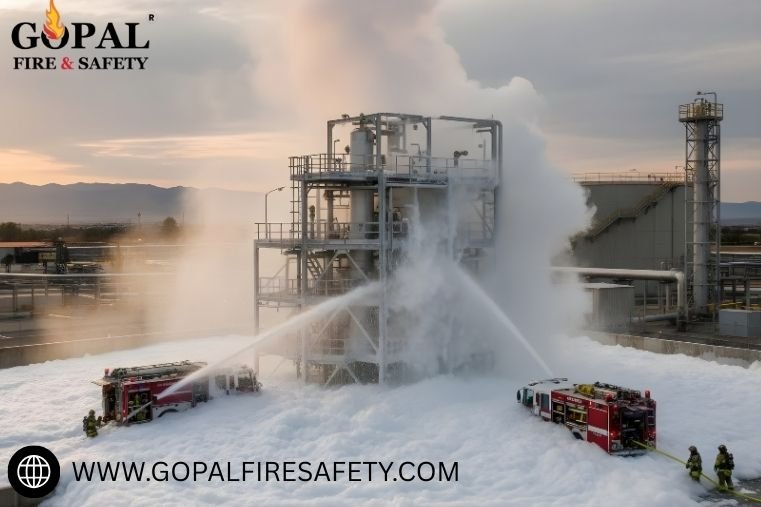
Fire Control Foam is a specialized fire suppression agent designed to quickly suppress flames, cool down burning surfaces, and prevent re-ignition. Unlike water, which can spread flammable liquids, Fire Control Foam forms a thick blanket over the fire, isolating oxygen and stopping combustion.
At Gopal Fire Safety, we provide industry-grade Fire Control Foam solutions designed for rapid response, high efficiency, and regulatory compliance. Learn more at:
👉 https://gopalfiresafety.com
What Is Fire Control Foam?
Fire Control Foam is a fire suppression compound made by mixing foam concentrate with water and air. When discharged, it expands to create a dense, stable foam layer that smothers fire by cutting off its oxygen supply and cooling the fuel surface.
Fire incidents today are more complex than ever. With the increase in flammable liquids, chemical storage, industrial processes, and high-risk commercial environments, traditional water-based fire suppression is no longer sufficient. This is where Fire Control Foam plays a vital role.
The primary functions of Fire Control Foam are:
- Smothering flames
- Cooling burning surfaces
- Preventing vapor release
- Stopping re-ignition
This makes Fire Control Foam extremely effective against flammable liquid fires, chemical fires, oil fires, and industrial hazards.
Why Fire Control Foam Is Essential for High-Risk Areas
Certain environments pose extreme fire risks. These include:
- Oil refineries
- Chemical plants
- Fuel depots
- Warehouses
- Airports
- Power plants
- Manufacturing units
- Paint factories
In such locations, Fire Control Foam is not optional—it is mandatory.
Water alone cannot extinguish flammable liquid fires. In fact, it can make them worse. Fire Control Foam suppresses these fires instantly and safely.
How Fire Control Foam Works
The science behind Fire Control Foam is simple but powerful.
When applied, Fire Control Foam:
- Forms a thick foam blanket
- Blocks oxygen supply
- Cools down the burning fuel
- Suppresses flammable vapors
- Prevents reignition
This multi-layered suppression is why Fire Control Foam is far more effective than water or dry agents in liquid-based fire scenarios.
Types of Fire Control Foam
Different fire scenarios require different types of Fire Control Foam. Each type is formulated for specific risks.
1. AFFF (Aqueous Film Forming Foam)
This is the most widely used Fire Control Foam.
Used in:
- Oil & gas facilities
- Airports
- Chemical plants
- Fuel storage areas
AFFF forms a thin film that spreads rapidly across the fuel surface, smothering flames instantly.
2. AR-AFFF (Alcohol-Resistant AFFF)
Designed for fires involving polar solvents like alcohols and ketones.
Used in:
- Pharmaceutical plants
- Chemical industries
- Paint factories
3. Class A Foam
Used for ordinary combustibles.
Used in:
- Warehouses
- Offices
- Residential complexes
- Textile factories
4. Class B Foam
Used for flammable liquids.
Used in:
- Petrochemical plants
- Fuel depots
- Refineries
5. Protein-Based Foam
Older technology but still used in some heavy industrial setups
At Gopal Fire Safety, we supply and install all types of Fire Control Foam systems depending on your hazard classification.
Key Benefits of Fire Control Foam
Using Fire Control Foam provides multiple safety and operational advantages:
- Faster fire suppression
- Reduced heat release
- Less water damage
- Minimal toxic smoke
- Improved evacuation safety
- Reduced downtime
- Lower property loss
Fire Control Foam is especially effective in preventing fire escalation.
Where Fire Control Foam Is Commonly Used
Fire Control Foam systems are installed in:
- Tank farms
- Aircraft hangars
- Chemical storage units
- Transformer yards
- Boiler rooms
- Fuel dispensing stations
- Industrial warehouses
Fire Control Foam Systems
Fire Control Foam is delivered through specialized systems.
Common Systems Include:
- Foam sprinkler systems
- Foam deluge systems
- Foam monitors
- Mobile foam trolleys
- Foam generators
- Foam proportioning systems
Each system is designed to deliver the correct foam-to-water ratio for maximum suppression.
Fire Control Foam vs Water Suppression
| Feature | Fire Control Foam | Water |
|---|---|---|
| Smothers fire | Yes | No |
| Prevents vapor | Yes | No |
| Prevents re-ignition | Yes | No |
| Safe for liquid fires | Yes | No |
| Faster suppression | Yes | No |
This makes Fire Control Foam superior in hazardous fire scenarios.
Industrial Applications of Fire Control Foam
Industries rely on Fire Control Foam because it:
- Suppresses flammable liquid fires
- Works on pressurized systems
- Minimizes explosion risk
- Improves firefighter safety
Environmental Considerations of Fire Control Foam
Modern Fire Control Foam formulations are designed to be:
- Biodegradable
- Low toxicity
- Environmentally safer
- PFAS-free (in newer variants)
At Gopal Fire Safety, we provide eco-compliant foam solutions.
Regulatory Compliance for Fire Control Foam
Fire Control Foam systems must comply with:
- National Building Code
- Fire Safety Norms
- Factory Act
- Insurance guidelines
- Environmental laws
We ensure full compliance.
Why Choose Gopal Fire Safety for Fire Control Foam?
Clients choose Gopal Fire Safety because:
- Certified foam systems
- Custom solutions
- Installation support
- Maintenance services
- Fire audits
- Training programs
Installation Process of Fire Control Foam Systems
Our process includes:
- Risk assessment
- Hazard classification
- Foam type selection
- System design
- Installation
- Testing & commissioning
- Training
Maintenance of Fire Control Foam Systems
Foam systems must be:
- Inspected quarterly
- Tested annually
- Calibrated regularly
- Refilled correctly
Staff Training for Fire Control Foam Usage
We train your team on:
- Foam system activation
- Emergency response
- Evacuation coordination
- Safety protocols
Fire Control Foam in Emergency Planning
Foam systems are integrated into:
- Fire alarms
- Smoke detection
- Emergency lighting
- Evacuation plans